- Anthropic’s June 30 Claude Science launch clears the publish bar because it is more than another frontier-model press cycle aimed at researchers.
- The primary-source details are specific enough to matter.
- That is why this belongs in the systems lane.
- Section
- AI Automation
- Read time
- 5 min read
- Data included
- What Claude Science packages into one lab-facing system
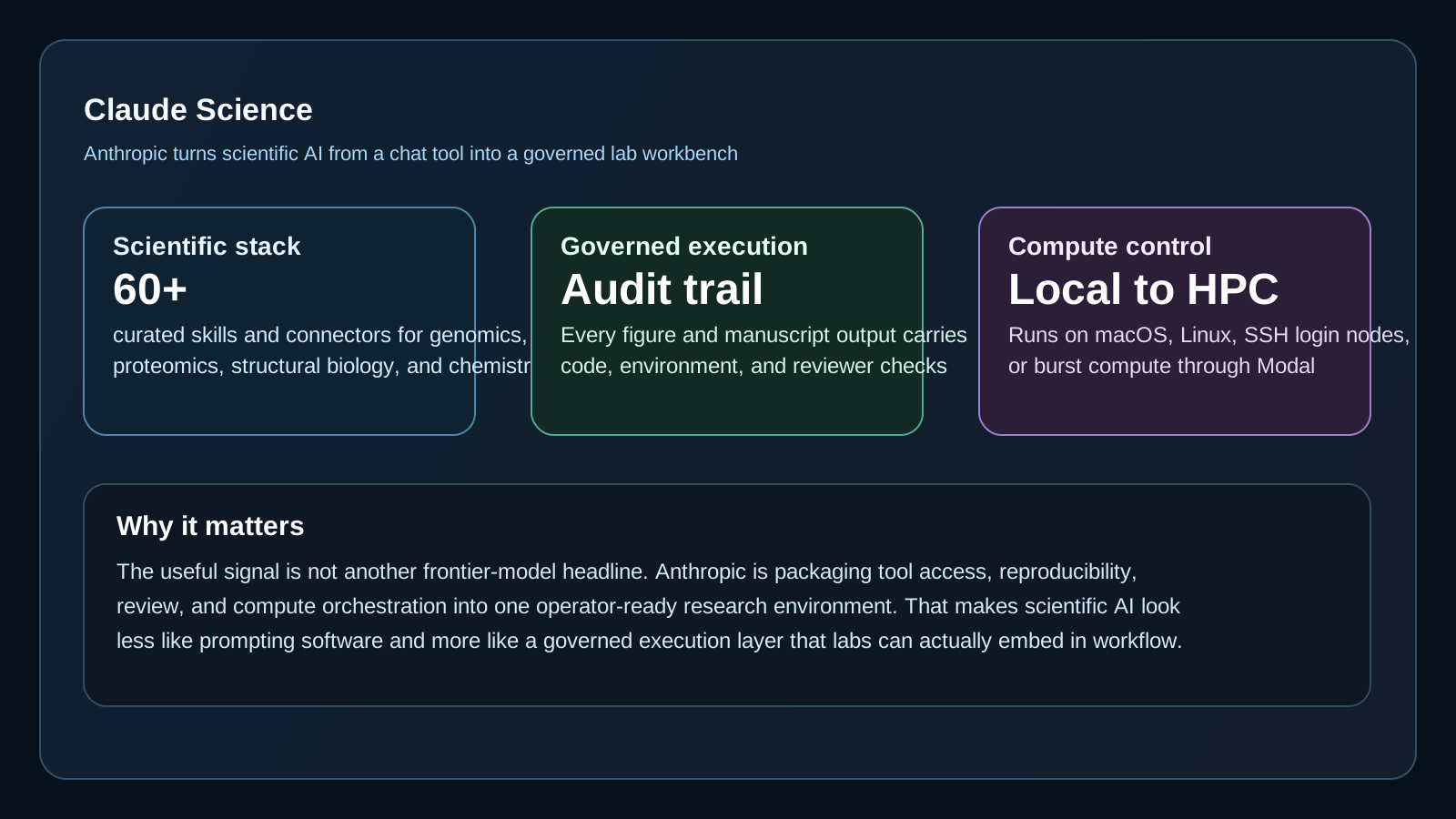
What Claude Science packages into one lab-facing system
The important shift is not the model alone. It is the bundling of tool access, review, reproducibility, and compute control into one research workflow.
| Layer | Primary-source detail | Why it matters |
|---|---|---|
| Scientific tooling | Anthropic says Claude Science includes more than 60 curated skills and connectors across genomics, single-cell analysis, proteomics, structural biology, and cheminformatics | Researchers get a domain-ready environment instead of stitching together dozens of tools and schemas by hand. |
| Reproducible artifacts | Outputs include the code, environment, plain-language explanation, and message history used to create each figure or manuscript | The product is selling traceability and reviewability, not just speed. |
| Compute orchestration | Claude Science can use local machines, SSH-accessed clusters, HPC login nodes, or Modal for burst compute | AI moves from advisory software into the execution path for actual scientific workloads. |
| Reviewer controls | A reviewer agent checks citations, calculations, and output consistency | Anthropic is trying to build QA into the workflow rather than leaving validation as an afterthought. |
| Deployment model | Beta access starts on Pro, Max, Team, and Enterprise plans, with admin enablement for organizational users | This looks like a productized vertical software layer, not a one-off research demo. |
Source: Anthropic announcement and Anthropic newsroom, both published June 30, 2026.
Anthropic’s June 30 Claude Science launch clears the publish bar because it is more than another frontier-model press cycle aimed at researchers. Anthropic says Claude Science is an AI workbench that integrates the tools and packages scientists already use, produces auditable artifacts, and provides flexible access to compute resources. The stronger Grid Report angle is that the company is trying to package scientific AI as a governed execution environment rather than a standalone assistant.
The primary-source details are specific enough to matter. Anthropic says Claude Science can run locally on macOS or Linux, on a remote machine over SSH, or through an HPC login node. It says the system uses a coordinating agent with access to more than 60 curated skills and connectors across genomics, single-cell analysis, proteomics, structural biology, cheminformatics, and related domains. Anthropic also says a reviewer agent checks citations and calculations, flags errors, and helps keep outputs traceable to the code and environment that produced them.
Claude Science matters because Anthropic is not just selling a better research assistant. It is packaging scientific tools, reviewer controls, and compute orchestration into a governed lab workbench.
That is why this belongs in the systems lane. The useful change is not simply that Anthropic wants life-sciences customers. The useful change is that scientific AI is being assembled into an operator-ready stack: data access, domain tools, artifact generation, reviewer controls, and compute orchestration in one environment. For labs and research teams, that is a much more concrete deployment model than asking scientists to bounce between chat windows, notebooks, cluster terminals, and disconnected databases.
The compute piece is especially important. Anthropic says Claude Science can draft a plan, ask before reaching new resources, and then submit jobs to the computing resources a lab already uses, including its own HPC cluster or Modal for compute on demand. That makes the story more than a knowledge-work automation launch. Anthropic is trying to move the product into a layer where the software does not just summarize papers; it helps manage the execution path between a research question and a completed analysis.
The auditability claim is what makes the angle defendable. Anthropic says outputs carry the exact code and environment that produced them, plus a plain-language description and full message history. If that works in practice, the product is not just selling convenience. It is selling a governed path to reproducibility and review, which is where many AI-for-science announcements usually get vague.
There is also a market-structure read-through here. Claude Science is available in beta for Pro, Max, Team, and Enterprise users, and Anthropic says Team and Enterprise admins can enable it for labs while eligible academic and nonprofit organizations can access discounted seats. In other words, Anthropic is not positioning scientific AI only as a research demo. It is already wrapping the product in seat economics, admin controls, and deployment plumbing that make it look like a vertical software layer.
This is materially different from the site’s recent systems coverage. OpenAI’s Agents-at-Work story was about evidence that delegated work is spreading across enterprise roles. The OpenAI Partner Network story was about the channel and governance layer for adoption. Claude Science is different because it turns a specific high-friction domain into a packaged execution environment with built-in review, domain connectors, and compute control.
There are obvious caveats. Anthropic is describing its own product, the strongest examples come from beta users, and research organizations will still need to validate outputs against domain standards and internal governance. But the narrower conclusion is well supported: Anthropic is trying to make scientific AI operational by bundling reproducibility, review, and compute management into the product itself.
That is enough to publish. Searchers looking for Claude Science do not need another shallow “AI for science” recap. The more useful answer is that Anthropic is attempting to turn scientific AI into a governed workbench that can plug into real lab workflow, not just a smarter chat interface.
Sources
Anthropic, “Claude Science, an AI workbench for scientists, is now available,” published June 30, 2026: https://www.anthropic.com/news/claude-science-ai-workbench
Anthropic Newsroom listing for June 30 product announcements: https://www.anthropic.com/news
By Nawaz Lalani
The Grid Report is written by Nawaz Lalani and focuses on source-backed coverage of AI infrastructure, grid power demand, automation systems, and market signals.
Follow the signal, not just the headline.
Get the daily Grid brief for source-backed coverage on AI power demand, infrastructure timing, automation, and market signals.