- Anthropic’s “When AI builds itself” piece clears the publish bar because it offers something rarer than another claim about future superintelligence.
- The original angle is not that AI can write code.
- That matters for operators far beyond Anthropic.
- Section
- AI
- Read time
- 4 min read
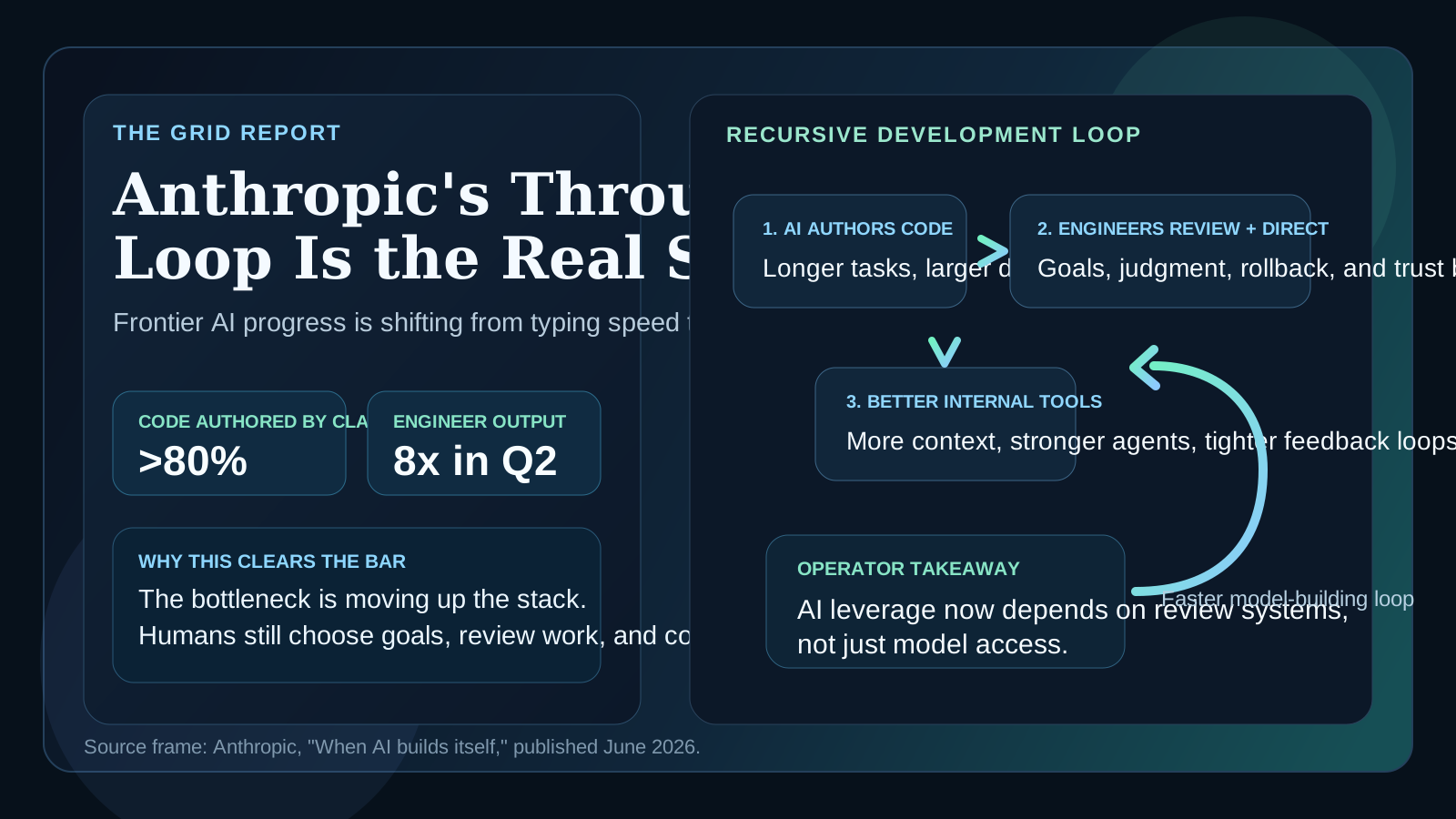
Anthropic’s “When AI builds itself” piece clears the publish bar because it offers something rarer than another claim about future superintelligence. It gives concrete internal operating data. Anthropic says that as of May 2026, more than 80% of the code merged into its codebase was authored by Claude, and that the typical engineer in the second quarter of 2026 was merging eight times as much code per day as in 2024. Those numbers are company-reported, not neutral, but they are still among the clearest signals yet that frontier AI development is turning into a workflow-and-control problem rather than a pure headcount problem.
The original angle is not that AI can write code. That story is old. The stronger read-through is that the bottleneck is moving up the stack. Anthropic says Claude can increasingly handle underspecified engineering tasks, that employees reported large output gains, and that open-ended task capability has improved sharply. If more code is machine-authored, the scarce human work shifts toward choosing goals, reviewing outputs, setting trust boundaries, and deciding which failures are acceptable inside production systems.
Once AI writes most of the code, the real leverage moves to review systems, judgment, and blast-radius control.
That matters for operators far beyond Anthropic. Many companies still treat coding agents as a convenience layer that saves a few hours on tickets. Anthropic is describing something more consequential: a system where AI writes, runs, and iterates on meaningful portions of the software-development cycle. Once that happens, the management question is no longer “Should we use AI?” It becomes “What review system prevents a faster loop from becoming a faster mistake?”
The piece also matters because it sharpens how investors and policy people should think about frontier-lab pace. If internal software throughput rises without a linear increase in engineering headcount, model progress can accelerate even before new chips or giant hiring waves arrive. Anthropic is explicit that current systems still lag humans on choosing what is worth doing, but it is equally explicit that the execution layer is moving much faster than most institutions are prepared for.
There is also a practical enterprise lesson buried in the frontier framing. The winning organizations will not only hand agents more tasks. They will redesign approval, rollback, observability, and escalation around agents that can operate over longer time horizons. Anthropic's own evidence implies that control surfaces matter more as systems become more autonomous, because speed compounds both useful output and operational risk.
There are clear caveats. Anthropic is publishing its own case for why recursive self-improvement could arrive sooner than institutions expect. The company notes that lines of code are an imperfect productivity measure, and its internal polling almost certainly overstates some gains. The article is still valuable because it grounds the debate in operating data rather than abstract speculation.
The better conclusion is that AI leverage is increasingly about supervision architecture. Once machines generate most of the code, human advantage does not disappear. It relocates toward judgment, system design, and failure containment.
Sources
Anthropic, “When AI builds itself,” accessed June 21, 2026: https://www.anthropic.com/institute/recursive-self-improvement
Anthropic Institute, “Focus areas for The Anthropic Institute,” last updated May 7, 2026: https://www.anthropic.com/research/anthropic-institute-agenda
By Nawaz Lalani
The Grid Report is written by Nawaz Lalani and focuses on source-backed coverage of AI infrastructure, grid power demand, automation systems, and market signals.
Follow the signal, not just the headline.
Get the daily Grid brief for source-backed coverage on AI power demand, infrastructure timing, automation, and market signals.