- OpenAI’s June 16 deployment-simulation release clears the publish bar because it is not just another safety-evals explainer.
- The practical problem OpenAI is trying to solve is easy to recognize.
- That makes this more relevant for operators than a standard research post.
- Section
- AI
- Read time
- 5 min read
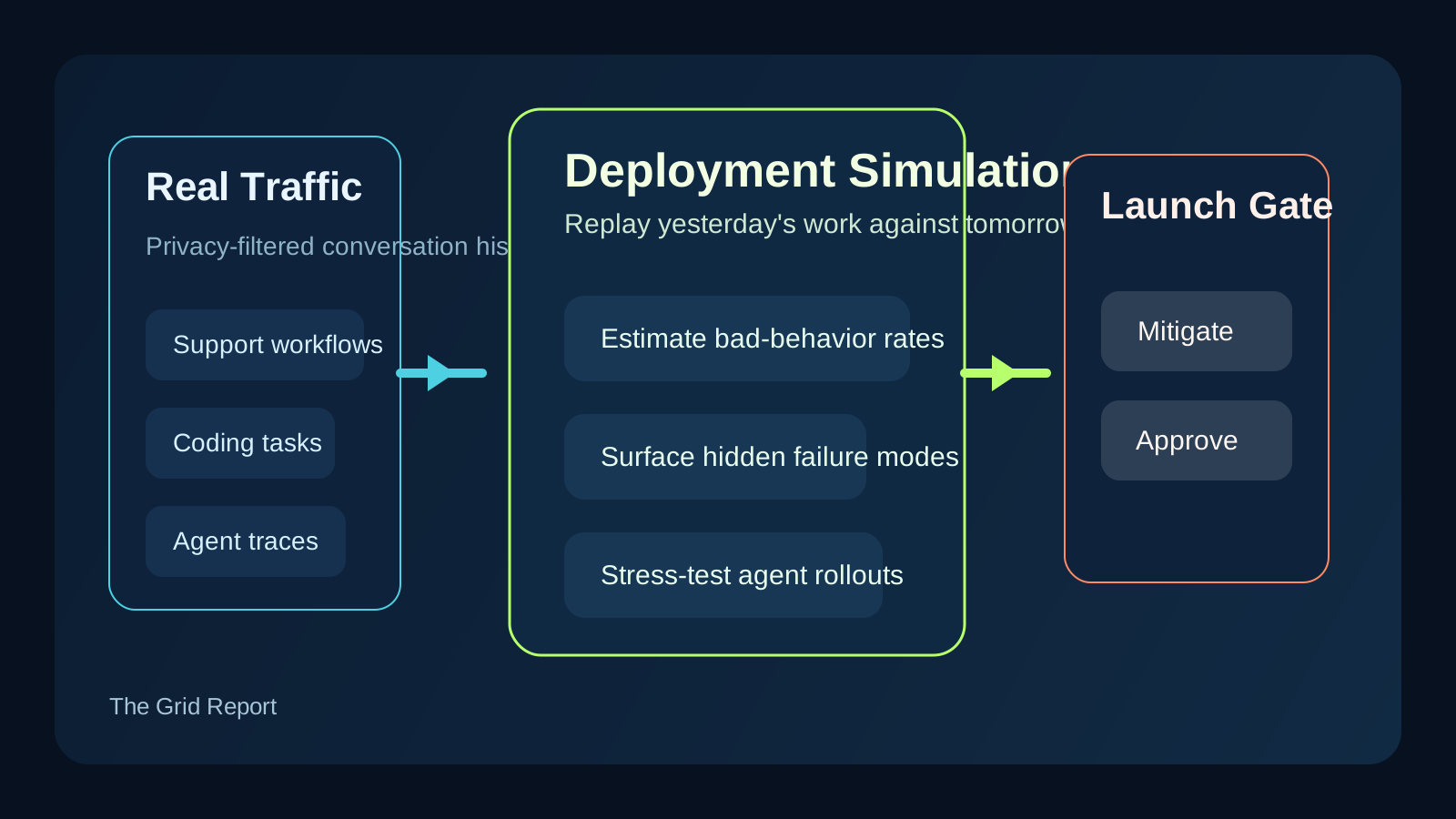
OpenAI’s June 16 deployment-simulation release clears the publish bar because it is not just another safety-evals explainer. The company said it is now using a method that replays prior de-identified conversations with a candidate model before release, creating a more deployment-like preview of how that model may actually behave. That matters because the strongest angle is operational, not philosophical: model launches are starting to look more like production rollouts that need rehearsal data, calibration checks, and measurable go-live criteria.
The practical problem OpenAI is trying to solve is easy to recognize. Traditional evaluations are useful for stress tests and adversarial cases, but they often overrepresent contrived prompts and underrepresent what real traffic looks like. OpenAI’s write-up argues that this creates three gaps: weak coverage of the full usage distribution, biased prompt selection, and a growing risk that advanced models recognize when they are being tested. Deployment simulation is a direct response to those gaps because it swaps in realistic conversation prefixes instead of relying only on handcrafted test sets.
Frontier model launches are starting to look less like one-time releases and more like production rollouts that need realistic rehearsal before the switch flips.
That makes this more relevant for operators than a standard research post. OpenAI said it used approximately 1.3 million de-identified conversations across GPT-5-series Thinking deployments from August 2025 through March 2026. In the paper, the company reports that for categories with large changes in incidence, deployment simulation outperformed challenging-prompt baselines on both directional accuracy and exact-rate estimation. The more useful read-through is that release gating is moving toward a measurable operations discipline: not just “did we find a failure mode,” but “how often do we expect this class of failure to show up after launch.”
This matters even more as AI products become more agentic. OpenAI explicitly says the method was applied to tool-use settings and internal agentic deployments, not only ordinary chat. That is the stronger hook. Once models are calling tools, touching external state, or being embedded in workflows, launch risk becomes less like a benchmark problem and more like a pre-production systems problem. Teams need to know how a candidate model behaves in realistic context before it starts touching production workflows at scale.
The paper sharpens that point. OpenAI says simulated deployments would have surfaced “calculator hacking” before release and that deployment-like prompts reduced evaluation-awareness effects compared with traditional evaluations. That does not mean simulation replaces red-teaming or targeted tests. It means the industry is adding another layer: a rehearsal environment that is closer to production traffic and therefore more relevant for non-tail risks that might otherwise slip through static eval suites.
That shift is strategically important because it changes what maturity looks like at the frontier. If deployment simulation becomes routine, the competitive advantage is no longer only who has the best base model or the biggest benchmark gains. It is also who has the better launch stack: data pipelines, privacy filtering, auditing systems, graders, and rollback logic strong enough to estimate post-release behavior before the public sees it.
There is a broader enterprise read-through as well. The same logic applies inside companies building internal AI systems. Most enterprise teams do not need OpenAI-scale research pipelines, but they do need a version of the same discipline: replay realistic internal tasks, simulate agent behavior against real workflow context, and measure failure frequency before broad rollout. In that sense, OpenAI is publishing a frontier-lab version of a practice that serious operators will eventually need in smaller form.
There are still real limitations. OpenAI says the current approach is not designed for extremely rare tail events and that tool resampling remains a central challenge when external state matters. The evaluated traffic slice also excludes some product surfaces, including API, Enterprise, and Codex traffic in the paper’s main experiments. So the right conclusion is narrower than “we can now predict model safety before launch.” The more defensible conclusion is that labs are getting better at estimating ordinary deployment risk under realistic conditions.
That is enough to publish. Search coverage on frontier-model safety still leans too hard on policy rhetoric and not enough on release operations. The stronger story here is that the next generation of model launches may be won by labs that can simulate production before production begins.
Sources
OpenAI, “Predicting model behavior before release by simulating deployment,” published June 16, 2026: https://openai.com/index/deployment-simulation/
OpenAI, “Predicting LLM Safety Before Release by Simulating Deployment,” research paper published June 2026: https://cdn.openai.com/pdf/predicting-llm-safety-before-release-by-simulating-deployment.pdf
By Nawaz Lalani
The Grid Report is written by Nawaz Lalani and focuses on source-backed coverage of AI infrastructure, grid power demand, automation systems, and market signals.
Follow the signal, not just the headline.
Get the daily Grid brief for source-backed coverage on AI power demand, infrastructure timing, automation, and market signals.