- OpenAI’s July 8, 2026 SWE-Bench Pro audit matters because it shifts the coding-agent conversation away from who won the latest leaderboard and toward whether the leaderboard itself can still be trusted.
- That is a bigger operational story than another benchmark dispute.
- OpenAI’s own framing makes the risk explicit.
- Section
- AI
- Read time
- 5 min read
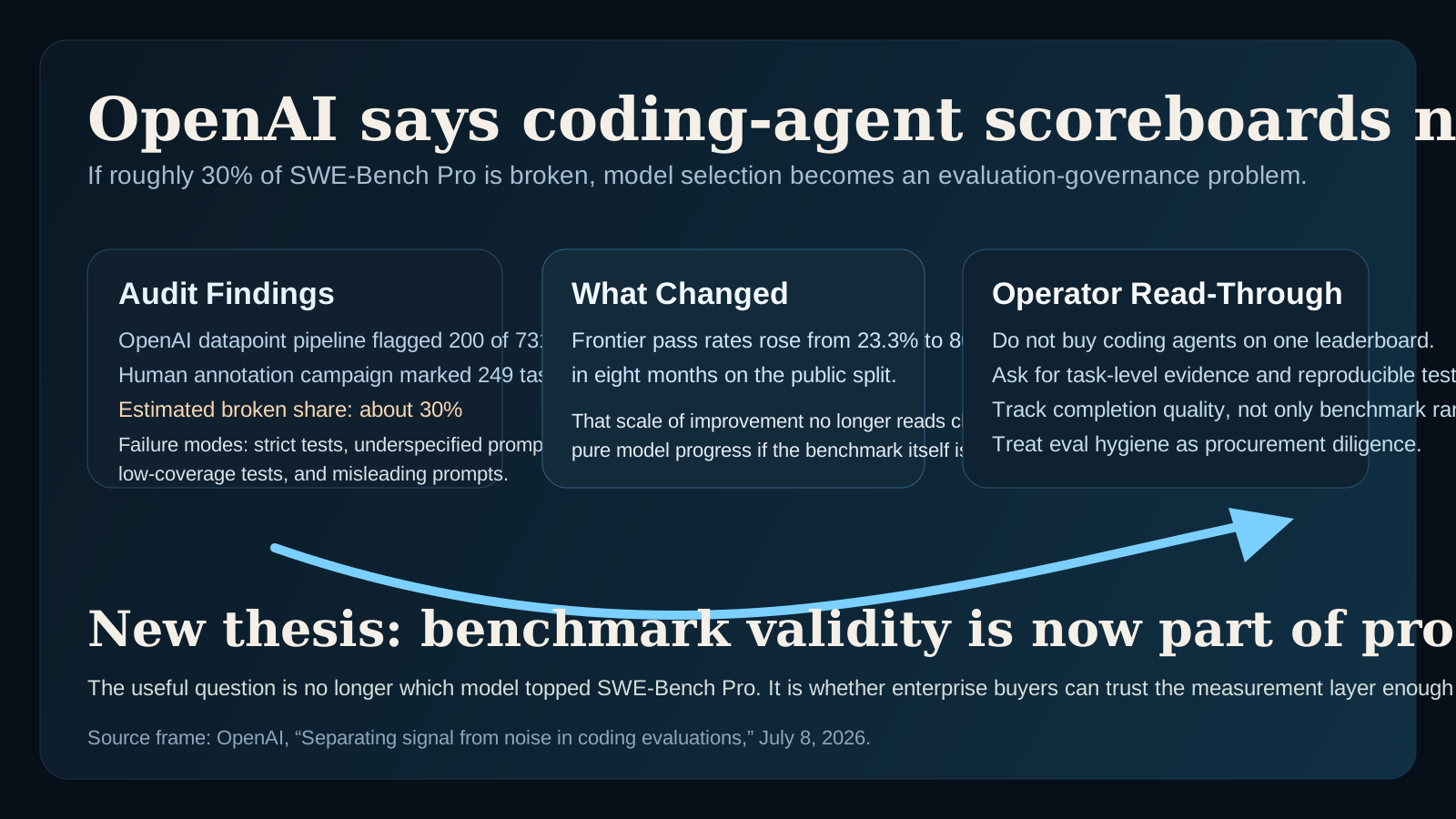
OpenAI’s July 8, 2026 SWE-Bench Pro audit matters because it shifts the coding-agent conversation away from who won the latest leaderboard and toward whether the leaderboard itself can still be trusted. The company says its datapoint analysis pipeline flagged 200 of the benchmark’s 731 public tasks as broken, while a parallel human annotation campaign marked 249 tasks broken. OpenAI’s conclusion is that roughly 30% of SWE-Bench Pro has issues serious enough to distort what the scores mean.
That is a bigger operational story than another benchmark dispute. Coding agents are moving into procurement, internal platform approvals, and enterprise rollout decisions. Once buyers start comparing vendors using benchmark deltas as evidence for model choice, evaluation quality becomes part of the product itself. A benchmark that overstates or misstates capability can push teams toward the wrong model, the wrong pricing tier, or the wrong confidence level for production use.
Once coding agents become a procurement decision, benchmark validity becomes part of the product and part of the diligence burden.
OpenAI’s own framing makes the risk explicit. The company says accurate capability measurement matters for deployment and safety decisions, including decisions under its Preparedness Framework. That matters because coding models are no longer being judged only for research prestige. They are being used to support claims about autonomy, software-maintenance reliability, and how much real engineering work a system can safely absorb.
The most useful details are not the headline percentages, but the failure modes. OpenAI says the broken tasks largely fall into four buckets: overly strict tests that enforce implementation details not specified in the prompt, underspecified prompts whose hidden tests require missing information, low-coverage tests that let incomplete fixes pass, and misleading prompts that point models toward behavior the tests then reject. In practical terms, a model can be functionally right and still be graded wrong, or functionally incomplete and still pass.
That changes how enterprise buyers should read big score jumps. OpenAI notes that frontier models on the public SWE-Bench Pro split improved from a 23.3% pass rate to 80.3% in eight months. Some of that may be real model progress. But if a large share of the benchmark is unstable, then part of the apparent spread between systems may reflect quirks in task design and grading rather than clean differences in coding capability. OpenAI goes far enough to retract its earlier recommendation that the wider community switch to SWE-Bench Pro.
The stronger Grid Report angle is that coding-agent procurement is starting to look like measurement governance. Buyers should still care about benchmarks, but they should stop treating any single public eval as a sufficient buying signal. The more useful diligence stack is task-level review, reproducible internal evals, repository-specific trials, completion quality under real constraints, and a clear understanding of how a vendor handles flaky or contaminated public benchmarks in its own marketing.
This story also sits cleanly beside the site’s recent coverage of deployment simulation and lower-cost coding models without repeating them. Deployment simulation was about estimating post-launch behavior under realistic traffic. Claude Sonnet 5 was about execution economics. This one is about the scoring layer underneath coding-agent claims. Before a team can trust a model to write patches, pass tests, or resolve issues, it has to trust the measurement system used to sell that capability in the first place.
That is why this is search-worthy now. Search demand around SWE-Bench Pro will naturally cluster around the headline that OpenAI found broken tasks. The more useful query is narrower and more practical: what does that discovery change for people actually buying, deploying, or evaluating coding agents? The answer is that benchmark hygiene is no longer a side issue. It is part of operator diligence.
Sources
OpenAI, “Separating signal from noise in coding evaluations,” published July 8, 2026: https://openai.com/index/separating-signal-from-noise-coding-evaluations/
OpenAI, “Why SWE-bench Verified no longer measures frontier coding capabilities,” published March 6, 2026: https://openai.com/index/why-we-no-longer-evaluate-swe-bench-verified/
By Nawaz Lalani
The Grid Report is written by Nawaz Lalani and focuses on source-backed coverage of AI infrastructure, grid power demand, automation systems, and market signals.
Follow the signal, not just the headline.
Get the daily Grid brief for source-backed coverage on AI power demand, infrastructure timing, automation, and market signals.