- Anthropic’s June 12 suspension of Fable 5 and Mythos 5 clears the publish bar because it is one of the clearest signals yet that frontier-model access can disappear for reasons far outside normal product planning.
- Anthropic’s own statement was blunt.
- The timing made the signal sharper.
- Section
- AI
- Read time
- 5 min read
Anthropic’s June 12 suspension of Fable 5 and Mythos 5 clears the publish bar because it is one of the clearest signals yet that frontier-model access can disappear for reasons far outside normal product planning. The useful story is not only that a model got pulled. It is that enterprise dependence on a frontier model can now run into export-control risk, compliance risk, and sudden workflow disruption all at once.
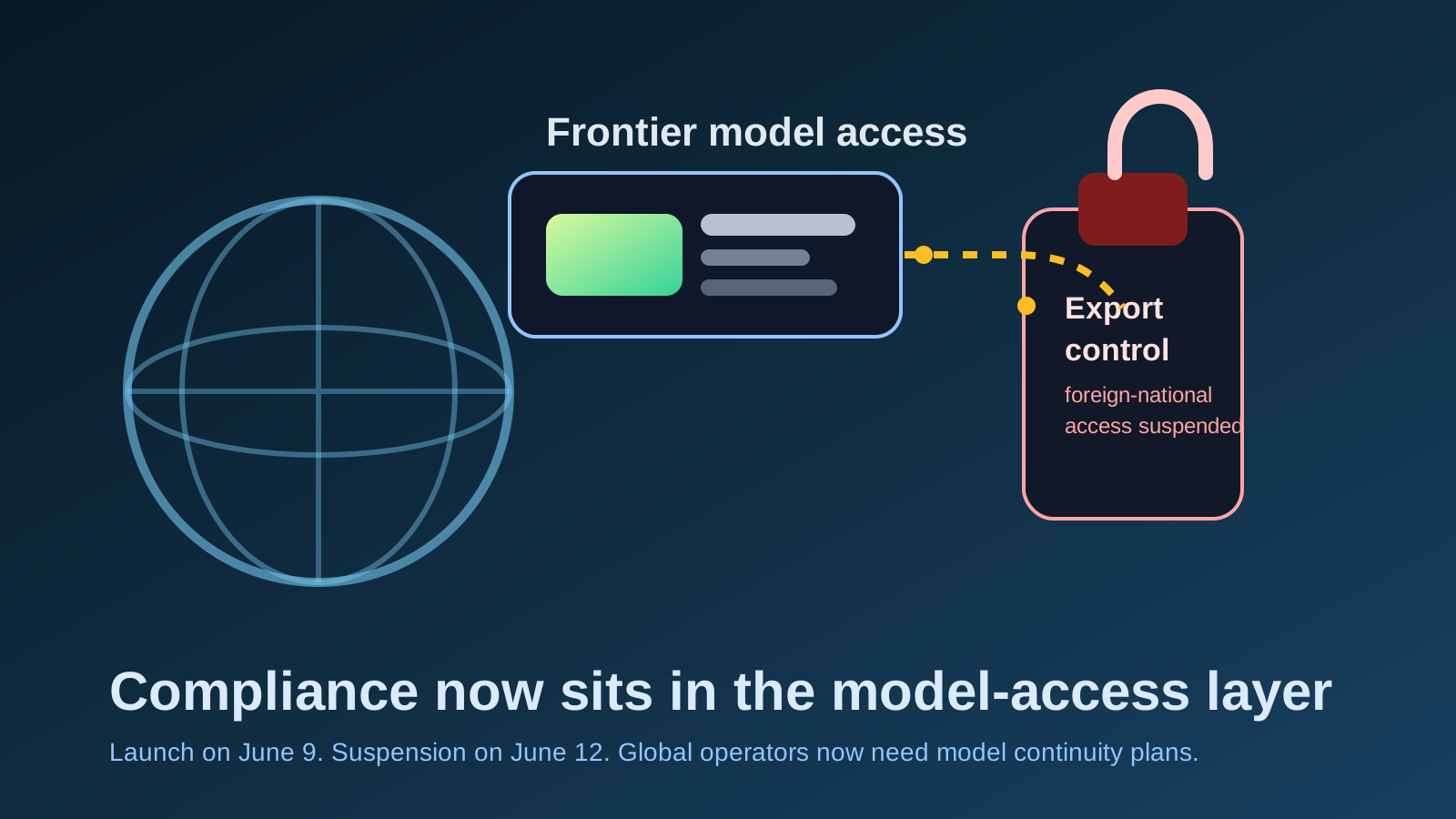
Anthropic’s own statement was blunt. The company said the U.S. government issued an export-control directive requiring it to suspend all access to Fable 5 and Mythos 5 by any foreign national, whether inside or outside the United States, including foreign-national Anthropic employees. Anthropic said the practical result was an abrupt shutdown of access for all customers in order to ensure compliance. That matters because it shows how quickly a frontier-model decision can become an operating event instead of a roadmap update.
Frontier-model access is starting to look less like ordinary SaaS availability and more like a policy-sensitive dependency.
The timing made the signal sharper. Anthropic had launched Claude Fable 5 and Claude Mythos 5 on June 9, describing Fable 5 as a generally available model and Mythos 5 as a restricted version for cyber defenders and infrastructure providers through Project Glasswing. Anthropic framed the launch around stronger autonomous work, elite cybersecurity capability, and broader future access. Three days later, access was suspended. That sequence is exactly why the story matters. Availability assumptions are getting weaker even as capability claims get stronger.
The stronger read-through is about enterprise architecture. If a company builds critical internal workflows around a small set of frontier models, the risk is no longer only price, latency, or vendor lock-in. It is whether a policy action, national-security order, or export-control interpretation can suddenly change who is allowed to use the model at all. For multinational companies, regulated operators, and global developer teams, that is not a theoretical edge case. It is now a real design constraint.
Anthropic also said the government directive did not provide specific details of the national-security concern, and that its understanding was the concern involved a method of bypassing or jailbreaking Fable 5. Anthropic argued the demonstrated vulnerabilities were narrow and that comparable capability already existed in other publicly available models. Whether or not that defense is persuasive, the more durable point remains: access decisions at the frontier can be made on a compressed timeline and with incomplete public explanation.
That makes this an AI infrastructure story, not only an Anthropic story. As models become part of security operations, software development, customer-service automation, and internal research workflows, access continuity becomes a governance issue. Serious buyers increasingly need fallback models, role-based access planning, regional deployment choices, and contractual assumptions that recognize a model may become restricted before a procurement cycle is finished.
There is also a policy-market read here. Frontier labs have spent the last year arguing that advanced models should be deployed responsibly while still reaching broad commercial adoption. The Fable 5 suspension shows that the middle ground is becoming harder to hold. If model capability moves close enough to a national-security boundary, governments may intervene faster than enterprise customers can adapt.
This is why the story still clears the search bar. Search demand around frontier models usually clusters around benchmark wins and product launches. The stronger and more useful query class is now operational: what happens if access is withdrawn after launch, who is affected, and how should companies plan for it?
That is enough to publish. The useful conclusion is narrower than “frontier AI is unstable.” The stronger conclusion is that access to frontier models is becoming a continuity risk that enterprises need to design around rather than assume away.
Sources
Anthropic, “Statement on the US government directive to suspend access to Fable 5 and Mythos 5,” published June 12, 2026: https://www.anthropic.com/news/fable-mythos-access
Anthropic, “Claude Fable 5 and Claude Mythos 5,” published June 9, 2026, with June 12 access-update notice: https://www.anthropic.com/news/claude-fable-5-mythos-5
By Nawaz Lalani
The Grid Report is written by Nawaz Lalani and focuses on source-backed coverage of AI infrastructure, grid power demand, automation systems, and market signals.
Follow the signal, not just the headline.
Get the daily Grid brief for source-backed coverage on AI power demand, infrastructure timing, automation, and market signals.