- OpenAI’s new Bio Bug Bounty clears the publish bar because the useful signal is not that the company says frontier models need safeguards.
- In a July 9 update, OpenAI said it is evolving the GPT-5.5 Bio Bug Bounty into an ongoing private OpenAI Bio Bounty Program focused on universal jailbreaks against frontier models, starting with GPT-5.6.
- That move matters because it changes safety assurance from a launch-adjacent exercise into continuous procurement of outside scrutiny.
- Section
- AI
- Read time
- 4 min read
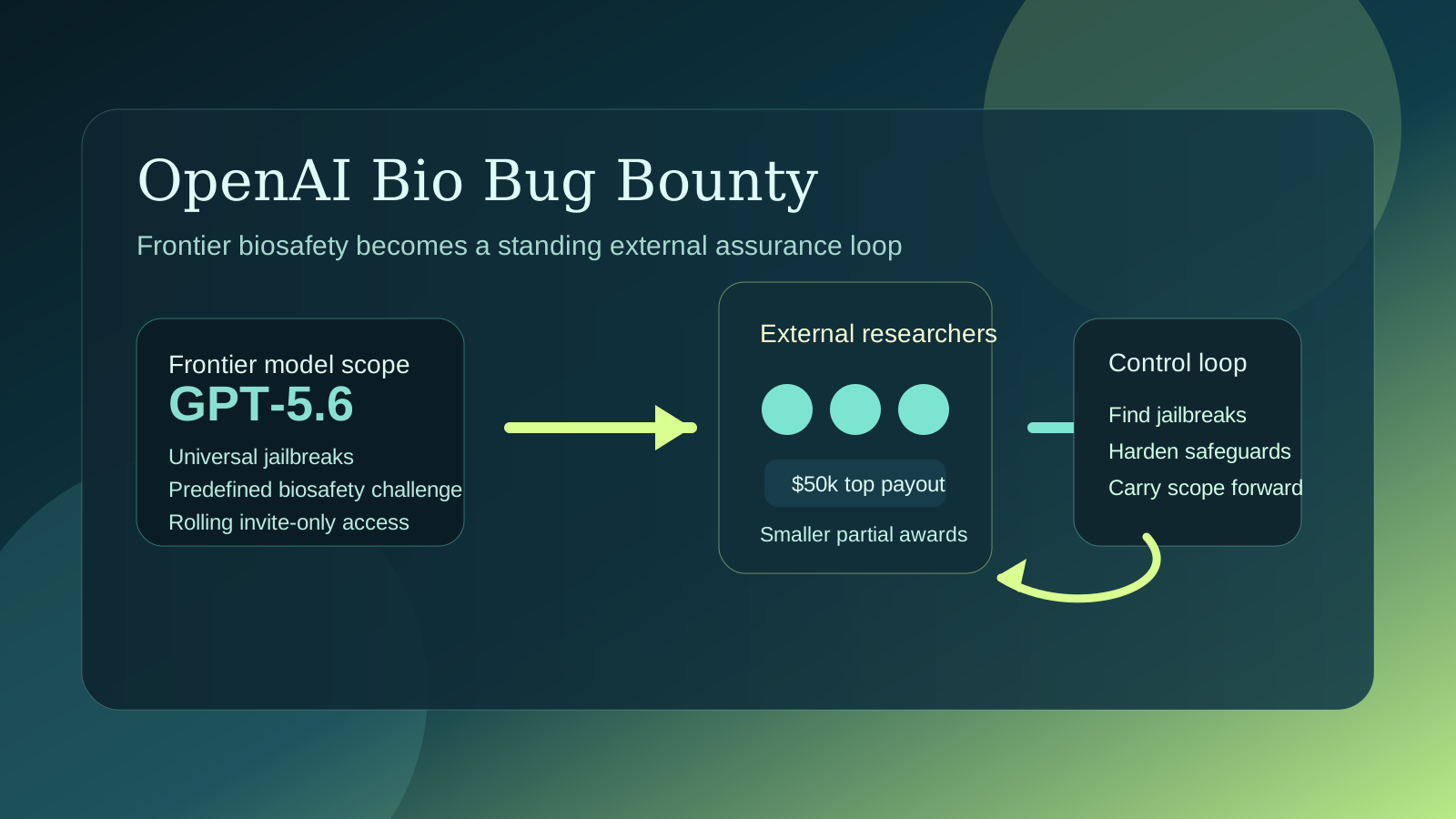
OpenAI’s new Bio Bug Bounty clears the publish bar because the useful signal is not that the company says frontier models need safeguards. The stronger signal is operational: it is turning biology safety testing into a standing external market for finding universal jailbreaks that defeat a predefined biosafety challenge.
In a July 9 update, OpenAI said it is evolving the GPT-5.5 Bio Bug Bounty into an ongoing private OpenAI Bio Bounty Program focused on universal jailbreaks against frontier models, starting with GPT-5.6. It also doubled the top reward for a universal jailbreak from $25,000 to $50,000 for both GPT-5.6 and GPT-5.5, while keeping GPT-5.5 in scope through July 27, 2026 before narrowing the program to GPT-5.6.
OpenAI is turning biosafety testing from a launch ritual into a standing market for outside researchers to keep breaking frontier safeguards.
That move matters because it changes safety assurance from a launch-adjacent exercise into continuous procurement of outside scrutiny. Instead of treating red-teaming as a one-time checkpoint around a major release, OpenAI is creating a recurring intake loop where vetted external researchers are paid to keep probing the same failure class over time.
This belongs in AI because it says something important about how frontier labs will increasingly package capability and control together. If the model layer is improving quickly, then the assurance layer also has to become persistent. A standing bounty program is a way to buy adversarial attention on demand instead of assuming internal teams can cover every meaningful jailbreak path alone.
The more original angle is economic. By putting a durable payout structure around a specific category of dangerous failure, OpenAI is effectively helping price a market for high-skill safety research. That is useful for operators and policymakers because it creates a clearer answer to a recurring question: what does ongoing external verification of a frontier model actually look like in practice?
It also extends existing site coverage without repeating it. The Grid Report has already covered OpenAI’s national security principles, SWE-Bench Pro audit, and Appia standards push. This story is different. It is not about access policy, benchmark integrity, or procurement standards. It is about a lab building a standing external mechanism for pressure-testing a concrete high-risk domain.
That gives the story search value. People looking up the July 2026 OpenAI Bio Bug Bounty need more than the application link. The more useful answer is that frontier biosafety is starting to look less like a one-off safety statement and more like a permanent red-team market attached to the model release cycle.
Sources
OpenAI, “OpenAI Bio Bug Bounty,” published July 9, 2026: https://openai.com/index/bio-bug-bounty/
OpenAI safety news index showing the Bio Bug Bounty launch alongside related evaluation and governance work: https://openai.com/news/safety-alignment/
By Nawaz Lalani
The Grid Report is written by Nawaz Lalani and focuses on source-backed coverage of AI infrastructure, grid power demand, automation systems, and market signals.
Follow the signal, not just the headline.
Get the daily Grid brief for source-backed coverage on AI power demand, infrastructure timing, automation, and market signals.