- OpenAI’s July 8 national-security principles matter for a more specific reason than the usual governance headline.
- OpenAI says it is publishing the principles as it expands work with the U.S.
- That makes this a product-structure story as much as a policy story.
- Section
- AI
- Read time
- 5 min read
OpenAI’s July 8 national-security principles matter for a more specific reason than the usual governance headline. The company is not only publishing another set of values. It is formalizing a new access model for frontier AI in sensitive government work: some of the most consequential deployments will move through a trusted-access layer tied to mission type, partner status, and explicit use restrictions.
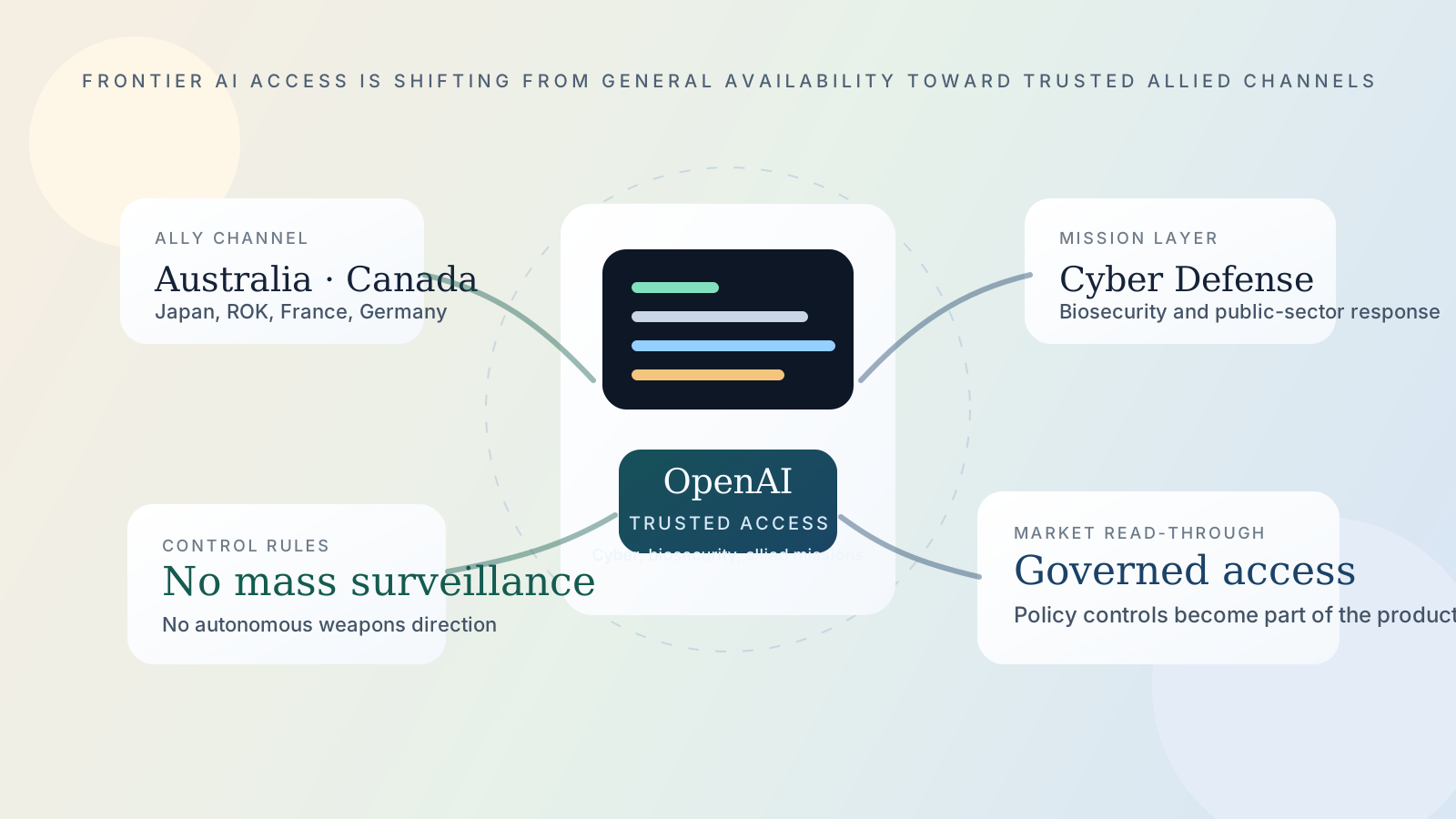
OpenAI says it is publishing the principles as it expands work with the U.S. government and allied partners in cyber defense and biosecurity. The practical signal sits in the details. The company says that in the past month it established Trusted Access for Cyber partnerships with Australia, Canada, Japan, the Republic of Korea, France, Germany, Poland, the Netherlands, and EU institutions including ENISA. That is more operational than a normal policy essay. It is a distribution map.
In sensitive government AI work, the product is no longer just the model. It is the governed access layer wrapped around the model.
That makes this a product-structure story as much as a policy story. Frontier-model access is starting to look segmented: broad commercial access on one side, then narrower channels for high-trust government and allied use cases on the other. OpenAI is effectively saying that the path into sensitive domains will be governed by partner qualification, contractual restrictions, and mission-specific controls rather than ordinary product availability.
The restrictions matter because they show where the boundary is being drawn. OpenAI says its existing government work already bars mass domestic surveillance, directing autonomous weapons systems, and high-stakes automated decisions. Those limits are not side notes. They are part of the operating wrapper around access. In practical terms, the model is no longer the whole product. The product is model plus eligibility plus contractual use conditions plus oversight.
That should matter to operators and investors because it changes how frontier AI expands into the public sector. A lab that can package trusted access, policy guardrails, and allied rollout relationships has a stronger route into sensitive workloads than a lab that only has benchmark strength. In that sense, government AI adoption is starting to resemble infrastructure procurement: access, governance, continuity, and partner trust all travel together.
This story also sits cleanly against the site’s recent OpenAI coverage without repeating it. The SWE-Bench audit was about whether buyers can trust coding-agent measurements. GPT-5.6 Sol was about routing and phased release management. This new release is about geopolitical segmentation. OpenAI is turning frontier access into something closer to an allied program layer.
There is also a broader market read-through. Once one frontier lab turns sensitive access into a governed partner program, rivals will face pressure to offer their own version of trusted channels, sovereign controls, or mission-specific deployment structures. The next competitive edge may not be only model quality. It may be which lab can make advanced capability usable inside the legal and institutional constraints of government buyers.
The search-worthy question is not just what OpenAI’s principles say. It is what they imply about how frontier AI will actually be delivered in high-stakes settings. The answer is that access is becoming conditional, structured, and strategically allocated. That is a meaningful shift in how frontier AI goes to market.
Sources
OpenAI, “Our approach to government and national security partnerships,” published July 8, 2026: https://openai.com/index/government-national-security-partnerships/
OpenAI, “Daybreak: Tools for securing every organization in the world,” published June 22, 2026: https://openai.com/index/daybreak-securing-the-world/
OpenAI, “Strengthening societal resilience with Rosalind Biodefense,” published May 29, 2026: https://openai.com/index/strengthening-societal-resilience-with-rosalind-biodefense/
By Nawaz Lalani
The Grid Report is written by Nawaz Lalani and focuses on source-backed coverage of AI infrastructure, grid power demand, automation systems, and market signals.
Follow the signal, not just the headline.
Get the daily Grid brief for source-backed coverage on AI power demand, infrastructure timing, automation, and market signals.