- OpenAI’s June 26 GPT-5.6 preview clears the publish bar because the useful signal is not that a new flagship model exists.
- The primary-source details are unusually explicit.
- There is a second, more important operator signal in the launch.
- Section
- AI
- Read time
- 5 min read
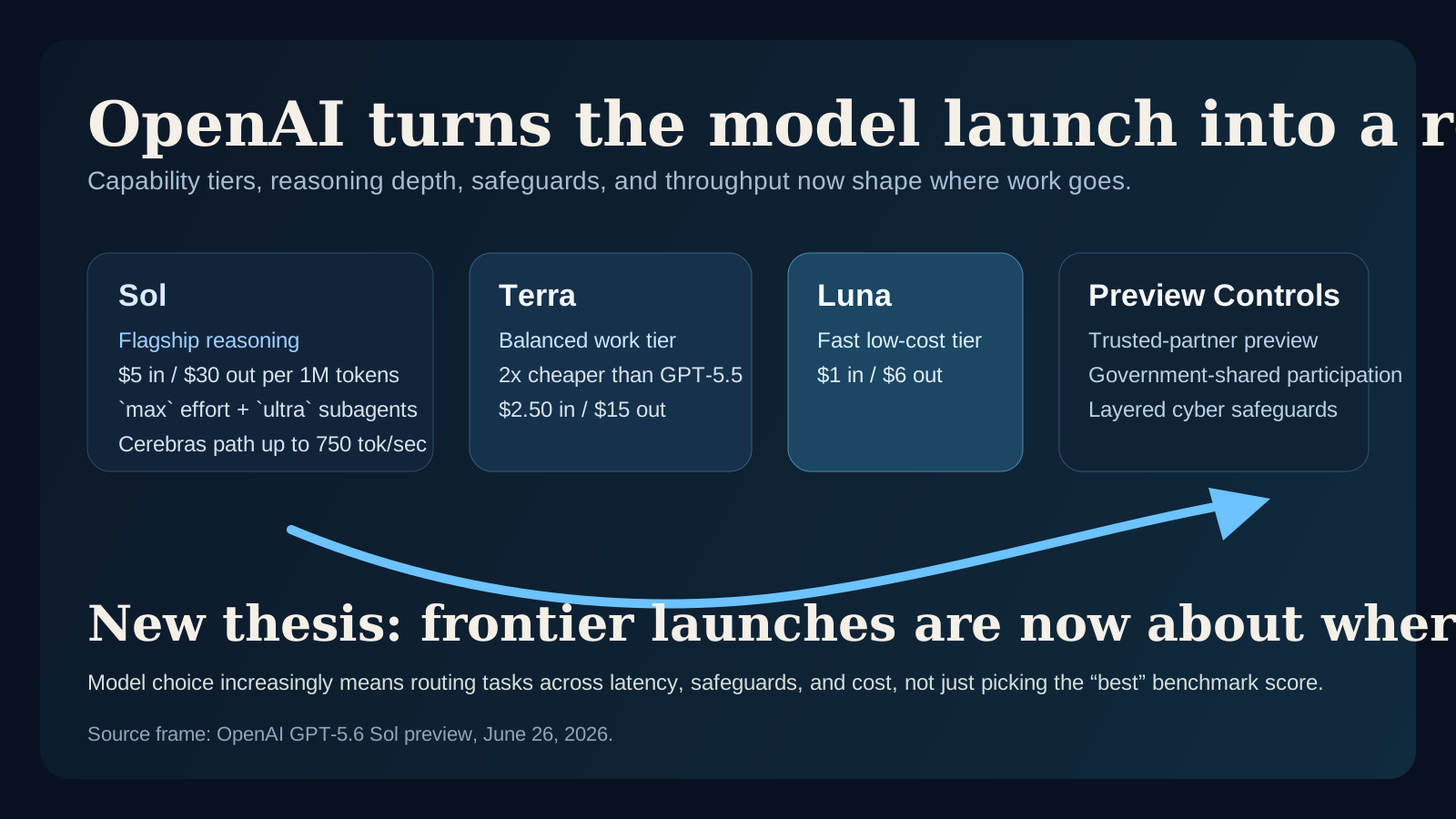
OpenAI’s June 26 GPT-5.6 preview clears the publish bar because the useful signal is not that a new flagship model exists. The stronger Grid Report angle is that OpenAI is turning frontier capability into a tiered operating stack across intelligence, speed, safeguards, and token economics. That makes model selection look less like a one-time benchmark decision and more like a routing problem.
The primary-source details are unusually explicit. OpenAI is previewing a three-model family: Sol as the flagship, Terra as a balanced everyday model, and Luna as the low-cost fast tier. It also says Terra offers competitive performance to GPT-5.5 at half the cost, while Luna is positioned as the cheapest option in the family. That matters because OpenAI is no longer treating the frontier only as one monolithic model. It is exposing capability tiers as a durable product architecture.
The useful GPT-5.6 signal is not just a stronger model. It is that frontier capability is being sold as a routing stack across speed, cost, safeguards, and reasoning depth.
There is a second, more important operator signal in the launch. OpenAI says GPT-5.6 introduces a new `max` reasoning effort and an `ultra` mode that uses subagents to accelerate complex work. In plain English, the company is not only selling raw model quality. It is productizing how much orchestration and time-to-answer a customer wants to buy for a given task.
The pricing reinforces that interpretation. OpenAI lists Sol at $5 per million input tokens and $30 per million output tokens, Terra at $2.50 and $15, and Luna at $1 and $6. That gives enterprises a clearer cost ladder for routing work by value rather than defaulting every task to the most expensive frontier model. If that product structure holds, the practical question for operators becomes which jobs truly need Sol and which should be pushed down the stack.
The throughput layer is what makes this story publishable. OpenAI says it is also launching GPT-5.6 Sol on Cerebras at up to 750 tokens per second in July. That is not a cosmetic detail. It implies that the frontier-model race is increasingly constrained by runtime speed and delivery path, not just raw reasoning quality. Once the same model family can be reached through different latency envelopes, inference infrastructure starts shaping product design and customer economics directly.
There is also a governance signal. OpenAI says the preview is initially limited to a small set of trusted partners whose participation was shared with the U.S. government, and that broader access will follow in the coming weeks. Combined with the layered safeguards and phased rollout, that suggests frontier launches are becoming release-management events involving policy process, differentiated access, and deployment controls rather than simple API drops.
This angle is materially different from the site’s recent OpenAI coverage. The Ona story was about persistent execution. The Spend Controls story was about enterprise budget discipline. The Partner Network story was about the services channel. GPT-5.6 Sol sits above those layers as the capability-routing system that determines what work gets sent where, at what latency, and at what cost.
That is enough to publish. Searchers looking for GPT-5.6 Sol do not need another generic model roundup. The more useful answer is what OpenAI is really shipping: a frontier model family designed to be routed across intelligence tiers, reasoning depth, safeguard posture, and runtime throughput.
Sources
OpenAI, “Previewing GPT-5.6 Sol: a next-generation model,” published June 26, 2026: https://openai.com/index/previewing-gpt-5-6-sol/
OpenAI GPT-5.6 preview system card for safety and deployment context: https://deploymentsafety.openai.com/
By Nawaz Lalani
The Grid Report is written by Nawaz Lalani and focuses on source-backed coverage of AI infrastructure, grid power demand, automation systems, and market signals.
Follow the signal, not just the headline.
Get the daily Grid brief for source-backed coverage on AI power demand, infrastructure timing, automation, and market signals.