- OpenAI’s July 22 Genesis announcement clears the publish bar because it says something more useful than “AI may help scientists.” The stronger signal is organizational.
- That is the original angle.
- The same-day government releases make that reading stronger.
- Section
- AI
- Read time
- 4 min read
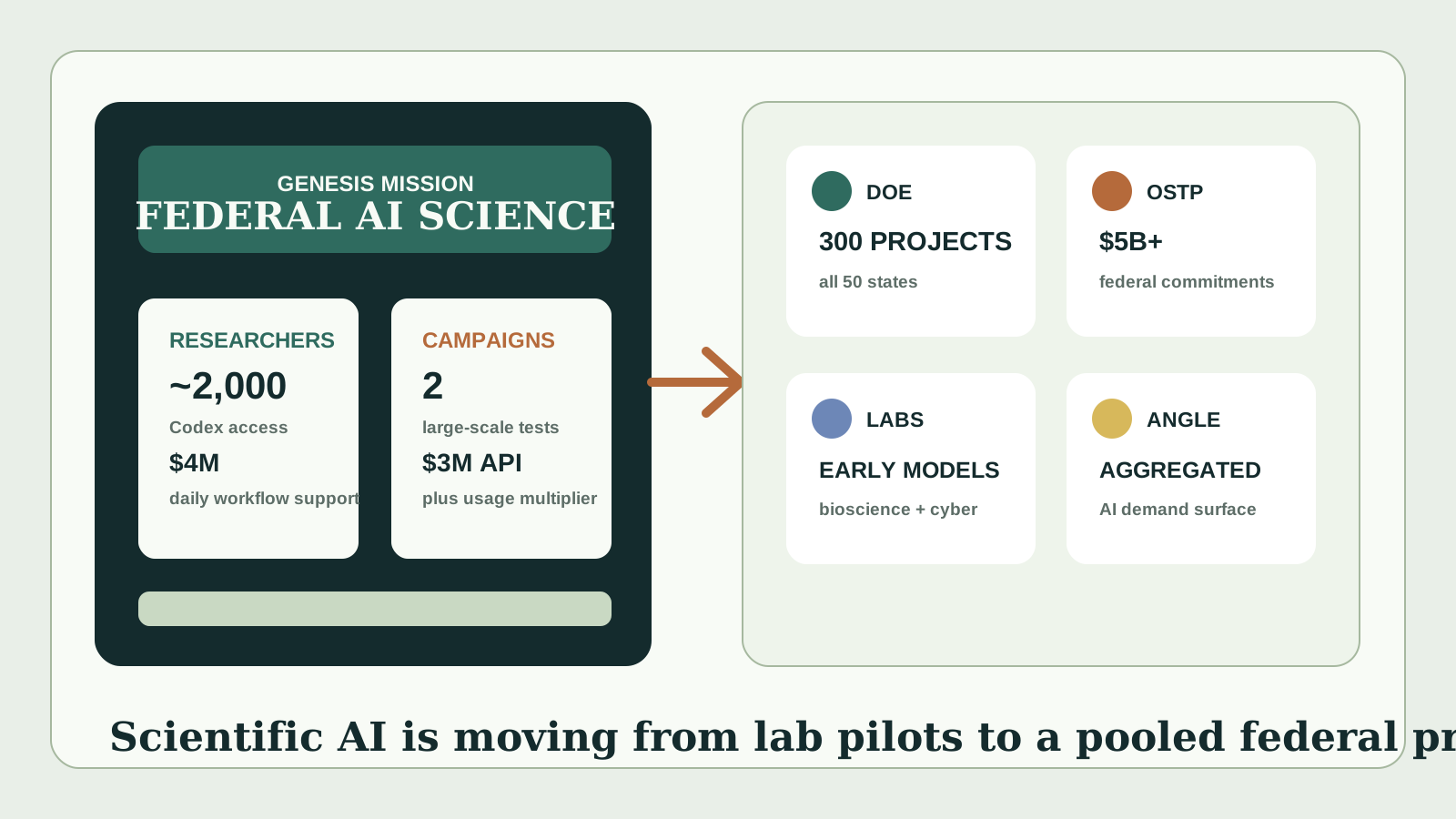
OpenAI’s July 22 Genesis announcement clears the publish bar because it says something more useful than “AI may help scientists.” The stronger signal is organizational. Scientific AI is being assembled into a federally coordinated demand-aggregation layer, where one mission pools researchers, credits, campaigns, and workflow preparation so frontier model access can be operationalized across institutions instead of negotiated piecemeal by individual labs.
That is the original angle. OpenAI said it will provide $4 million in Codex access to about 2,000 Genesis researchers at National Laboratories and universities, commit $3 million in API support to two large-scale scientific campaigns, offer up to $10 million in API usage for $2.5 million spent, provide selected biology researchers access to GPT-Rosalind, and extend early model and cyber-capability access to trusted national-laboratory teams. Read narrowly, that is a grant-style support package. Read correctly, it is a mechanism for concentrating AI demand into one federal science program with enough scale to shape workflows, evaluations, and procurement behavior.
The important shift is not only better science tooling. It is the emergence of a pooled federal buyer surface for frontier AI in research.
The same-day government releases make that reading stronger. The White House said more than $5 billion of federal commitments were unveiled to expand the Genesis Mission alongside new National Science and Technology Challenges. The Department of Energy said the first Genesis Mission projects selected under its request for applications amount to nearly 300 projects spanning all 50 states, aimed at accelerating breakthroughs in energy, discovery science, and national security. Those details matter because they move the story beyond one vendor promotion. They show the federal system trying to create a broad, programmatic buyer surface for scientific AI.
This belongs in the AI lane rather than a generic policy or research roundup because the useful question is how frontier-model demand gets turned into repeatable usage. Scientific institutions usually do not fail to adopt new tools because no one is interested. They fail because access is fragmented, budgets are narrow, workflows are unprepared, and each team has to invent its own validation stack. Genesis is an attempt to solve that bottleneck by aggregating users, credits, and mission priorities into one operating framework.
OpenAI’s own framing reinforces that. The company says Genesis aims to connect frontier models with the people, supercomputers, simulations, and facilities behind American science, and says the broader mission is intended to integrate AI with federal scientific data, advanced computing, experimental facilities, and expert teams while doubling the productivity and impact of American research within a decade. The two initial large-scale campaigns the company highlighted, high-temperature superconductors and an Atlas of the Machine-Accessible Frontier, are less important as standalone topics than as proof that the program is trying to direct frontier AI toward named national challenges rather than diffuse experimentation.
This also clears the duplicate screen against the site’s last 30 days. Anthropic’s Claude Science story was about a governed workbench for individual labs and research teams. Bristol Myers Squibb’s Vera Rubin buildout was about internal scientist throughput inside one enterprise. This thesis is materially different. The sharper question here is what happens when scientific AI stops being a vertical product sale and starts becoming a federally coordinated demand and deployment surface.
The operator relevance is straightforward. AI vendors that want durable science business may need more than strong models or benchmark wins. They may need structured access programs, workflow engineering, evaluation support, and pricing mechanics that fit mission-scale research environments. Public institutions, meanwhile, may increasingly prefer pooled programs that standardize access and validation rather than letting every laboratory negotiate its own scattered AI stack.
There are still limits. OpenAI is describing its own commitments on its own terms, the performance of the funded projects is unknown, and public commitments measured in credits do not guarantee scientific breakthroughs. But those caveats do not weaken the main read-through. They sharpen it: the market for scientific AI is maturing from isolated pilots into an organized demand layer where procurement design, workflow readiness, and program scale matter as much as raw model capability.
That is enough to publish. Searchers looking up OpenAI and the Genesis Mission do not need another abstract story about AI accelerating discovery. The more useful answer is that Washington is helping turn scientific AI into a pooled demand and deployment system, and that changes how this category may be bought, governed, and scaled.
Sources
OpenAI, “Advancing the next era of national science,” published July 22, 2026: https://openai.com/index/advancing-the-next-era-of-national-science/
The White House, “Trump Administration Announces More Than $5 Billion for the Genesis Mission, a National Mission on AI for Science,” published July 22, 2026: https://www.whitehouse.gov/releases/2026/07/45502/
U.S. Department of Energy, “Secretary of Energy Chris Wright Announces First Genesis Mission Projects Selected to Accelerate AI-Driven Scientific Discovery,” published July 22, 2026: https://www.energy.gov/articles/secretary-energy-chris-wright-announces-first-genesis-mission-projects-selected-accelerate
By Nawaz Lalani
The Grid Report is written by Nawaz Lalani and focuses on source-backed coverage of AI infrastructure, grid power demand, automation systems, and market signals.
Follow the signal, not just the headline.
Get the daily Grid brief for source-backed coverage on AI power demand, infrastructure timing, automation, and market signals.