- Microsoft and Mistral’s July 21 expansion clears the publish bar because it says something more useful than “Europe wants sovereign AI.” The companies are tying frontier-model access to three concrete delivery layers at once: Europe-based GPU capacity, a common development surface through Microsoft Foundry and Foundry Local, and a deployment ladder that runs from public cloud to cloud-connected local systems to fully disconnected environments.
- The original angle is that sovereign AI is becoming a capacity-and-control operating model.
- That matters because regulated buyers increasingly need more than residency language.
- Section
- AI
- Read time
- 4 min read
Microsoft and Mistral’s July 21 expansion clears the publish bar because it says something more useful than “Europe wants sovereign AI.” The companies are tying frontier-model access to three concrete delivery layers at once: Europe-based GPU capacity, a common development surface through Microsoft Foundry and Foundry Local, and a deployment ladder that runs from public cloud to cloud-connected local systems to fully disconnected environments. That is a more operational story than another sovereignty slogan.
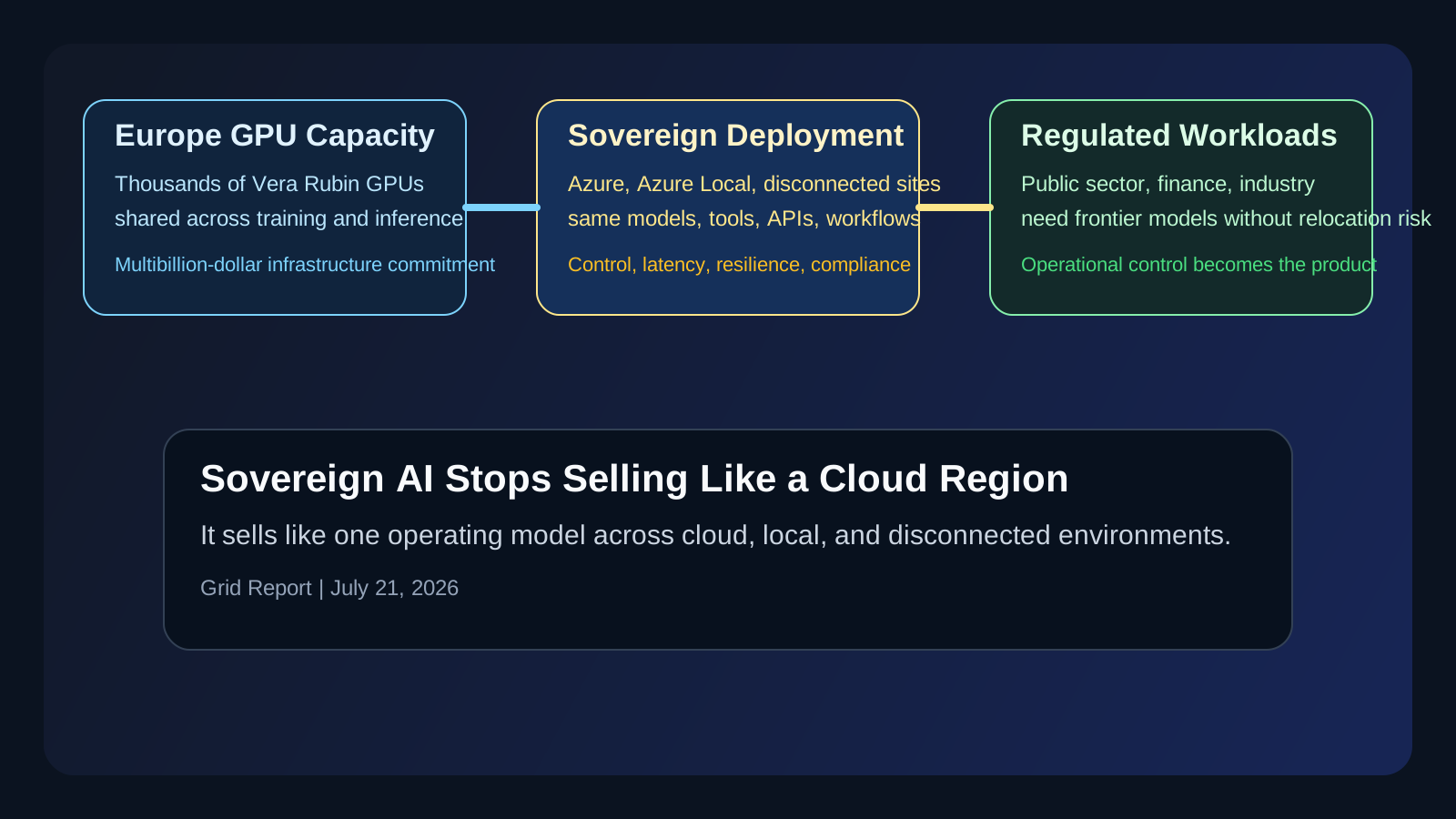
The original angle is that sovereign AI is becoming a capacity-and-control operating model. Microsoft says it will leverage Mistral’s expanded Europe-based GPU infrastructure through a multibillion-dollar agreement, while Mistral’s latest Medium 3.5 and OCR 4 models move into Microsoft Foundry and Copilot Studio. The useful read-through is not only that the model catalog got bigger. It is that Microsoft is trying to make control over where AI runs feel continuous even when the underlying environments differ sharply.
Sovereign AI is starting to sell less like a political promise and more like one operating model across cloud, local, and disconnected environments.
That matters because regulated buyers increasingly need more than residency language. They need a way to build once, preserve governance, and decide later whether the workload belongs in Azure, Azure Local, or a disconnected installation. Microsoft’s announcement makes that continuity explicit. The company frames Foundry and Foundry Local as one build surface, then matches it with operating environments that range from cloud scale to isolated local deployment. That is what turns the story into a real systems shift.
Mistral’s role is what gives the announcement infrastructure weight instead of leaving it as software packaging. Microsoft says the agreement is backed by expanded AI infrastructure in Europe, with Mistral adding GPU capacity using NVIDIA Vera Rubin systems to support training, inference, and large-scale deployment. In practice, that means sovereignty is not being sold only as a policy preference or a compliance feature. It is being sold as physically available compute.
This also clears the duplicate screen against the site’s last 30 days of sovereignty coverage. France’s June 25 story was about national campus and power execution. Equinix’s June 23 piece was about enterprise colocation blueprints. Amazon India was about regional cloud pre-positioning. This thesis is narrower and more useful for search: Microsoft and Mistral are trying to standardize how regulated organizations consume frontier AI across multiple control levels without rewriting the application each time.
The operator lesson is straightforward. Once frontier models become deployable across cloud, local, and disconnected settings with the same tools and APIs, the buying question changes. It becomes less about which vendor has the cleanest sovereignty narrative and more about which vendor can reduce redesign risk while preserving compliance, latency, resilience, and data-control requirements.
There are still limits. The announcement is company-framed, and the practical value will depend on how broadly these deployment patterns work outside flagship regulated accounts. But that caveat does not weaken the signal. It sharpens it: sovereign AI is maturing into a product category where control over execution paths matters as much as model quality.
That is enough to publish. Searchers looking up the Microsoft-Mistral expansion do not need a recycled partnership summary. The more useful answer is that sovereign AI is starting to sell like one operating model spanning capacity, tooling, and deployment control.
Sources
Microsoft News, “Microsoft and Mistral expand strategic partnership to give enterprises and regulated industries frontier AI they can control,” published July 21, 2026: https://news.microsoft.com/source/2026/07/21/microsoft-and-mistral-expand-strategic-partnership-to-give-enterprises-and-regulated-industries-frontier-ai-they-can-control/
NVIDIA Blog, “NVIDIA Vera Rubin Driving Performance Per Watt, Lowest Token Cost for Partners Worldwide,” published July 21, 2026: https://blogs.nvidia.com/blog/vera-rubin/
By Nawaz Lalani
The Grid Report is written by Nawaz Lalani and focuses on source-backed coverage of AI infrastructure, grid power demand, automation systems, and market signals.
Follow the signal, not just the headline.
Get the daily Grid brief for source-backed coverage on AI power demand, infrastructure timing, automation, and market signals.