- The June 16 Equinix-Cisco-NVIDIA expansion clears the publish bar because it explains where a large share of enterprise AI infrastructure may actually get built.
- The stronger angle is not simply that three major vendors want to sell AI hardware together.
- This belongs in the infrastructure lane because the core value proposition is physical and operational.
- Section
- Infrastructure
- Read time
- 4 min read
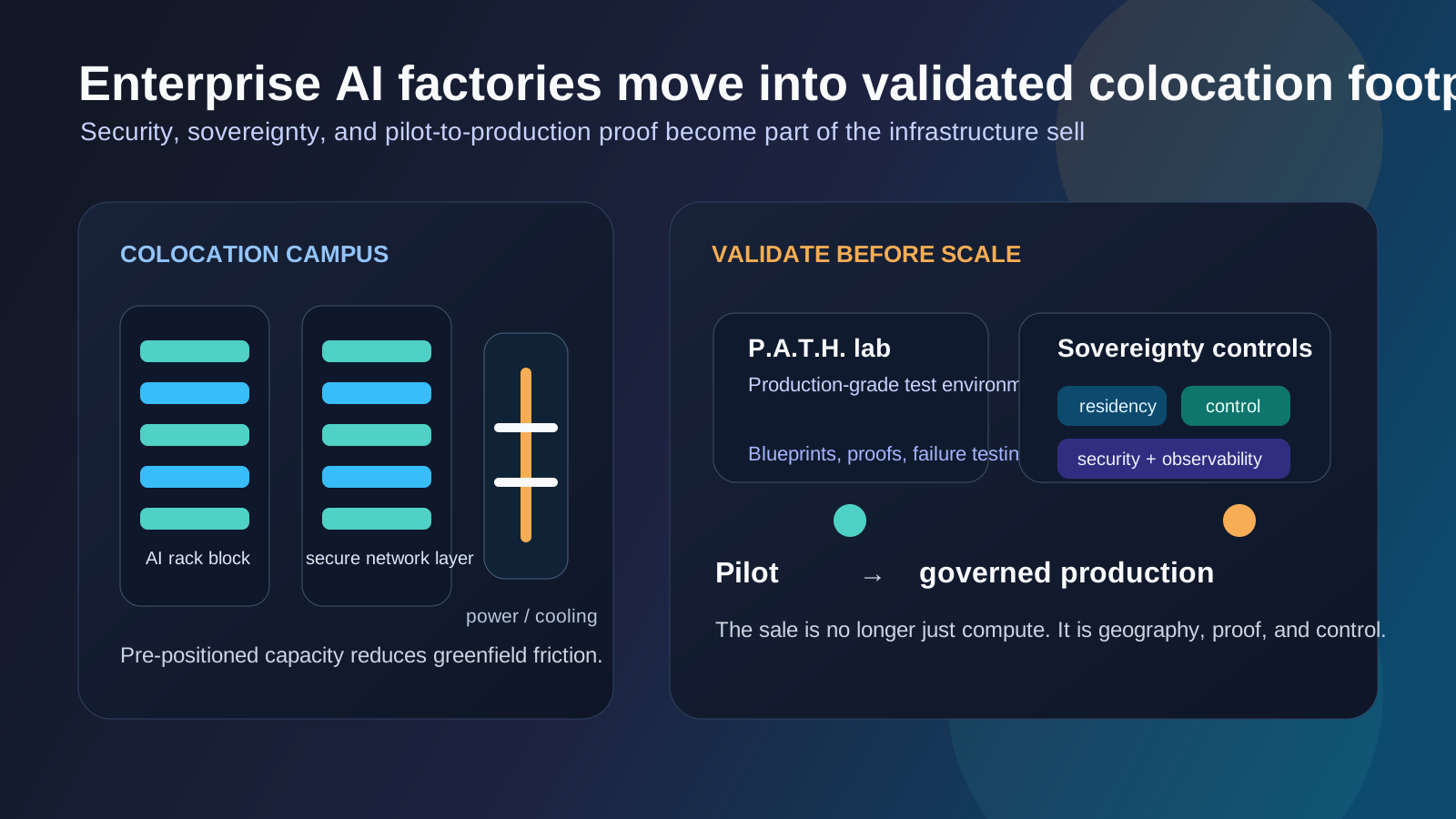
The June 16 Equinix-Cisco-NVIDIA expansion clears the publish bar because it explains where a large share of enterprise AI infrastructure may actually get built. The release says Equinix will enable customers to deploy Cisco Secure AI Factory with NVIDIA across its global data-center footprint, using standardized blueprints and automation, and will pair that with a partner-led lab environment where customers can test and validate infrastructure before broader rollout. That is more useful than another “AI partnership” headline because it speaks directly to how enterprise buyers reduce deployment risk.
The stronger angle is not simply that three major vendors want to sell AI hardware together. It is that enterprise AI factories are becoming a colocation-and-sovereignty product. Equinix says its footprint offers the interconnection density, specialized power, and advanced cooling needed for the latest AI systems, while Presidio’s P.A.T.H. Lab gives customers a production-grade environment to test architecture choices before committing to full-scale deployment. The message is clear: pilot-to-production speed increasingly depends on whether infrastructure is already staged in the right places and can be proven under realistic conditions.
Enterprise AI factories are starting to sell less like bespoke projects and more like validated colocation blueprints with sovereignty built into the pitch.
This belongs in the infrastructure lane because the core value proposition is physical and operational. Equinix is not pitching only rack space. It is packaging site readiness, partner-delivered reference architectures, and deployment validation into one product motion. That matters because many enterprises want AI capacity without waiting for a greenfield build or taking on the complexity of stitching together compute, networking, security, data movement, and observability from scratch.
The sovereignty layer is what makes the story more original. Presidio says the important shift is that businesses want AI infrastructure that can run “without sacrificing data sovereignty or control.” Cisco’s own Secure AI Factory positioning similarly frames the stack around security and observability from core to edge. Read together, the better takeaway is that enterprise AI adoption is now colliding with residency, compliance, and control requirements that generic public-cloud access does not always solve cleanly.
That has operator relevance across several buyer classes. Enterprises in regulated sectors get a way to test how AI workloads behave across hybrid cloud, neocloud, on-premises, and colocation environments before signing up for a broad deployment. Infrastructure partners get a clearer role as the delivery layer between model vendors and real production systems. Colocation providers get a new argument for why their campuses matter in the AI stack: not just power and space, but trusted geography, interconnection, and pre-validated build patterns.
This also creates a useful read-through for investors. If enterprise AI factories can be sold through existing colocation footprints with partner-certified blueprints, then some portion of AI infrastructure demand may flow through dense interconnection platforms rather than only through hyperscaler-owned campuses. That does not replace giant greenfield projects. It broadens the set of infrastructure assets that can monetize AI demand.
There are caveats. The announcement is still a vendor-led press release, and standardized blueprints do not remove the usual bottlenecks around GPU availability, capital budgets, power procurement, or internal governance. But those caveats do not weaken the signal. They clarify it. The market is trying to make enterprise AI infrastructure easier to buy by moving uncertainty out of the first production deployment and into a validated lab-plus-colocation workflow.
That is why this clears the search bar. The useful question is no longer only “what is an AI factory?” It is which infrastructure setups let a buyer move from experiment to governed production fastest while keeping data location, security posture, and operating control intact. Equinix, Cisco, and NVIDIA are now selling a direct answer to that question.
Sources
Equinix, “Equinix Collaborates with Cisco and NVIDIA to Deploy Secure AI Factories Across Global Data Center Footprint,” published June 16, 2026: https://newsroom.equinix.com/2026-06-16-Equinix-Collaborates-with-Cisco-and-NVIDIA-to-Deploy-Secure-AI-Factories-Across-Global-Data-Center-Footprint
Cisco, “Accelerate AI innovation with Cisco Secure AI Factory with NVIDIA,” accessed June 23, 2026: https://www.cisco.com/site/us/en/solutions/artificial-intelligence/secure-ai-factory/index.html
By Nawaz Lalani
The Grid Report is written by Nawaz Lalani and focuses on source-backed coverage of AI infrastructure, grid power demand, automation systems, and market signals.
Follow the signal, not just the headline.
Get the daily Grid brief for source-backed coverage on AI power demand, infrastructure timing, automation, and market signals.