- Applied Digital’s June 8 Delta Forge 2 announcement clears the publish bar because it gives a rare clean look at how AI campus economics are changing.
- That matters because speculative campus narratives are no longer enough.
- The company’s own language points in that direction.
- Section
- Infrastructure
- Read time
- 5 min read
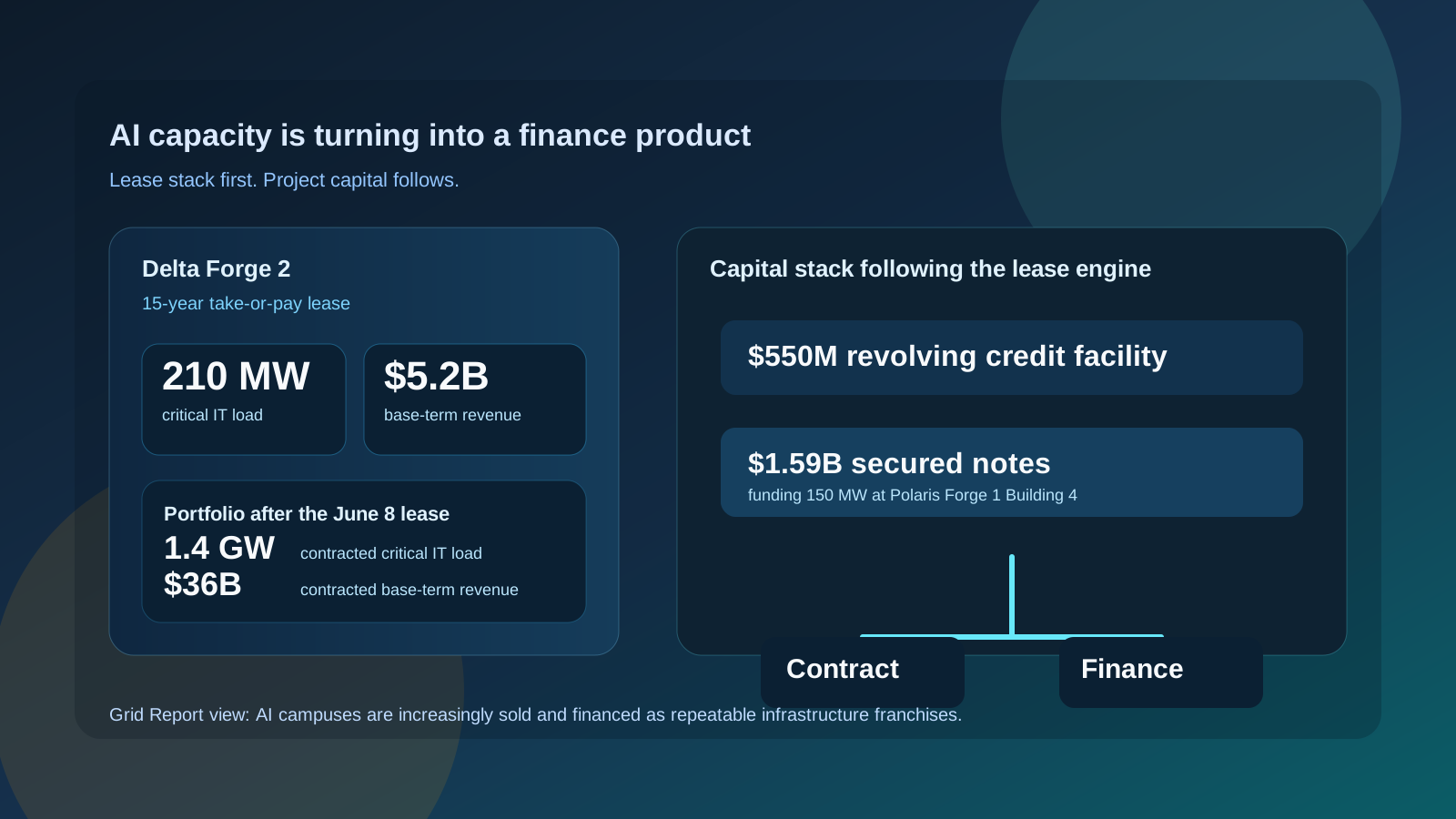
Applied Digital’s June 8 Delta Forge 2 announcement clears the publish bar because it gives a rare clean look at how AI campus economics are changing. The company said it signed a 210 megawatt, 15-year take-or-pay lease with a U.S.-based high investment-grade hyperscaler, representing about $5.2 billion in base-term contracted revenue and as much as $12.7 billion if renewal options are exercised across a 30-year term. The useful story is not just “another AI campus got leased.” It is that capacity is being packaged as a long-duration infrastructure product.
That matters because speculative campus narratives are no longer enough. Applied Digital says the deal brings its total contracted portfolio to about $36 billion in base-term lease revenue across five AI Factory campuses, backed by roughly 1.4 gigawatts of critical IT load and 2.15 gigawatts of gross grid-connected utility power. For investors and lenders, those numbers make the asset class look less like optional growth land and more like a contracted revenue stack that can support larger financing structures.
AI campuses are starting to be sold less as speculative land-and-power stories and more as long-duration, contract-backed capacity franchises.
The company’s own language points in that direction. CEO Wes Cummins described the strategy as a franchise model: a repeatable design, construction, and operations template deployed across multiple campuses and markets. That is the real hook. AI infrastructure developers are trying to prove they are not one-off project merchants. They want to be valued as scalable capacity platforms that can stamp out standardized campuses against repeat hyperscaler demand.
The lease structure reinforces the point. A 15-year take-or-pay agreement shifts the conversation from “will this campus fill up” to “how much of the future cash flow is already spoken for.” Once those contracts exist, new campuses can be marketed, financed, and underwritten against demonstrated demand rather than only a broad AI thesis. That is a much stronger operating model than speculative megawatt storytelling.
Timing also matters. Applied Digital says initial operations at Delta Forge 2 are anticipated to begin in the first quarter of 2028. In other words, the market is still paying for future-ready capacity years before energization, provided the developer can offer enough confidence around customer quality, power access, cooling design, and repeat execution. That is a meaningful signal about where hyperscaler procurement is moving: earlier, larger, and more contract-heavy.
The campus design details matter too. Applied Digital says Delta Forge 2 uses proprietary waterless cooling technology and high-power-density infrastructure built for large-scale training and inference workloads. That does not just support a sustainability line item. It supports the idea that AI campuses are being differentiated on their ability to convert contracted megawatts into dense, monetizable compute environments without tripping over water or facility limits.
This story also helps explain why capital is chasing certain infrastructure names more aggressively than others. If the market believes a developer has repeat customers, standardized campus design, and long-duration contracted revenue, it becomes easier to treat the company like a capacity franchise rather than a speculative builder. That changes both valuation logic and financing options.
There are obvious caveats. The hyperscaler remains unnamed, the campus location is undisclosed beyond being in a southern state, and operations are still years away. Applied Digital is also telling its own story in the best possible light. But the narrower conclusion is well supported: AI campuses are increasingly being sold and financed as contracted capacity systems, not just as hopeful real estate development projects.
That is enough to publish. Search coverage on AI infrastructure still focuses too much on logos and megawatts. The stronger operator and investor read is that a new class of AI campus company is trying to industrialize the revenue model itself.
Sources
Applied Digital, “Applied Digital Signs 210 MW Lease at Delta Forge 2, Expanding Its AI Factory Franchise Model to a Fifth Campus,” published June 8, 2026: https://ir.applieddigital.com/news-events/press-releases/detail/154/applied-digital-signs-210-mw-lease-at-delta-forge-2
SEC exhibit filing of Applied Digital’s June 8, 2026 press release: https://www.sec.gov/Archives/edgar/data/1144879/000149315226027984/ex99-1.htm
By Nawaz Lalani
The Grid Report is written by Nawaz Lalani and focuses on source-backed coverage of AI infrastructure, grid power demand, automation systems, and market signals.
Follow the signal, not just the headline.
Get the daily Grid brief for source-backed coverage on AI power demand, infrastructure timing, automation, and market signals.