- Meta’s July 13 Richland Parish expansion clears the publish bar because the useful signal is not merely that another giant AI campus got bigger.
- Meta said it is expanding the Richland Parish, Louisiana campus to 5 gigawatts of compute capacity and investing more than $1 billion in local infrastructure improvements, including roads, water, and wastewater systems.
- The stronger operator detail is the way the project is being framed.
- Section
- Infrastructure
- Read time
- 4 min read
- Data included
- Meta’s Louisiana package is larger than a datacenter expansion
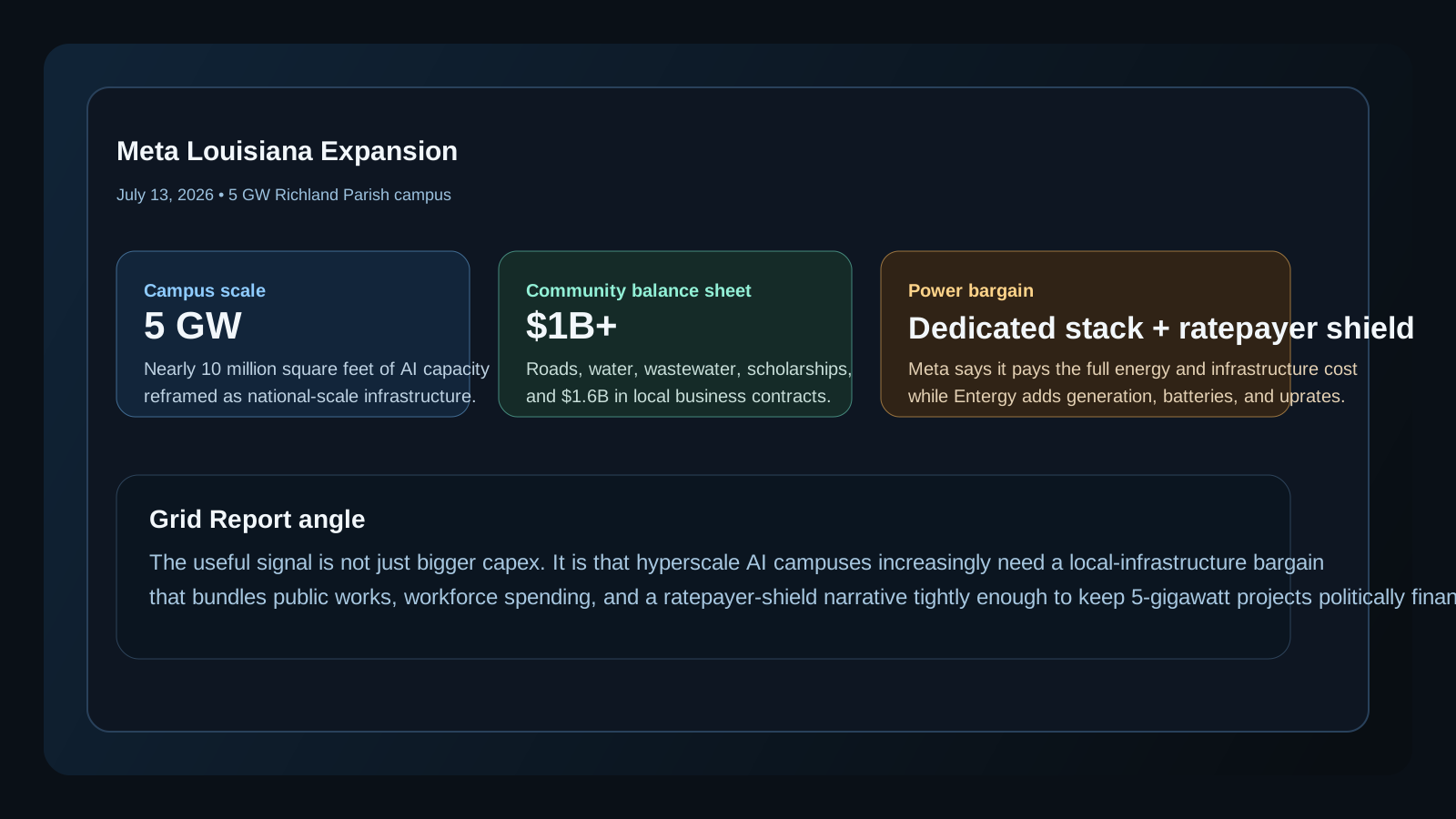
Meta’s Louisiana package is larger than a datacenter expansion
The project is being sold as a combined capacity, utility, and community bargain rather than a pure server-campus buildout.
| Layer | July 2026 signal | Why it matters |
|---|---|---|
| Campus scale | Expansion to 5 GW of compute capacity | The site is large enough that power, public works, and politics all become first-order constraints. |
| Local infrastructure | More than $1 billion for roads, water, and wastewater | The buildout requires visible outside-the-fence investment, not only data halls. |
| Community economics | More than $1.6 billion in local contracts and $5 million for trade scholarships | Meta is tying project legitimacy to local business and workforce benefits. |
| Ratepayer shield | Meta says it pays the full energy and related infrastructure cost | The power story now has to answer who pays before expansion can stay politically durable. |
Sources: Meta July 13, 2026 newsroom post; Louisiana Economic Development; Entergy Louisiana.
Meta’s July 13 Richland Parish expansion clears the publish bar because the useful signal is not merely that another giant AI campus got bigger. The sharper signal is structural: a 5-gigawatt project now has to be sold as a full local-infrastructure bargain, with visible economic benefits and a ratepayer shield attached to the same announcement as the capacity increase.
Meta said it is expanding the Richland Parish, Louisiana campus to 5 gigawatts of compute capacity and investing more than $1 billion in local infrastructure improvements, including roads, water, and wastewater systems. The company also said local Louisiana businesses have already received more than $1.6 billion in contracts, that the campus will provide more than 1,000 roles once operational, and that Louisiana Delta Community College is receiving a $5 million donation to fund scholarships for local residents entering data-center-related trades.
At 5 gigawatts, an AI campus is no longer just a real-estate project. It has to be sold as a local-infrastructure bargain with a ratepayer answer attached.
The stronger operator detail is the way the project is being framed. Meta says it pays the full costs of the energy, water, and related infrastructure the data center uses so consumers are not paying the cost. The same post points to an Entergy agreement that adds seven new natural-gas-fueled plants, three grid-scale batteries, nuclear uprates, and other purchased power, while Meta highlights expected customer savings rather than only new load growth. That is not incidental PR language. It is the political packaging required for a campus this large.
This belongs in infrastructure because the useful product is no longer only the building. It is the entire outside-the-fence support system: power, public works, local contracting, workforce formation, and a narrative that the host community is getting paid alongside the hyperscaler. At 5 gigawatts, the campus is too large to survive on generic job-creation talking points alone.
The original angle is that AI campuses are starting to look like negotiated public-works bundles with private compute attached. The more power-intensive and capital-intensive the site becomes, the more the developer needs to prove that roads, utility systems, schools, local business formation, and ratepayer protections move with the project rather than after it.
That also keeps the story distinct from recent site coverage. Meta’s Alberta campus was a jurisdiction-and-off-grid story. Microsoft’s Wisconsin piece was about a campus moving from capex into operations. Richland Parish adds a different layer: how a hyperscaler tries to keep a massive AI expansion socially and regulatorily financeable once the load is measured in gigawatts rather than megawatts.
There are obvious limits. This is company-framed material, not an independent audit of long-term power costs, execution risk, or how the full generation package lands with regulators. But those limits do not erase the signal. They clarify it. Hyperscalers increasingly understand that the infrastructure sale now includes the surrounding county and utility balance sheet, not just the data hall.
The search value is straightforward. People looking up Meta’s Louisiana expansion do not only need the 5-gigawatt headline. The more useful answer is that AI campus growth is becoming a local-infrastructure bargain, where community payoffs and ratepayer protections increasingly matter as much as the server capacity itself.
Sources
Meta, “Teachers and Local Businesses Win as Meta Expands Louisiana Data Center,” published July 13, 2026: https://about.fb.com/news/2026/07/teachers-local-businesses-win-as-meta-expands-louisiana-data-center/
Louisiana Economic Development, “Meta Commits More Than $50 Billion for North Louisiana Project, Becoming One of the Largest Data Centers in History,” published July 12, 2026: https://www.opportunitylouisiana.com/news/meta-commits-more-than-50-billion-for-north-louisiana-project-becoming-one-of-the-largest-data-centers-in-history
Entergy Louisiana, “Statement from Phillip May, President and CEO, Entergy Louisiana,” published June 19, 2026: https://www.entergy.com/news/statement-from-phillip-may-president-and-ceo-entergy-louisiana
By Nawaz Lalani
The Grid Report is written by Nawaz Lalani and focuses on source-backed coverage of AI infrastructure, grid power demand, automation systems, and market signals.
Follow the signal, not just the headline.
Get the daily Grid brief for source-backed coverage on AI power demand, infrastructure timing, automation, and market signals.