- Microsoft’s June 23 Mount Pleasant announcement clears the publish bar because it marks something more useful than another hyperscale campus rendering or capex pledge.
- That distinction matters because the physical AI buildout is full of planned campuses, memoranda, power concepts, and land narratives that still have to survive equipment delivery, commissioning, local utility work, workforce ramp, and construction sequencing.
- The article belongs in the infrastructure lane because the most useful signal is capacity proof, not another software or model launch.
- Section
- Infrastructure
- Read time
- 4 min read
- Data included
- Why Microsoft’s Wisconsin milestone is more useful than another campus announcement
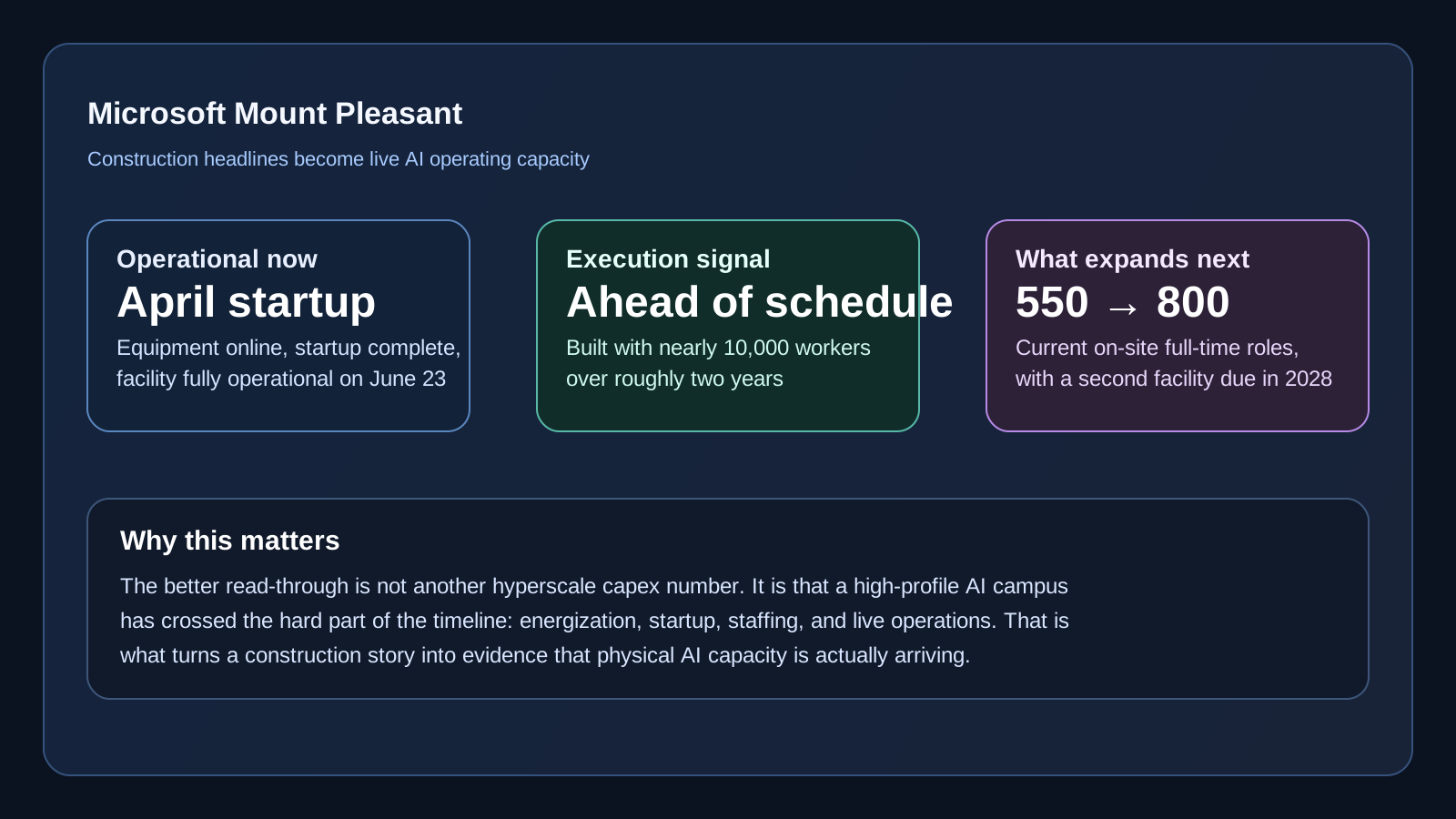
Why Microsoft’s Wisconsin milestone is more useful than another campus announcement
The signal is that the site has crossed from construction promise into live operating capacity with a visible second phase behind it.
| Signal | What Microsoft said | Why it matters |
|---|---|---|
| Operational threshold | Equipment came online in April and the first facility is now fully operational | This shifts the story from announced capex to real commissioned capacity. |
| Execution pace | Microsoft said the first facility was completed ahead of schedule with nearly 10,000 construction workers over two years | Delivery discipline matters more than campus size when timelines are the scarce resource. |
| Current footprint | Nearly 550 full-time employees are already on-site | A live staffing base makes the campus more tangible than a pure construction narrative. |
| Regional spend | Microsoft estimates $4.7 billion of local hyperscale construction spending between 2024 and 2028 | The campus is becoming a broader industrial and political footprint, not just a server site. |
| Expansion path | A second adjacent facility is under construction and scheduled for completion in 2028 | The real test is whether first-site success compounds into multi-phase capacity growth. |
Source: Microsoft Source press release published June 23, 2026.
Microsoft’s June 23 Mount Pleasant announcement clears the publish bar because it marks something more useful than another hyperscale campus rendering or capex pledge. The company said its first datacenter facility in the Village of Mount Pleasant is now fully operational after bringing equipment online and conducting startup activities in April. For the Grid Report audience, that makes this an execution story. The important threshold is not that another campus exists on paper. It is that a major AI site has moved through energization, startup, staffing, and live operations.
That distinction matters because the physical AI buildout is full of planned campuses, memoranda, power concepts, and land narratives that still have to survive equipment delivery, commissioning, local utility work, workforce ramp, and construction sequencing. Microsoft says the Wisconsin facility was completed ahead of schedule, with nearly 10,000 construction workers contributing over the past two years. If that claim holds, the operator-grade read-through is that this project has already cleared several of the practical delays that often turn AI infrastructure ambition into a slower real-world timeline.
The useful Wisconsin signal is not another AI campus promise. It is that a major site has crossed into live operations ahead of schedule.
The article belongs in the infrastructure lane because the most useful signal is capacity proof, not another software or model launch. Brad Smith said the now-operational Fairwater datacenter makes Wisconsin home to the world’s most powerful supercomputer. The exact performance claim is Microsoft’s own framing, and it should be treated that way. But the larger point does not depend on that line. A campus that is actually online and staffed changes the evidence base around hyperscale delivery in the Midwest.
Microsoft also gave unusually concrete local operating detail. It said there are currently nearly 550 full-time employees on-site supporting the first facility and that local spending on hyperscale construction in Wisconsin is expected to reach $4.7 billion between 2024 and 2028. The company also said it has directly purchased from 29 businesses across 11 Wisconsin counties. Those details matter because they show how a datacenter campus shifts from an abstract AI buildout talking point into a regional industrial footprint with suppliers, payroll, and local political durability.
This is also why the story is distinct from Microsoft’s other recent Grid Report appearances. Pecos was a dedicated power-stack story. The company’s water post was a cooling-and-siting story. Mount Pleasant is different. It is about proof of delivery. When an AI campus crosses from construction into operations, the useful question becomes whether the operator can keep expanding cleanly from that base.
That is the next signal to watch. Microsoft said construction on a second facility immediately adjacent to the first is already underway and scheduled for completion in 2028. Once the second facility is fully operational, the company expects full-time employment in the Village to grow to around 800, with additional northern expansion representing hundreds more jobs. That turns Wisconsin into more than a one-building milestone. It becomes a test case for whether hyperscale AI infrastructure can compound in a region without stalling after the first success.
There are obvious caveats. The source is Microsoft’s own company announcement, not an independent operating audit, and “fully operational” does not answer every question about final load, customer mix, or ultimate compute utilization. But those caveats do not weaken the main thesis. They clarify it. The meaningful development is that a prominent AI campus has crossed from promise into operations, and that is a much stronger infrastructure signal than another announcement about what might get built later.
That makes the article search-worthy now. Searchers looking for Microsoft’s Wisconsin campus do not need another generic summary of the investment. The more useful question is what changes once the facility is live. The answer is that the conversation shifts from capex rhetoric to execution evidence, staffing, second-phase expansion, and whether real AI capacity is showing up on the timeline investors and operators were promised.
Sources
Microsoft Source, “Microsoft completes construction on first datacenter facility in Mount Pleasant, Wisconsin,” published June 23, 2026: https://news.microsoft.com/source/2026/06/23/microsoft-completes-construction-on-first-datacenter-facility-in-mount-pleasant-wisconsin/
Microsoft Source, “Latest news,” accessed June 25, 2026 for publication timing and campus context: https://news.microsoft.com/source/view-all/
By Nawaz Lalani
The Grid Report is written by Nawaz Lalani and focuses on source-backed coverage of AI infrastructure, grid power demand, automation systems, and market signals.
Follow the signal, not just the headline.
Get the daily Grid brief for source-backed coverage on AI power demand, infrastructure timing, automation, and market signals.