- Microsoft’s June 24 datacenter water post clears the publish bar because it surfaces a real infrastructure constraint that still gets treated as secondary next to megawatts and GPUs.
- The stronger Grid Report angle is that cooling architecture is becoming part of where AI campuses can get built, how they are permitted, and whether they remain politically durable once neighbors start asking what new digital infrastructure does to local resources.
- Microsoft gave unusually concrete operating detail.
- Section
- Infrastructure
- Read time
- 5 min read
- Data included
- Why Microsoft’s cooling disclosure matters beyond sustainability language
Why Microsoft’s cooling disclosure matters beyond sustainability language
The useful read-through is that water intensity can change the politics and economics of AI campus expansion.
| Signal | What Microsoft disclosed | Why it matters |
|---|---|---|
| Water intensity | Average water-use effectiveness fell from 2.3 L/kWh to 0.27 in 2025 | A lower water footprint can change how datacenter projects are judged in water-sensitive markets. |
| New AI design | The AI-optimized design introduced in 2024 uses zero water for cooling during operations | Cooling design is becoming part of siting strategy rather than a background engineering choice. |
| Fleet mix | About 90% of Microsoft’s 2025 owned fleet uses highly efficient low- to zero-water cooling systems | This is not one pilot project. It points to a broader operating direction across the fleet. |
| Community costs | Microsoft says it funds needed system upgrades and has invested more than $500 million in water projects since 2020 | Datacenter growth increasingly includes payments meant to avoid shifting local infrastructure costs onto ratepayers. |
| Policy durability | The company linked water work to its Community-First AI Infrastructure approach | Water is becoming part of the political durability stack for AI expansion, not just an ESG appendix. |
Source: Microsoft official blog post published June 24, 2026, with supporting context from Microsoft’s December 2024 datacenter cooling post.
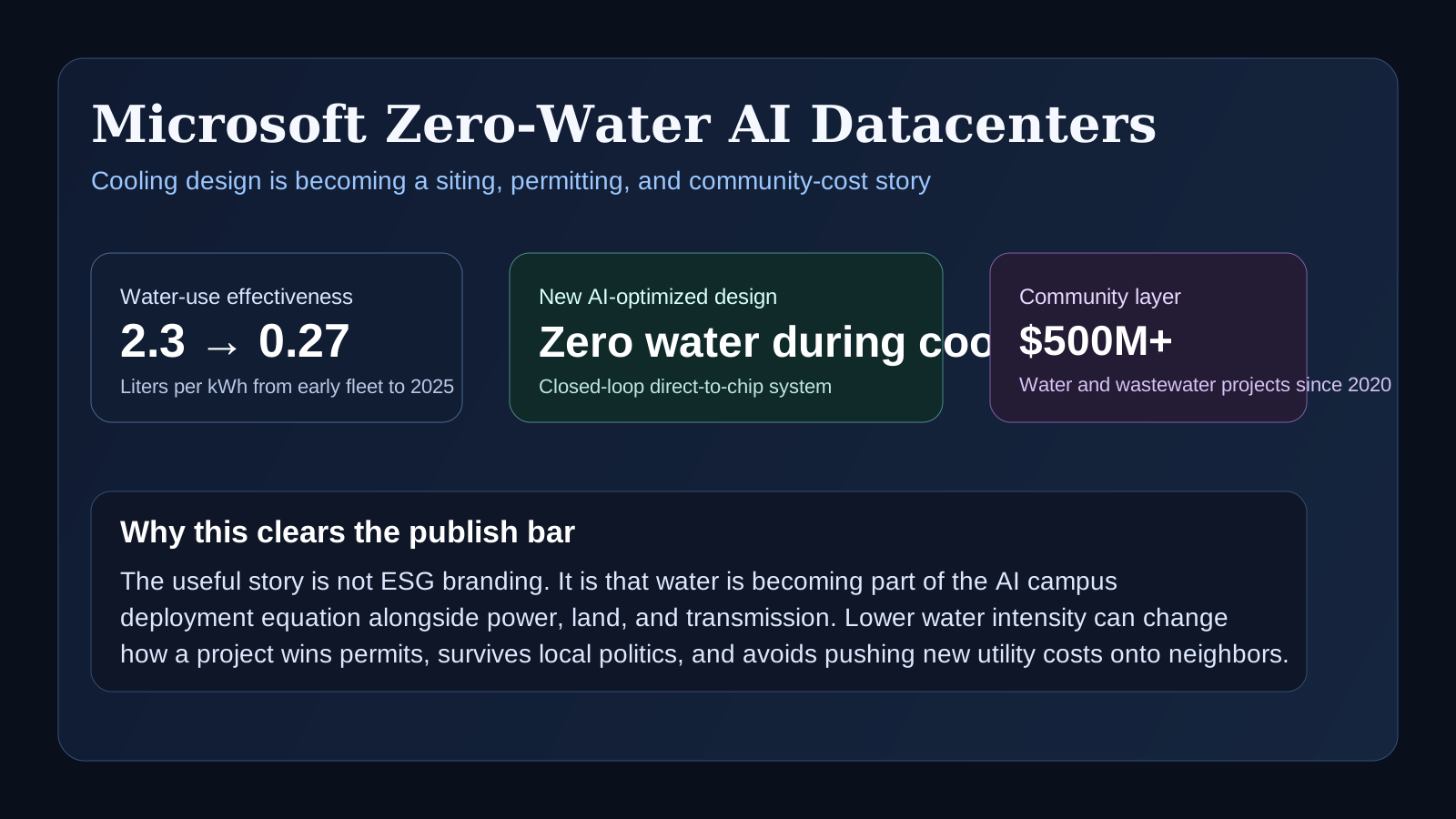
Microsoft’s June 24 datacenter water post clears the publish bar because it surfaces a real infrastructure constraint that still gets treated as secondary next to megawatts and GPUs. Microsoft said it has improved water-use effectiveness across datacenter generations by nearly 90%, from 2.3 liters per kilowatt-hour in its early fleet to 0.27 in 2025, and that its AI-optimized design introduced in 2024 consumes zero water for cooling during operations. That is not only an efficiency claim. It is a siting claim.
The stronger Grid Report angle is that cooling architecture is becoming part of where AI campuses can get built, how they are permitted, and whether they remain politically durable once neighbors start asking what new digital infrastructure does to local resources. Power still matters more. But water is becoming one of the filters that determines which projects move smoothly and which ones collect friction.
Microsoft’s June 24 post matters because cooling design is no longer just an engineering detail. It is becoming part of the siting and community-approval stack for AI campuses.
Microsoft gave unusually concrete operating detail. It said around 90% of its 2025 owned datacenter fleet already uses highly efficient low- to zero-water cooling systems, and that the new AI design uses a closed-loop, direct-to-chip system with zero water evaporation during operations. For operators, that matters because the cooling conversation is shifting away from generic efficiency language and toward specific site-level tradeoffs in water withdrawal, reuse, and community infrastructure.
The community-cost layer is what makes this worth publishing now. Microsoft said it funds required water-system upgrades in full so local communities do not shoulder the cost of supporting its operations. The company cited more than $25 million in water and sewer improvements near Leesburg, Virginia, and more than $500 million invested since 2020 across more than 75 water and wastewater infrastructure projects. That is the important signal. Hyperscaler growth is increasingly paired with direct infrastructure payments meant to blunt ratepayer and local-politics backlash.
This makes the story distinct from our recent cooling coverage. NVIDIA’s 45°C liquid-cooling push was mainly a system-density and power-and-water-efficiency story. Microsoft is different. It is explicitly tying water stewardship to Community-First AI Infrastructure, municipal upgrades, recycled or non-potable water sourcing, and a datacenter design choice that can change how campuses are perceived in water-sensitive regions.
Search value is also clear. There will be routine pickup around the phrase “water positive.” The more useful operator and policy query is narrower: how does lower-water AI cooling change project durability in contested datacenter markets? Microsoft’s disclosure suggests that water intensity is becoming a practical siting variable alongside power timing, transmission access, and tax treatment.
There are limits. This is Microsoft’s own framing, not a regulator’s audit, and zero water during cooling operations does not mean a campus has zero water footprint overall. The company also remains early in deploying the newer AI-optimized design across its broader fleet. Those caveats matter. But they do not weaken the core point. They show where the infrastructure conversation is moving.
That is enough to publish. The right takeaway is not that water has replaced power as the bottleneck. It has not. The point is that advanced cooling design can now affect permitting risk, community negotiations, municipal upgrade obligations, and the local politics of AI growth. That is more useful than a generic sustainability rewrite.
Sources
Microsoft, “Inside Microsoft’s two-decade push to cut water intensity while scaling for growth,” published June 24, 2026: https://blogs.microsoft.com/blog/2026/06/24/inside-microsofts-two-decade-push-to-cut-water-intensity-while-scaling-for-growth/
Microsoft Cloud Blog, “Sustainable by design: Next-generation datacenters consume zero water for cooling,” published December 9, 2024: https://www.microsoft.com/en-us/microsoft-cloud/blog/2024/12/09/sustainable-by-design-next-generation-datacenters-consume-zero-water-for-cooling/
By Nawaz Lalani
The Grid Report is written by Nawaz Lalani and focuses on source-backed coverage of AI infrastructure, grid power demand, automation systems, and market signals.
Follow the signal, not just the headline.
Get the daily Grid brief for source-backed coverage on AI power demand, infrastructure timing, automation, and market signals.