- Microsoft and AMD’s July 20 infrastructure update clears the publish bar because it does more than announce another silicon partnership.
- The original angle is that cloud AI capacity is becoming workload-specialized at the system level.
- That matters because the bottleneck in AI infrastructure is spreading sideways.
- Section
- Infrastructure
- Read time
- 4 min read
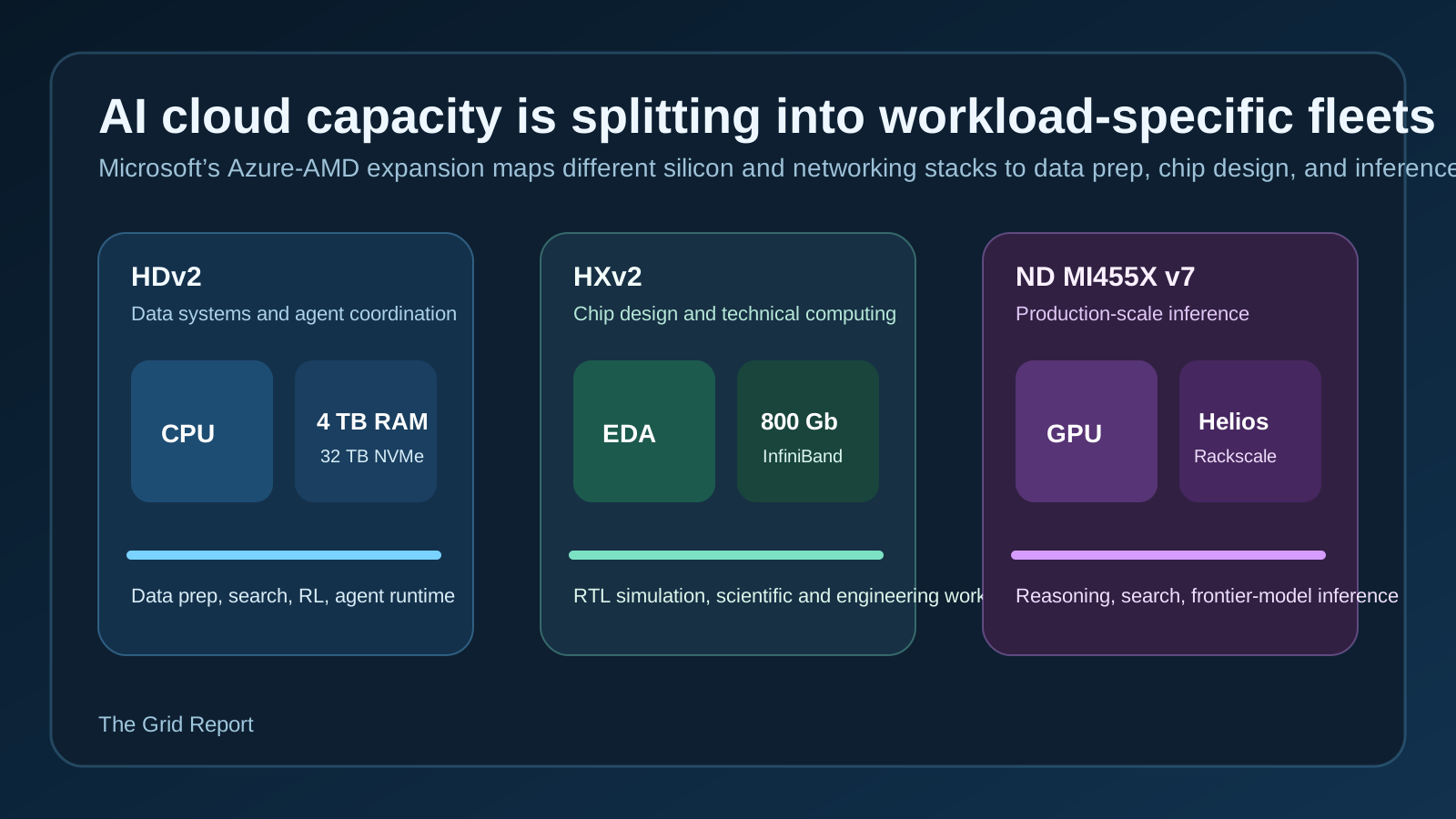
Microsoft and AMD’s July 20 infrastructure update clears the publish bar because it does more than announce another silicon partnership. Microsoft is explicitly dividing Azure’s next AI capacity block into different workload systems: HDv2 for data preparation and agent coordination, HXv2 for semiconductor design and technical computing, and ND MI455X v7 for large-scale inference. That is a more useful infrastructure signal than a generic “cloud adds more GPUs” rewrite.
The original angle is that cloud AI capacity is becoming workload-specialized at the system level. Microsoft says modern AI services now need different compute shapes across the lifecycle: CPU-heavy data and search pipelines that keep accelerators fed, high-memory and high-frequency infrastructure for electronic-design automation, and rackscale GPU systems for reasoning and inference. AMD’s companion release sharpens the same point by describing Helios as a full rackscale platform that combines MI455X GPUs, EPYC Venice CPUs, Pensando networking, and ROCm software.
AI cloud capacity is no longer one giant GPU bucket. It is becoming a portfolio of purpose-built workload fleets.
That matters because the bottleneck in AI infrastructure is spreading sideways. The site has already covered packaging constraints, optics maintenance, and post-training yield. Microsoft’s Azure-AMD move adds another layer: even when the cloud has access to plenty of accelerators, operators still need the right surrounding fleet for data movement, agent runtime, networking, chip-design throughput, and production inference economics. Capacity is becoming a portfolio problem, not a single-cluster problem.
Microsoft’s own product split makes the point concrete. HDv2 is framed around data processing, search, reinforcement learning, and agent coordination at scale. HXv2 is tuned for RTL simulation and broader scientific or engineering workloads, with 800 Gb InfiniBand and large-memory configurations. ND MI455X v7 is aimed at reasoning, search, and modern AI services running at production scale. Those are three different infrastructure businesses hiding inside one Azure announcement.
This belongs in infrastructure rather than markets or generic AI because the main lesson is operational. Cloud providers are no longer only racing to secure the most accelerators. They are packaging differentiated fleets for distinct economic jobs inside the AI stack. The more agentic and model-driven workloads diverge, the less useful the old mental model of one interchangeable pool of AI capacity becomes.
It also clears the duplicate screen. The site’s recent TSMC story was about foundry ramp timing. The Qualcomm piece was about second-source CPU ambition. The Microsoft and 3M story was about the optical layer. This thesis is materially different. Azure is signaling that hyperscale AI capacity is being sold as a set of purpose-built workload environments rather than one monolithic frontier-compute product.
There is still uncertainty. Microsoft and AMD are describing upcoming offerings, and AMD says Helios will begin shipping to customers including Microsoft in the second half of 2026. So the deployment story is not yet fully proven in the field. But that does not weaken the strategic read-through. It clarifies where hyperscalers think the next margin and performance fights will happen: in how precisely they match infrastructure to each segment of the AI workflow.
That is enough to publish. Searchers looking up the Azure-AMD expansion do not need another product roundup. The more useful answer is that hyperscale AI infrastructure is fragmenting into specialized fleets, and that changes how operators should think about capacity planning, cloud differentiation, and the next layer of bottlenecks.
Sources
Microsoft, “Microsoft expands Azure AI and HPC infrastructure with AMD,” published July 20, 2026: https://blogs.microsoft.com/blog/2026/07/20/microsoft-expands-azure-ai-and-hpc-infrastructure-with-amd/
AMD, “Microsoft to Deploy Next-Gen AMD Instinct and AMD EPYC Processors as the Companies Expand Their Long-Term Strategic Partnership,” published July 20, 2026: https://newsroom.amd.com/news/microsoft-azure-ai-infrastructure/
By Nawaz Lalani
The Grid Report is written by Nawaz Lalani and focuses on source-backed coverage of AI infrastructure, grid power demand, automation systems, and market signals.
Follow the signal, not just the headline.
Get the daily Grid brief for source-backed coverage on AI power demand, infrastructure timing, automation, and market signals.