- TSMC’s July 16 second-quarter report clears the publish bar because it does more than confirm that AI chip demand is still strong.
- The strongest detail in the earnings release is not the headline revenue number by itself.
- That is why this belongs in markets, not just semiconductor product coverage.
- Section
- Markets
- Read time
- 4 min read
- Data included
- TSMC’s quarter points to execution pressure inside the AI chip stack
TSMC’s quarter points to execution pressure inside the AI chip stack
The key signal is not only that demand stayed strong. It is that the next supply unlock depends on the timing of node ramps and the rest of the fulfillment chain staying aligned.
| Signal | What TSMC reported | Why it matters now |
|---|---|---|
| Q2 revenue | $40.20 billion | Demand remained strong enough for TSMC to print another step-up quarter instead of showing AI fatigue. |
| Advanced-node mix | 77% of wafer revenue at 7nm and below | AI infrastructure is still pulling heavily on the most supply-constrained manufacturing tiers. |
| 2nm contribution | 3% of wafer revenue | The node is starting from a small base, which makes ramp timing more important than headline excitement. |
| 3Q guidance | $44.6 billion to $45.8 billion | Customers are still booking capacity aggressively enough to keep pressure on the whole supply chain. |
| Management framing | Q3 supported by continued strong leading-edge demand and steep 2nm ramp | The market is shifting from demand proof toward execution proof. |
Source: TSMC July 16, 2026 earnings release and 2026 Q2 quarterly-results page.
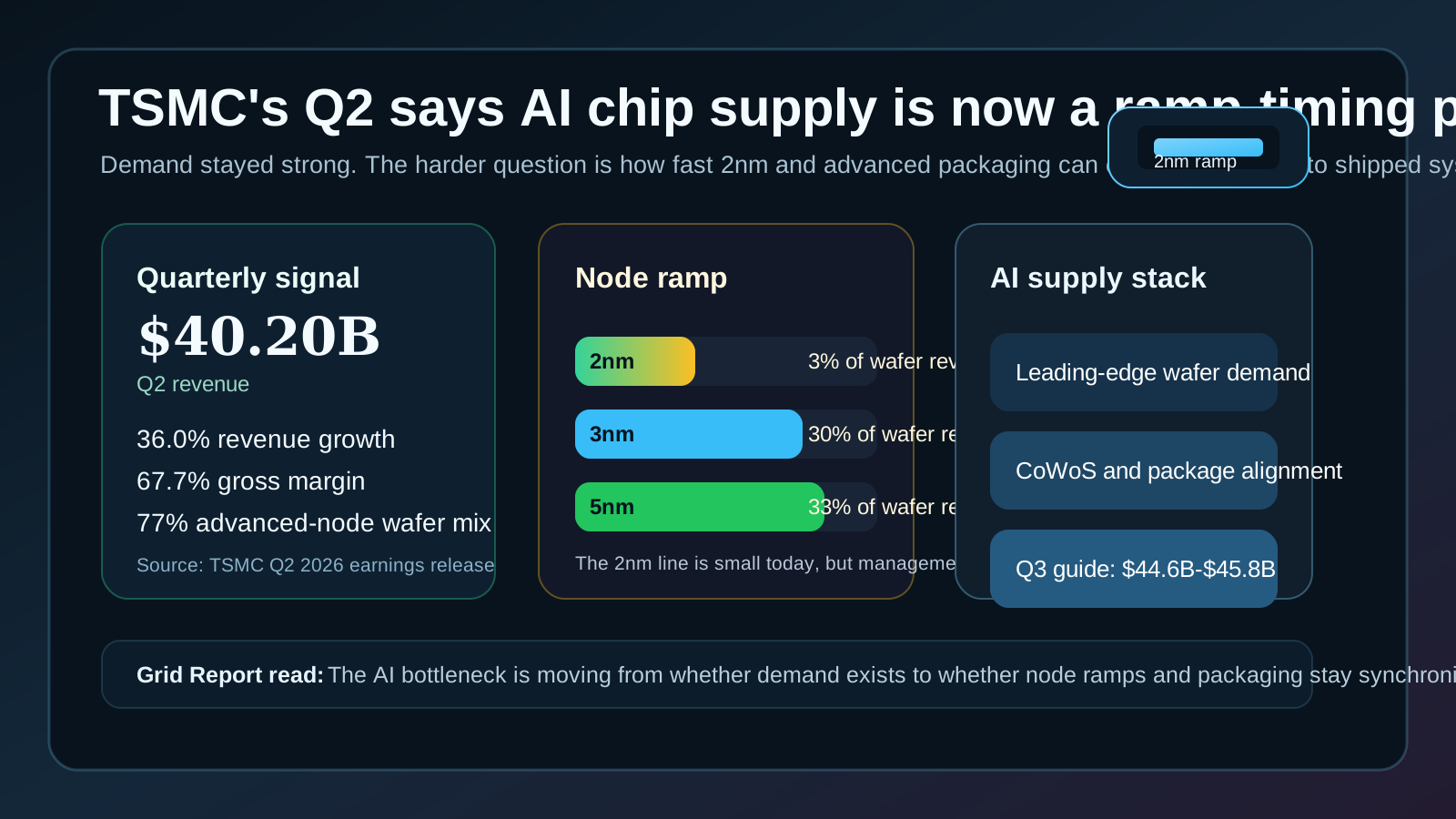
TSMC’s July 16 second-quarter report clears the publish bar because it does more than confirm that AI chip demand is still strong. TSMC reported second-quarter revenue of $40.20 billion, up 36.0% year over year, with gross margin at 67.7% and advanced nodes at 77% of wafer revenue. It also guided third-quarter revenue to $44.6 billion to $45.8 billion. The useful operator read-through is that the market is no longer mainly asking whether AI demand is real. It is asking how fast TSMC can translate that demand through node ramps and package output without losing timing.
The strongest detail in the earnings release is not the headline revenue number by itself. It is TSMC’s own explanation for the next quarter: continued strength in leading-edge demand, including what the company called the steep ramp of its 2-nanometer technology. In the second quarter, 2-nanometer was only 3% of wafer revenue, while 3-nanometer was 30% and 5-nanometer was 33%. That mix says the real handoff is just starting. The next phase of AI supply depends on whether that 2nm ramp arrives cleanly enough to support the customers already queued behind it.
The next AI-chip question is not whether demand exists. It is whether 2nm and advanced packaging can stay synchronized enough to ship against it.
That is why this belongs in markets, not just semiconductor product coverage. Investors have spent two years treating AI chips as a demand story. TSMC’s numbers suggest the scarcer asset is increasingly execution bandwidth inside the manufacturing stack. If the foundry can keep yields, wafer starts, and packaging aligned while 2nm rises, then more of the AI backlog turns into revenue across the supply chain. If that handoff slips, the constraint does not disappear. It just moves downstream into platform timing, customer launch schedules, and delayed system deployments.
The packaging layer is the buried part of the story. TSMC’s public release does not turn Q2 into a packaging explainer, but the broader earnings discussion and the market context point in the same direction: leading-edge wafers are only one half of AI infrastructure supply. The other half is whether advanced packaging and related system integration can keep pace. That matters because every additional quarter of mismatch between front-end wafer output and back-end package capacity changes who can ship, who has to wait, and which AI infrastructure names can actually monetize demand on time.
There is also a clean market signal in the guidance itself. A company does not guide to $44.6 billion to $45.8 billion for the next quarter unless customers are still pulling hard on capacity. TSMC said the business should be supported by continued strong demand for leading-edge process technologies. That keeps pressure on the parts of the stack that are hardest to expand quickly: the newest nodes, advanced packaging, power-hungry AI accelerators, and the industrial discipline needed to bring all of them up together.
The stronger conclusion is that AI chip supply is becoming a ramp-coordination story. TSMC’s quarter matters not because it reveals a new wave of hype, but because it shows that the market is still running hot enough for manufacturing timing to become the next key variable.
Sources
TSMC, “TSMC Reports Second Quarter EPS of NT$27.25,” published July 16, 2026: https://pr.tsmc.com/english/news/3326
TSMC Investor Relations, “2026 Q2 Quarterly Results,” accessed July 18, 2026: https://investor.tsmc.com/english/quarterly-results/2026/q2
TSMC Q2 2026 earnings conference transcript snippet surfaced via TSMC Investor Relations search results, accessed July 18, 2026: https://investor.tsmc.com/english/encrypt/files/encrypt_file/reports/2026-07/57b65edbfe6e480e74abe202be983ecbde79e934/TSMC%202Q26%20Transcript.pdf
By Nawaz Lalani
The Grid Report is written by Nawaz Lalani and focuses on source-backed coverage of AI infrastructure, grid power demand, automation systems, and market signals.
Follow the signal, not just the headline.
Get the daily Grid brief for source-backed coverage on AI power demand, infrastructure timing, automation, and market signals.