- SK hynix’s planned American listing clears the publish bar because it does more than produce another bullish chip-market headline.
- The shift matters because the AI semiconductor trade is still usually framed around GPU leaders, quarterly memory pricing, or supply-chain tightness.
- The company’s significance in the current stack is what makes the financing signal matter.
- Section
- Markets
- Read time
- 5 min read
- Data included
- Why the SK hynix filing is a markets signal, not just another chip headline
Why the SK hynix filing is a markets signal, not just another chip headline
The event matters because it asks public markets to finance the memory layer of the AI buildout at unusual scale.
| Layer | What is visible now | Why it matters |
|---|---|---|
| Raise size | Reports point to roughly 45.45 trillion won, or about $29.4 billion | The scale alone makes memory financing part of the AI capital-markets story. |
| Listing route | The company is pursuing a Nasdaq ADR listing | A U.S. listing broadens the investor base around a strategic AI supplier. |
| Timing | Reports said trading could begin on July 10, 2026 | The market gets an immediate test of appetite rather than a distant planning signal. |
| Capacity implication | Proceeds are being framed around AI-driven expansion needs | HBM growth now depends on access to financing as well as process technology. |
| Market read-through | The raise asks investors to underwrite memory as durable AI infrastructure | A clean deal would support the thesis that the bottleneck layers of AI still attract deep capital. |
Sources: Reuters via Yahoo Finance, Yahoo Finance market coverage, Barron’s, and SEC filing detail published June 24-25, 2026.
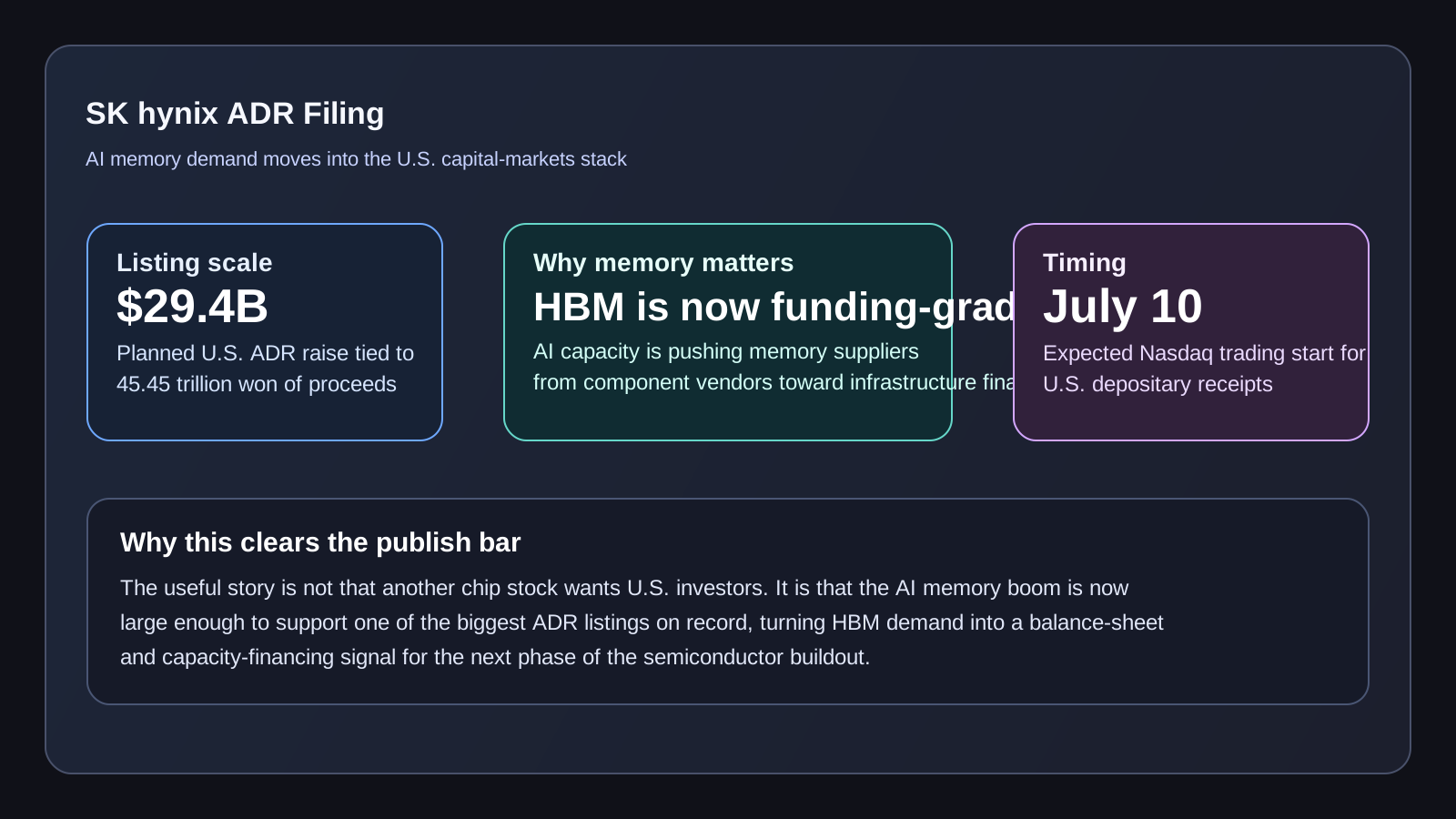
SK hynix’s planned American listing clears the publish bar because it does more than produce another bullish chip-market headline. Multiple reports on June 24 and June 25 said the company is seeking roughly 45.45 trillion won, or about $29.4 billion, through a Nasdaq ADR listing tied to the AI chip boom. That belongs in the markets lane because the stronger story is not only that memory demand is high. It is that AI memory is becoming large enough to pull a major supplier directly into the American capital-markets stack.
The shift matters because the AI semiconductor trade is still usually framed around GPU leaders, quarterly memory pricing, or supply-chain tightness. SK hynix’s filing adds another layer: capital formation. When a memory supplier can pursue a raise of this size, the market is no longer only rewarding current earnings. It is helping fund the next wave of capacity, process investment, and manufacturing expansion needed to keep the AI buildout moving.
SK hynix’s filing matters because AI memory is no longer only a supply-chain constraint. It is becoming a financeable infrastructure category.
The company’s significance in the current stack is what makes the financing signal matter. SK hynix is one of the central suppliers of high-bandwidth memory used in AI accelerators. That does not make every memory story publishable. This one is different because the listing itself is the event. Searchers do not need another generic explanation that AI uses more memory. The more useful question is how memory suppliers fund the next round of scale when HBM has become a strategic bottleneck inside the broader infrastructure cycle.
The reported deal details are large enough to matter on their own. Bloomberg, Reuters, Barron’s, and other outlets said the company aims to raise roughly $29.4 billion and expects ADR trading on Nasdaq to begin on July 10, 2026. Search reporting also pointed to roughly 17.79 million new shares backing the receipts. Even if the final pricing or timing changes, the attempted scale already tells you what the company believes the market will underwrite: AI memory is no longer a side component business. It is being treated like core infrastructure.
This also helps separate SK hynix’s latest move from our earlier memory coverage. Micron’s June 24 quarter was a contracted-infrastructure story about customer agreements, demand visibility, and revenue quality. NVIDIA’s June 21 SK hynix partnership was a supply-chain-and-fab-automation story. The new ADR plan is different. It is a funding story about how AI-era memory leadership converts into balance-sheet optionality and a broader investor base.
Operator and investor relevance both follow from that framing. Operators care because tighter access to growth capital can influence how quickly memory capacity expands and whether the rest of the AI hardware stack keeps pace. Investors care because a listing of this size effectively asks public markets to validate memory as a durable AI buildout layer rather than a short-lived cyclical trade. If the raise lands cleanly, it reinforces the idea that infrastructure capital is still available for the parts of the semiconductor stack the market sees as mission critical.
There are limits. Filing size is not final proceeds, and large offerings can still be repriced, delayed, or absorbed less cleanly than expected. Much of the currently visible reporting is still framing the transaction around initial filing details. Those caveats matter. But they do not weaken the thesis enough to skip the story. They are exactly why the event is useful now: the market is being asked, in real time, how much capital it is willing to commit to the memory layer of the AI buildout.
That makes this search-worthy now. A generic “SK hynix is listing in the U.S.” rewrite would not add much. The better angle is narrower and more useful: a giant ADR raise would signal that AI memory has moved from supply-chain constraint to financeable infrastructure category. That is the question operators, investors, and semiconductor watchers should be asking.
Sources
Yahoo Finance / Reuters, “South Korea’s SK Hynix says to raise up to $29 bln in U.S. ADR listing,” published June 24, 2026: https://finance.yahoo.com/technology/articles/south-koreas-sk-hynix-says-080534381.html
Yahoo Finance, “SK Hynix plans $29 billion Nasdaq ADR listing in 2026,” published June 25, 2026: https://finance.yahoo.com/markets/stocks/articles/sk-hynix-plans-29-billion-115737339.html
Barron’s, “SK Hynix Stock Will List in the U.S. What That Means for South Korea and Chip Funds,” published June 25, 2026: https://www.barrons.com/articles/sk-hynix-stock-chips-south-korea-funds-1c2dcb12
U.S. SEC EDGAR filing detail for SK hynix Form F-1 accepted June 24, 2026: https://www.sec.gov/Archives/edgar/data/2120882/000119312526280172/0001193125-26-280172-index.htm
By Nawaz Lalani
The Grid Report is written by Nawaz Lalani and focuses on source-backed coverage of AI infrastructure, grid power demand, automation systems, and market signals.
Follow the signal, not just the headline.
Get the daily Grid brief for source-backed coverage on AI power demand, infrastructure timing, automation, and market signals.