- The June 17 FOMC decision clears the publish bar because it matters more for AI infrastructure than for software stories built on lighter balance sheets.
- This belongs in the markets lane because the useful question is not whether rates moved.
- The stronger angle is that the Fed’s hold acts as a sorting mechanism.
- Section
- Markets
- Read time
- 4 min read
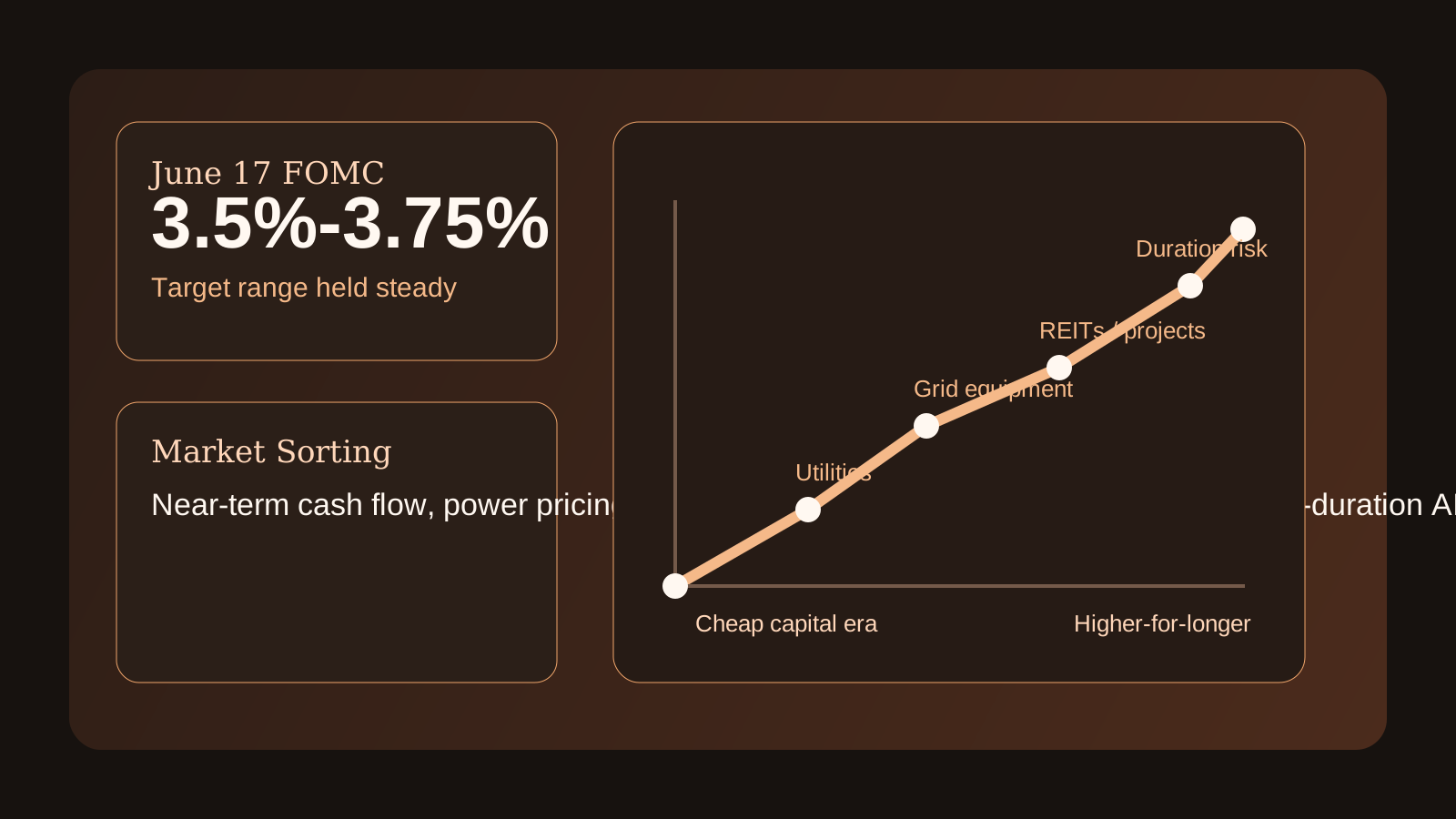
The June 17 FOMC decision clears the publish bar because it matters more for AI infrastructure than for software stories built on lighter balance sheets. The Federal Reserve kept the target range for the federal funds rate at 3-1/2 to 3-3/4 percent and maintained the broader higher-for-longer posture that has defined capital allocation this year. That means the AI trade still has to pass through financing math, not just demand narratives.
This belongs in the markets lane because the useful question is not whether rates moved. They did not. The useful question is which AI-linked business models can still clear the hurdle with financing conditions held where they are. In the current cycle, AI infrastructure is full of duration-sensitive assets: power campuses, leased capacity, cooling retrofits, utility upgrades, merchant compute, and factory-scale hardware commitments that need debt, equity, and time before they turn into steady cash generation.
The Fed did not move rates on June 17, but it still moved the AI market by keeping cost-of-capital pressure on the weakest buildout models.
The stronger angle is that the Fed’s hold acts as a sorting mechanism. Businesses with near-term contracted revenue, stronger counterparties, or infrastructure already placed in service can still look investable because the carrying cost of capital is visible and manageable. Businesses that still depend on long-dated demand assumptions, aggressive refinancing, or multi-step construction sequences become harder to underwrite when the policy range stays elevated and the margin for execution error stays thin.
That matters because the June article stack on this site already shows how capital intensive the buildout has become. AI campuses are being financed like infrastructure. Utility territories are rewriting tariff logic. Companies are signing giant reserved-capacity commitments and long-duration power arrangements before revenue is fully realized. In that environment, a rate hold is not neutral. It rewards balance-sheet resilience, contract quality, and projects that can move from announcement to cash generation without too many financing turns in the middle.
Operator and investor relevance both follow from that. Operators should assume that treasury discipline, counterparty quality, and energization timelines remain strategic variables, not back-office details. Investors should stop treating AI exposure as one macro bucket. The names most exposed to prolonged construction, power-delivery lag, or external funding needs can trade very differently from businesses monetizing the same AI wave through existing assets, higher utilization, or already-contracted demand.
There are obvious limits to the signal. One FOMC decision does not determine the full year, and the statement itself is economy-wide rather than AI-specific. But the point is not that the Fed singled out data centers. The point is that AI infrastructure is now large and capital intensive enough that ordinary monetary policy bites directly into who can build, refinance, and scale cleanly.
That is why this clears the search bar. A generic “Fed holds rates” rewrite would add nothing. The more useful search intent is narrower: which AI infrastructure models get stronger when capital remains selective, and which ones look more fragile when money is not meaningfully cheaper yet.
Sources
Federal Reserve, “Federal Reserve issues FOMC statement,” published June 17, 2026: https://www.federalreserve.gov/newsevents/pressreleases/monetary20260617a.htm
Federal Reserve, “June 17, 2026: FOMC Projections materials, accessible version,” published June 17, 2026: https://www.federalreserve.gov/monetarypolicy/fomcprojtabl20260617.htm
Federal Reserve, “Implementation Note issued June 17, 2026,” published June 17, 2026: https://www.federalreserve.gov/newsevents/pressreleases/monetary20260617a1.htm
By Nawaz Lalani
The Grid Report is written by Nawaz Lalani and focuses on source-backed coverage of AI infrastructure, grid power demand, automation systems, and market signals.
Follow the signal, not just the headline.
Get the daily Grid brief for source-backed coverage on AI power demand, infrastructure timing, automation, and market signals.