- Snowflake’s May 27 AWS announcement clears the publish bar because it exposes a useful market signal hiding underneath the usual strategic-partnership language.
- The company paired that commitment with several numbers that make the signal stronger.
- That is why the stronger angle is capacity insurance.
- Section
- Markets
- Read time
- 5 min read
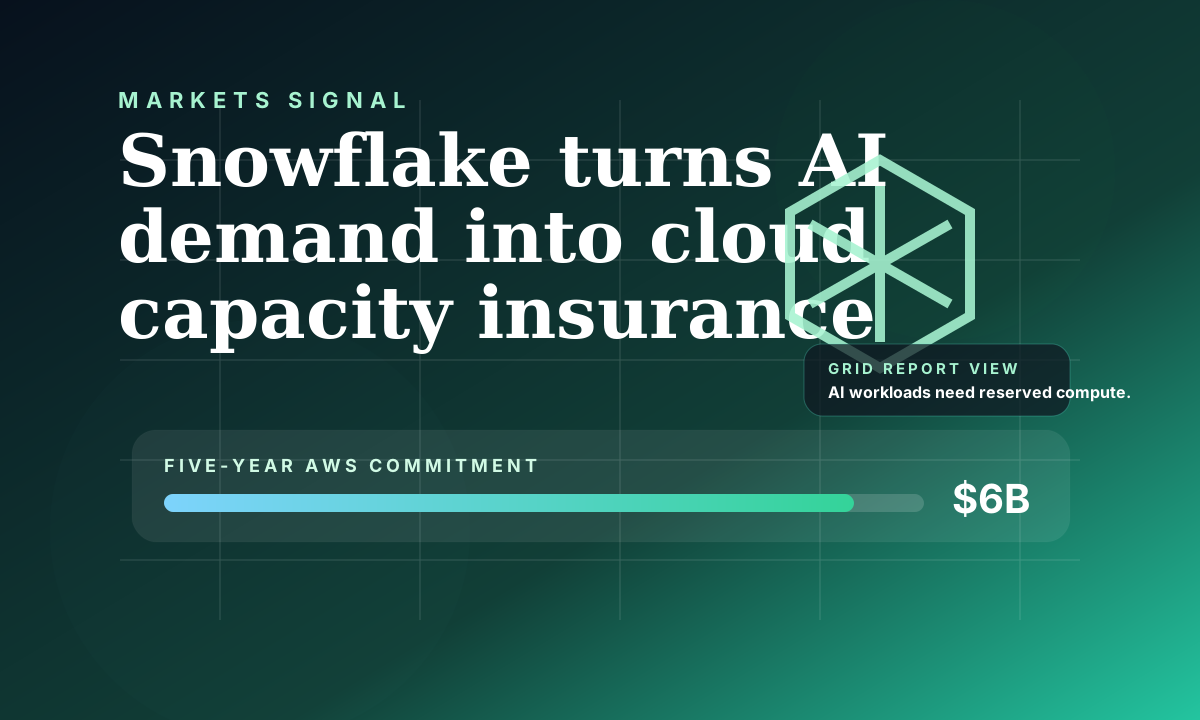
Snowflake’s May 27 AWS announcement clears the publish bar because it exposes a useful market signal hiding underneath the usual strategic-partnership language. Snowflake said it is committing $6 billion in Graviton compute and AI spend on AWS over five years, its largest infrastructure commitment to date. That makes this less a software-collaboration story than a demand signal: enterprise AI is increasingly showing up as reserved infrastructure procurement.
The company paired that commitment with several numbers that make the signal stronger. Snowflake said it has now surpassed $7 billion in lifetime AWS Marketplace sales and exceeded $2 billion in calendar-year 2025 sales through the marketplace, more than doubling transaction growth year over year. Those are not soft adoption anecdotes. They suggest that AI and data workloads are translating into real procurement volume, contracting velocity, and platform concentration.
A multi-year $6 billion cloud commitment is what enterprise AI demand looks like when it stops being a slide deck and starts becoming procurement.
That is why the stronger angle is capacity insurance. Once an enterprise platform company believes AI demand is durable enough, it stops talking only about product roadmaps and starts locking in long-term cloud capacity, economics, and go-to-market alignment. A $6 billion commitment says Snowflake wants guaranteed room to serve future workloads on terms it can plan against, not just opportunistic access to whatever capacity is left in the market.
There is a second-order market read here as well. Snowflake says the agreement expands joint investments in workload migrations, customer success, industry solutions, and deeper product integrations around generative and agentic AI. In practice, that means cloud procurement, model enablement, and enterprise distribution are getting bundled more tightly together. The companies are not only selling software on infrastructure. They are coordinating the commercial stack needed to push customers from experimentation into production.
The data-governance angle matters too. Snowflake frames the agreement around helping customers build AI applications and agents directly on governed enterprise data, without moving it outside their secure environment. That makes the infrastructure commitment more intelligible. If customers want to run AI close to their operational data under strong governance, then the platform vendor needs dependable capacity beneath that promise.
This is also one reason the story fits the markets lane better than the systems lane. The question here is not whether Snowflake has useful AI features. It is what a multi-billion-dollar compute reservation says about where enterprise AI demand is becoming tangible. Capital markets care when software demand starts requiring upstream infrastructure commitments, because that is when the narrative becomes visible in procurement and cloud economics.
There are still reasons to stay narrow. Snowflake is naturally presenting the collaboration in the best possible light, and a five-year spend commitment does not guarantee perfect monetization. But the announcement does show something concrete: a major enterprise platform believes the next wave of AI demand is big enough and durable enough to justify a long-duration capacity reservation.
That matters because many AI stories remain too abstract. Search traffic is full of generic “enterprise agents are growing” claims. Snowflake offers a harder indicator. If enterprise AI really is moving into production, one of the first places it should become visible is in multi-year infrastructure commitments, marketplace throughput, and cloud-alignment strategy. That is exactly what this announcement shows.
That is enough to publish. The useful takeaway is not that Snowflake and AWS still like each other. It is that enterprise AI demand is starting to show up where markets can actually measure it: in reserved spend, contracted distribution, and infrastructure dependence.
Sources
Snowflake, “Snowflake Expands AWS Collaboration with $6B Commitment to Accelerate Enterprise Agentic AI Adoption,” published May 27, 2026: https://www.snowflake.com/en/news/press-releases/snowflake-expands-aws-collaboration-with-6b-commitment-to-accelerate-enterprise-agentic-ai-adoption/
Snowflake investor relations quarterly-results page referencing the expanded AWS collaboration and $6 billion agreement: https://investors.snowflake.com/financials/quarterly-results/default.aspx
By Nawaz Lalani
The Grid Report is written by Nawaz Lalani and focuses on source-backed coverage of AI infrastructure, grid power demand, automation systems, and market signals.
Follow the signal, not just the headline.
Get the daily Grid brief for source-backed coverage on AI power demand, infrastructure timing, automation, and market signals.