- Brookfield and Bloom Energy’s June 30 announcement clears the publish bar because it is more than another AI-infrastructure headline number.
- The primary-source facts are straightforward.
- That last point is the real story.
- Section
- Markets
- Read time
- 5 min read
- Data included
- Why the Brookfield-Bloom expansion matters
Why the Brookfield-Bloom expansion matters
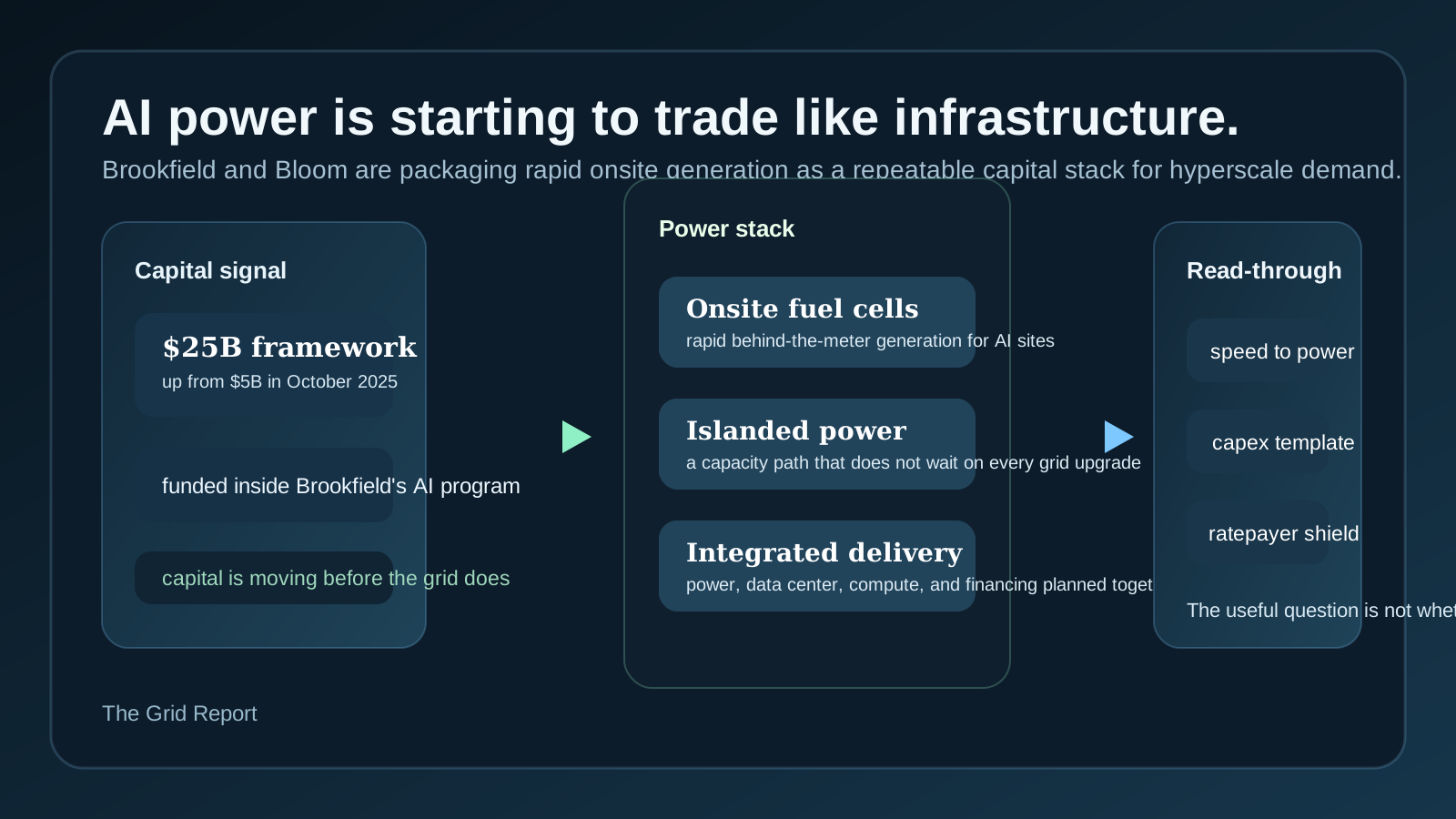
The important shift is not just a bigger dollar figure. It is the conversion of rapid onsite power into an infrastructure-finance template for AI demand.
| Layer | Primary-source detail | Why it matters |
|---|---|---|
| Framework size | Brookfield expanded the Bloom financing framework from $5 billion to $25 billion | The scale change implies the market expects sustained demand for dedicated AI power solutions. |
| Delivery model | The partnership finances Bloom onsite power projects for AI infrastructure globally | Power is being packaged as part of the campus build, not left entirely to the utility timeline. |
| Customer pull | Bloom said hyperscalers and AI infrastructure developers are demanding fast, reliable power | The bottleneck is commercial urgency around energization, not only long-run electricity availability. |
| Capital structure | Brookfield tied the expansion to its larger AI infrastructure program spanning power, compute, and AI factories | Investors are underwriting integrated AI infrastructure stacks instead of isolated components. |
| Strategic read-through | The companies described a model integrating power, compute, data-center infrastructure, and capital from the outset | Speed to power is becoming a financeable product with its own underwriting logic. |
Sources: Bloom Energy investor relations release published June 30, 2026, and Brookfield AI infrastructure program release published November 19, 2025.
Brookfield and Bloom Energy’s June 30 announcement clears the publish bar because it is more than another AI-infrastructure headline number. The companies said Brookfield is expanding its financing framework for Bloom power projects from $5 billion to $25 billion. The stronger Grid Report angle is that fast onsite power for AI campuses is starting to be packaged as a repeatable capital product rather than a one-off workaround.
The primary-source facts are straightforward. Bloom and Brookfield said the expanded framework is aimed at financing power projects for AI infrastructure globally, using Bloom’s onsite fuel-cell systems and Brookfield’s larger AI-infrastructure investment program. Bloom said the demand is coming from hyperscalers and AI infrastructure developers looking for fast, reliable power. Brookfield said the model is meant to integrate power, compute, data-center infrastructure, and capital from the outset.
The useful Brookfield-Bloom signal is not the headline dollar figure. It is that power certainty for AI campuses is starting to be financed as its own infrastructure product.
That last point is the real story. Most AI power coverage still treats electricity as a gating input that sits downstream of land, chips, and construction. This deal suggests a different structure is emerging. If developers can finance a dedicated power layer alongside the campus itself, then speed to power stops being only a utility-planning question and becomes part of project finance, customer contracting, and infrastructure underwriting.
This is why the article belongs in markets rather than a generic energy or data-center bucket. The useful change is not simply that Bloom may sell more fuel cells. It is that Brookfield is effectively betting there will be enough unmet demand for faster power delivery to justify a much larger financing pool. In other words, power certainty itself is becoming investable.
There is also a timing signal here. Brookfield launched its broader $100 billion AI infrastructure program in November 2025 with a mandate spanning power, AI factories, compute infrastructure, and adjacent assets. The Bloom expansion shows that the market is already pushing capital deeper into the power layer only seven months later. That is a strong clue that grid timing is not easing fast enough for large customers to rely on the traditional build cycle alone.
For operators, the attraction is obvious. Behind-the-meter or islanded generation can shorten the path from signed demand to energized capacity, especially where transmission upgrades, substation work, or interconnection studies would otherwise delay a campus. For investors, the attraction is different: the power bottleneck may now support long-duration contracted returns that look more like infrastructure than speculative AI software.
But the story is not that the grid no longer matters. Bloom’s systems still sit inside a broader fuel, permitting, siting, and community-acceptance stack, and onsite generation is not a universal substitute for transmission or cleaner bulk-system capacity. The practical point is narrower and more important: when the grid moves slowly enough, developers start paying to create a parallel delivery lane.
That makes this different from the recent run of AI power stories focused on tariffs, load flexibility, or utility politics alone. Brookfield and Bloom are trying to turn constrained grid access into a bankable deployment template. If that works, more capital will flow toward dedicated generation, flexible interconnection architectures, and bundled campus-power deals designed to monetize speed itself.
That is enough to publish. Searchers looking for the Brookfield-Bloom announcement do not need another recap of AI electricity demand. The more useful answer is that this partnership expansion marks a shift in market structure: AI power is increasingly being financed as its own capacity stack, because waiting for the normal grid timeline is becoming commercially unacceptable.
Sources
Bloom Energy investor relations, “Brookfield and Bloom Energy Expand AI Infrastructure Partnership to $25 Billion; Fivefold Increase to Build and Finance Rapid Power for AI Infrastructure,” published June 30, 2026: https://investor.bloomenergy.com/press-releases/press-release-details/2026/Brookfield-and-Bloom-Energy-Expand-AI-Infrastructure-Partnership-to-25-Billion-Fivefold-Increase-to-Build-and-Finance-Rapid-Power-for-AI-Infrastructure/default.aspx
Brookfield, “Brookfield Launches $100 Billion AI Infrastructure Program,” published November 19, 2025: https://bam.brookfield.com/press-releases/brookfield-launches-100-billion-ai-infrastructure-program
By Nawaz Lalani
The Grid Report is written by Nawaz Lalani and focuses on source-backed coverage of AI infrastructure, grid power demand, automation systems, and market signals.
Follow the signal, not just the headline.
Get the daily Grid brief for source-backed coverage on AI power demand, infrastructure timing, automation, and market signals.