- Intel’s July 23 second-quarter results clear the publish bar because the useful signal is not only that the company beat expectations.
- That is the original angle.
- The CFO commentary is what makes this especially publishable.
- Section
- Markets
- Read time
- 4 min read
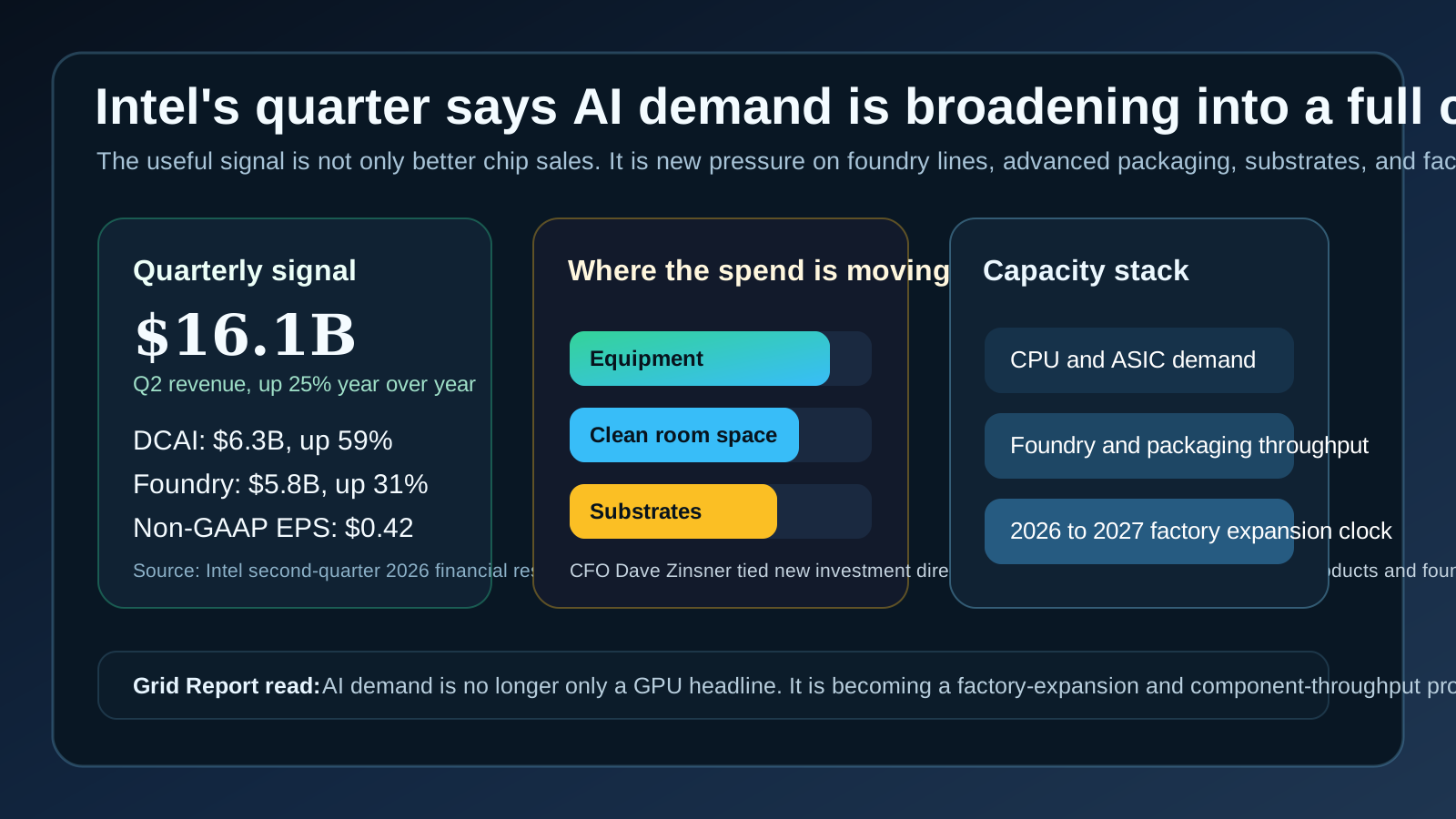
Intel’s July 23 second-quarter results clear the publish bar because the useful signal is not only that the company beat expectations. The stronger story is breadth. AI demand is no longer showing up only as a frontier-GPU trade. It is now pushing on the broader compute and manufacturing stack: server CPUs, custom silicon, foundry services, advanced packaging, factory equipment, clean room capacity, and the substrate supply needed to hold all of that together.
That is the original angle. Intel reported second-quarter revenue of $16.1 billion, up 25% year over year, with Data Center and AI revenue up 59% to $6.3 billion and Intel Foundry revenue up 31% to $5.8 billion. CEO Lip-Bu Tan said AI is driving demand across Intel’s CPU franchise, ASICs, advanced packaging, and wafer foundry network. Read correctly, that does not describe a company catching a one-quarter trading bounce. It describes AI demand spreading sideways into more of the industrial base behind compute.
AI demand is no longer only a GPU story. It is becoming a broader factory-expansion and component-throughput problem across the rest of the compute stack.
The CFO commentary is what makes this especially publishable. Dave Zinsner said AI-driven compute continues to strengthen and that Intel is meaningfully increasing investment in equipment, clean room space, and substrates to support expected growth this year and next across products and foundry. That language matters because it shifts the story from sales to physical throughput. Once management starts naming equipment bays, clean room buildout, and substrates, the scarce asset is no longer only demand. It is the capacity to process that demand without creating a new set of bottlenecks further down the stack.
This is where Intel’s quarter becomes more useful than a generic earnings rewrite. Searchers looking up the release do not need another summary of revenue and EPS. They need the harder read-through: AI demand is becoming broad enough to reward the companies that can coordinate front-end manufacturing, back-end packaging, and supporting materials at the same time. Intel is effectively telling the market that the opportunity is not confined to one chip category. It spans multiple layers of the compute system.
That also helps explain why the quarter belongs in the markets lane instead of pure chip-product coverage. Investors have spent most of this cycle treating AI as a narrow accelerator winner-take-most trade. Intel’s results point to a more diversified capacity thesis. If AI workloads continue to lift CPUs, custom silicon, foundry utilization, networking, and packaging together, then the next leg of the trade may depend less on who has the flashiest model demo and more on who can finance, equip, and expand real manufacturing throughput fast enough.
The duplicate screen holds. The site’s July 16 TSMC story argued that leading-edge AI supply had become a node-ramp and packaging-timing problem. Alphabet’s July 22 story was about public-markets financing pressure from AI capex. This thesis is materially different. Intel’s quarter is not mainly about one node handoff or one balance sheet. It is about AI compute demand widening into a broader factory-and-components expansion problem across the rest of the semiconductor stack.
There are limits. Intel is still describing its own momentum, execution risk remains real, and the company’s GAAP net loss was distorted by a large interest and other charge. But those caveats do not weaken the key signal. They sharpen it. If AI-driven compute is strong enough to pull more spending into equipment, clean room space, and substrates even while Intel is still rebuilding credibility, then the broader market should treat manufacturing breadth as part of the AI demand story, not just a footnote to it.
The operator and investor takeaway is straightforward. The next constraint in AI compute may not come from whether customers want more capacity. It may come from whether the second-tier layers of the stack can scale in time: foundry slots, advanced packaging flow, supporting materials, and the factory expansion projects that keep all of them moving. Intel’s July 23 quarter is one of the clearest signs yet that this broader capacity clock is already running.
Sources
Intel, “Intel Reports Second-Quarter 2026 Financial Results,” published July 23, 2026: https://www.intc.com/news-events/press-releases/detail/1776/intel-reports-second-quarter-2026-financial-results
Intel Investor Relations, “Q2 2026 Quarterly Results,” accessed July 24, 2026: https://www.intc.com/
By Nawaz Lalani
The Grid Report is written by Nawaz Lalani and focuses on source-backed coverage of AI infrastructure, grid power demand, automation systems, and market signals.
Follow the signal, not just the headline.
Get the daily Grid brief for source-backed coverage on AI power demand, infrastructure timing, automation, and market signals.