- Oracle’s Wisconsin challenge clears the publish bar because it says something more useful than “data centers are controversial.” The stronger signal is financial.
- That is the original angle.
- The practical consequence is what makes the story worth publishing now.
- Section
- Markets
- Read time
- 4 min read
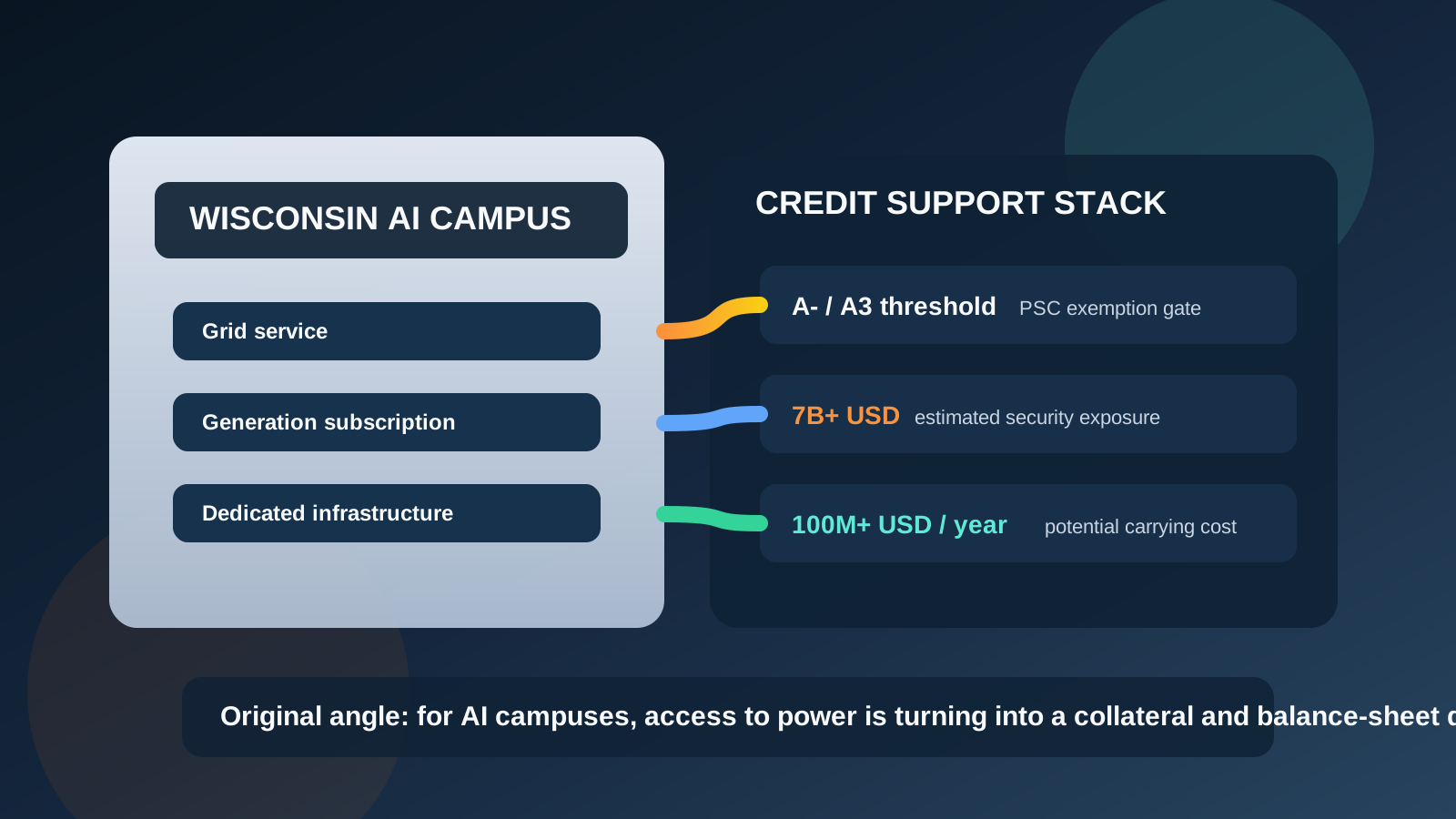
Oracle’s Wisconsin challenge clears the publish bar because it says something more useful than “data centers are controversial.” The stronger signal is financial. Large-load power service is becoming a collateralized product, which means the next AI-campus bottleneck is not only whether a project can get power, but whether its sponsor can afford the balance-sheet drag that regulators and utilities increasingly want in front of that power.
That is the original angle. In April, the Public Service Commission of Wisconsin overhauled We Energies’ proposed Very Large Customer tariff to tighten ratepayer protections. The commission said large data centers should pay their own way, required them to cover the full cost of subscribed generation, and added more reporting and transparency requirements. Oracle’s later affidavit in support of rehearing says the final tariff went further on financial support than the utility originally proposed by removing utility discretion to waive the requirement and by setting a higher exemption threshold tied to credit ratings and liquidity tests.
The next AI power bottleneck is not only who gets the megawatts. It is who can afford to collateralize them.
The practical consequence is what makes the story worth publishing now. Oracle says the Lighthouse Campus near Port Washington could be forced to post security sufficient to cover subscribed generation, dedicated distribution facilities, and other tariff charges, with exposure that could exceed $7 billion and annual carrying costs that could exceed $100 million. Read narrowly, that is one company complaining about one state commission. Read correctly, it is a preview of how AI infrastructure finance changes once power access is treated like a counterparty-risk problem.
This belongs in markets rather than generic regulation coverage because the useful question is who can carry the credit burden. If hyperscale and frontier-AI campuses must lock up letters of credit or equivalent support at this scale, then the economic contest shifts. It is no longer only about headline capex, land banks, and power-purchase optionality. It is also about who has the balance-sheet flexibility, rating profile, and financing structure to warehouse grid-access risk while projects ramp.
The wider context strengthens the thesis. Edison Electric Institute’s July 2026 large-load survey shows that specialized tariffs are no longer a Wisconsin outlier. Utilities and regulators across multiple states are now using long contract terms, minimum-load obligations, upfront infrastructure funding, and customer-specific protections to prevent AI and data-center buildout from shifting costs onto other ratepayers. Wisconsin is simply one of the clearest cases where that trend has been quantified in a way investors and operators can immediately understand.
This also clears the duplicate screen against the site’s last 30 days. The current inventory covered Microsoft’s Wisconsin campus as an operations-proof story, Oklahoma’s new law as a utility-contract model, North Carolina’s power tax as an incentive screen, and FERC large-load actions as a tariff rewrite story. This thesis is materially different. The sharper question here is what happens when power access itself starts consuming scarce corporate credit capacity.
The operator and investor relevance is straightforward. For developers, cloud vendors, utilities, and capital partners, the key diligence item is not only megawatts under discussion but the financial-security stack attached to those megawatts. A campus with nominally available power can still become uneconomic if the tariff demands too much locked collateral, too much parent support, or too much upfront commitment before revenue-producing compute is online.
There are still limits. Oracle’s filing is advocacy, not a neutral regulatory summary, and Wisconsin may not become the exact template every state follows. But that caveat does not weaken the read-through. It sharpens it: if AI buildout keeps pushing utilities toward stricter large-load protections, then the ability to finance power risk becomes part of the infrastructure moat.
That is enough to publish. Searchers looking up Oracle’s Wisconsin tariff fight do not need another local-dispute rewrite. The more useful answer is that AI power access is starting to look like a collateral and balance-sheet problem, and that changes which projects can actually scale.
Sources
Public Service Commission of Wisconsin, “PSC Overhauls We Energies’ Data Center Tariff, Makes Improvements to Protect Existing Customers,” published April 24, 2026: https://psc.wi.gov/Documents/PressReleases/04.24.2026PressRelease.PDF
Affidavit of Julia Robin in support of joint petition for rehearing or reopening, Docket No. 6630-TE-113, lines describing the final financial support requirements and Oracle’s estimated exposure, accessed via Wisconsin Public Radio document mirror: https://www.wpr.org/wp-content/uploads/2026/06/Oracle-Testimony.pdf
Edison Electric Institute, “Large Load Projects and Tariffs (July 2026),” published July 2026: https://www.eei.org/-/media/Project/EEI/Documents/Issues%20and%20Policy/List%20of%20Large%20Customer%20Projects%20and%20Tariffs
By Nawaz Lalani
The Grid Report is written by Nawaz Lalani and focuses on source-backed coverage of AI infrastructure, grid power demand, automation systems, and market signals.
Follow the signal, not just the headline.
Get the daily Grid brief for source-backed coverage on AI power demand, infrastructure timing, automation, and market signals.