- OG&E’s June 18 large-load tariff filing clears the publish bar because it turns a broad AI-power argument into an operating model.
- That is the stronger Grid Report angle.
- The official parameters are specific enough to matter.
- Section
- Policy
- Read time
- 5 min read
- Data included
- What OG&E’s proposed large-load model changes
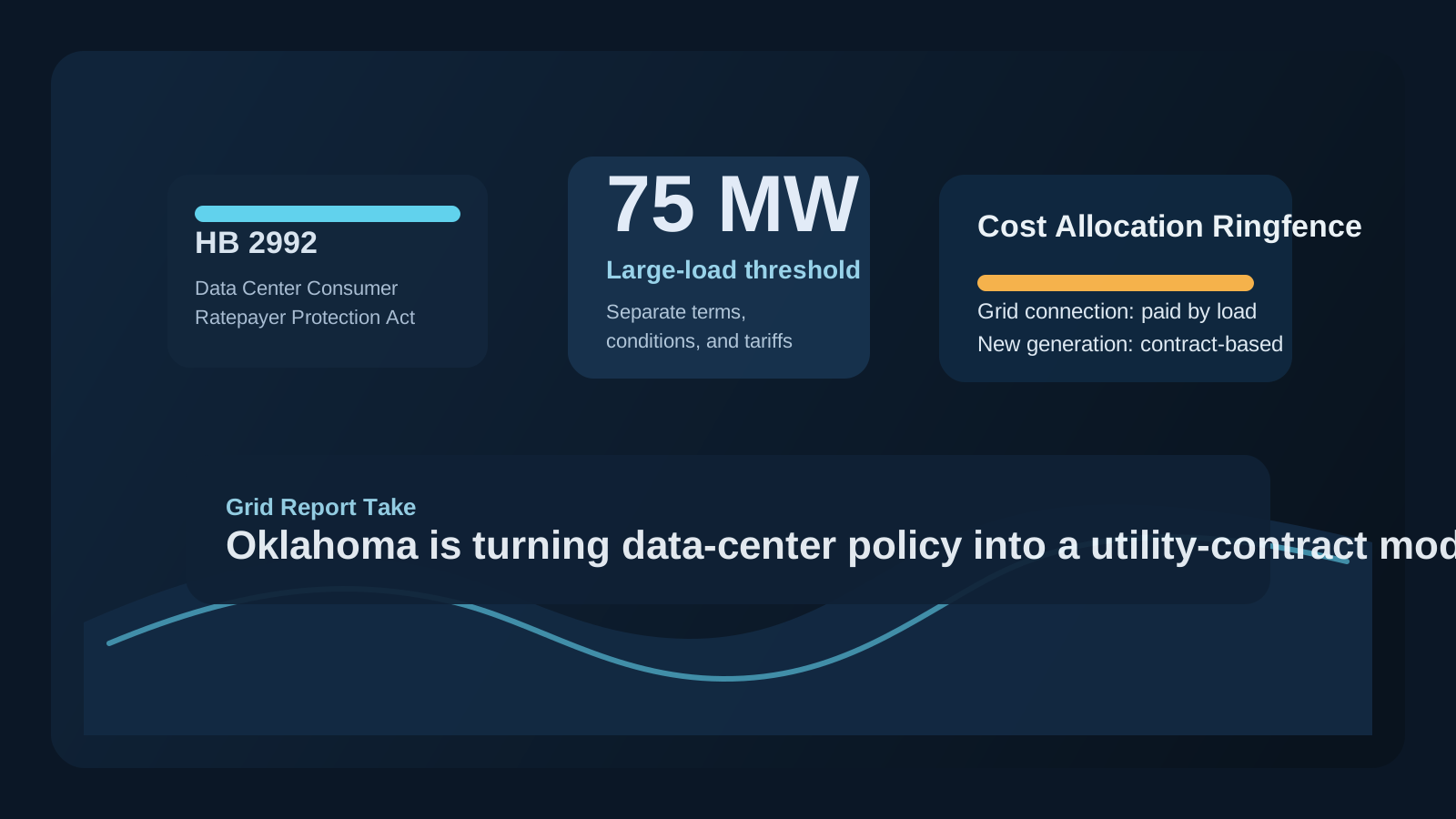
What OG&E’s proposed large-load model changes
The publishable part of the Oklahoma story is that the protections are becoming contract terms, not just talking points.
| Design element | Proposed structure | Why it matters |
|---|---|---|
| Large-load threshold | 75 MW for new large loads, major expansions, or changed load profiles | Creates a separate customer class before giant projects disappear into ordinary tariff treatment. |
| Direct connection costs | 100% paid upfront by the large-load customer | Reduces the risk that transmission and distribution hookup costs get pushed onto existing customers. |
| Contract duration | 15-year proposed term with up to five-year ramp-up | Forces longer commitments and makes speculative or slow-ramping projects carry more of their own risk. |
| Residential protection charge | $25 million to $30 million per year expected collection | Creates a dedicated mechanism that could offset adverse customer impacts if regulators approve credits later. |
| Google precedent | Connection costs, contracted costs, and share of generation paid by Google | Shows the broader tariff is being tested against a real hyperscale customer, not only written in theory. |
Sources: OG&E June 18, 2026 tariff release, OG&E data-center page, OG&E April 30, 2026 Google agreement release, and Oklahoma legislative materials for HB 2992.
OG&E’s June 18 large-load tariff filing clears the publish bar because it turns a broad AI-power argument into an operating model. Oklahoma already passed House Bill 2992, the Data Center Customer Ratepayer Protection Act of 2026, and OG&E had already announced a landmark agreement to serve three Google data centers. The new tariff filing matters because it starts converting those principles into concrete terms: which customers count as large loads, what they have to pay upfront, how long they have to commit, and how household customers might be protected if the economics go wrong.
That is the stronger Grid Report angle. The useful story is not simply that Oklahoma wants data centers without higher residential bills. Many states say some version of that. What looks different here is the move toward a utility-contract model in which large-load growth is governed through explicit thresholds, billing minimums, collateral, capacity commitments, early-termination penalties, and a separate customer-protection charge instead of being left to vague promises about economic development.
Oklahoma is not only debating who pays for AI power. It is trying to turn that argument into a repeatable contract structure before large-load costs leak into household bills.
The official parameters are specific enough to matter. OG&E says the proposed tariff would apply to new customers expecting at least 75 megawatts of demand, to existing customers adding 75 megawatts of incremental demand, or to customers whose load profile changes enough to cross the threshold. The utility says those customers would pay upfront for 100% of connection-related transmission and distribution costs, face a proposed 15-year term, and operate with a maximum five-year ramp-up period. Those are not cosmetic details. They define how much project risk the utility is trying to keep off the broader rate base.
The customer-protection mechanism is just as important as the interconnection rule. OG&E says large-load customers would also pay a monthly charge intended to benefit residential customers, with expected collections of roughly $25 million to $30 million per year. The Oklahoma Corporation Commission would still have to review how any credits are handled in rate cases, but the design principle is clear: if data-center growth creates adverse impacts, the tariff is supposed to create a funding rail that can push some value back toward ordinary customers rather than leaving them exposed by default.
This is where the Google agreement becomes more than a local business-development announcement. In its April 30 release, OG&E said Google would pay 100% of the costs to connect the new sites to the grid, pay all contracted costs regardless of actual energy use, and pay its share of power generation required to serve the data centers. OG&E also said the agreement forms the basis for the broader tariff it would file later. Read together, that means Oklahoma is not only writing a law about data-center cost discipline. It is testing a repeatable contract structure with a named hyperscale customer.
Why does that matter beyond one state? Because large-load politics are moving from theory into utility administration. The older version of the debate asked who should pay for substations, transmission, or generation tied to AI campuses. Oklahoma’s version asks a more operational question: what contract package makes a large-load project credible enough to serve without leaving households to absorb the downside if the load arrives late, ramps too slowly, or disappears? That is a more useful search question for operators, regulators, utilities, and infrastructure investors.
The model is not risk free. OG&E’s tariff still needs Oklahoma Corporation Commission approval, public review is expected to take months, and Google’s earlier agreements do not include every feature of the newer tariff proposal. KOSU also reported that the proposed monthly customer-protection fee would not apply to Google’s existing contract as written. So this is not a finished statewide template yet. It is a live test of whether a utility can lock in enough contractual discipline before a wave of hyperscale load becomes embedded in the broader system.
That caveat is exactly why the story is worth publishing now. Across the country, the AI power fight often gets framed as a binary choice between welcoming data centers and protecting ratepayers. Oklahoma is trying something more concrete: define a large-load class at 75 megawatts, force long-duration commitments, isolate direct connection costs, and build an explicit consumer-protection mechanism into the tariff stack. If that holds up in commission review, it could become a model other utilities study when the next batch of AI campuses shows up.
Sources
OG&E, “OG&E Proposed Large-Load Tariff Protects Oklahoma households,” published June 18, 2026: https://www.oge.com/web/portal/-/205-press-release
OG&E, “OG&E & Data Centers,” accessed June 24, 2026: https://www.oge.com/web/portal/og-e-data-centers
OG&E, “Contract secures customer protections as new data centers announced in OG&E service area,” published April 30, 2026: https://www.oge.com/web/portal/-/200-press-release
Oklahoma Legislature, “Bill Information for HB 2992,” accessed June 24, 2026: https://www.oklegislature.gov/BillInfo.aspx?Bill=hb2992&Session=2600
KOSU / StateImpact Oklahoma, “OG&E proposes new data center agreement intended to prevent residential utility cost spikes,” published June 19, 2026: https://www.kosu.org/business/2026-06-19/og-e-proposes-new-data-center-agreement-intended-to-prevent-residential-utility-cost-spikes
By Nawaz Lalani
The Grid Report is written by Nawaz Lalani and focuses on source-backed coverage of AI infrastructure, grid power demand, automation systems, and market signals.
Follow the signal, not just the headline.
Get the daily Grid brief for source-backed coverage on AI power demand, infrastructure timing, automation, and market signals.