- TeraWulf’s Anthropic lease clears the publish bar because the useful signal is not merely that another AI campus found a tenant.
- That is the original angle.
- A few days later, Bloomberg reported that TeraWulf was preparing roughly $3.5 billion of debt for the Kentucky campus, including its first move into the leveraged-loan market.
- Section
- Markets
- Read time
- 4 min read
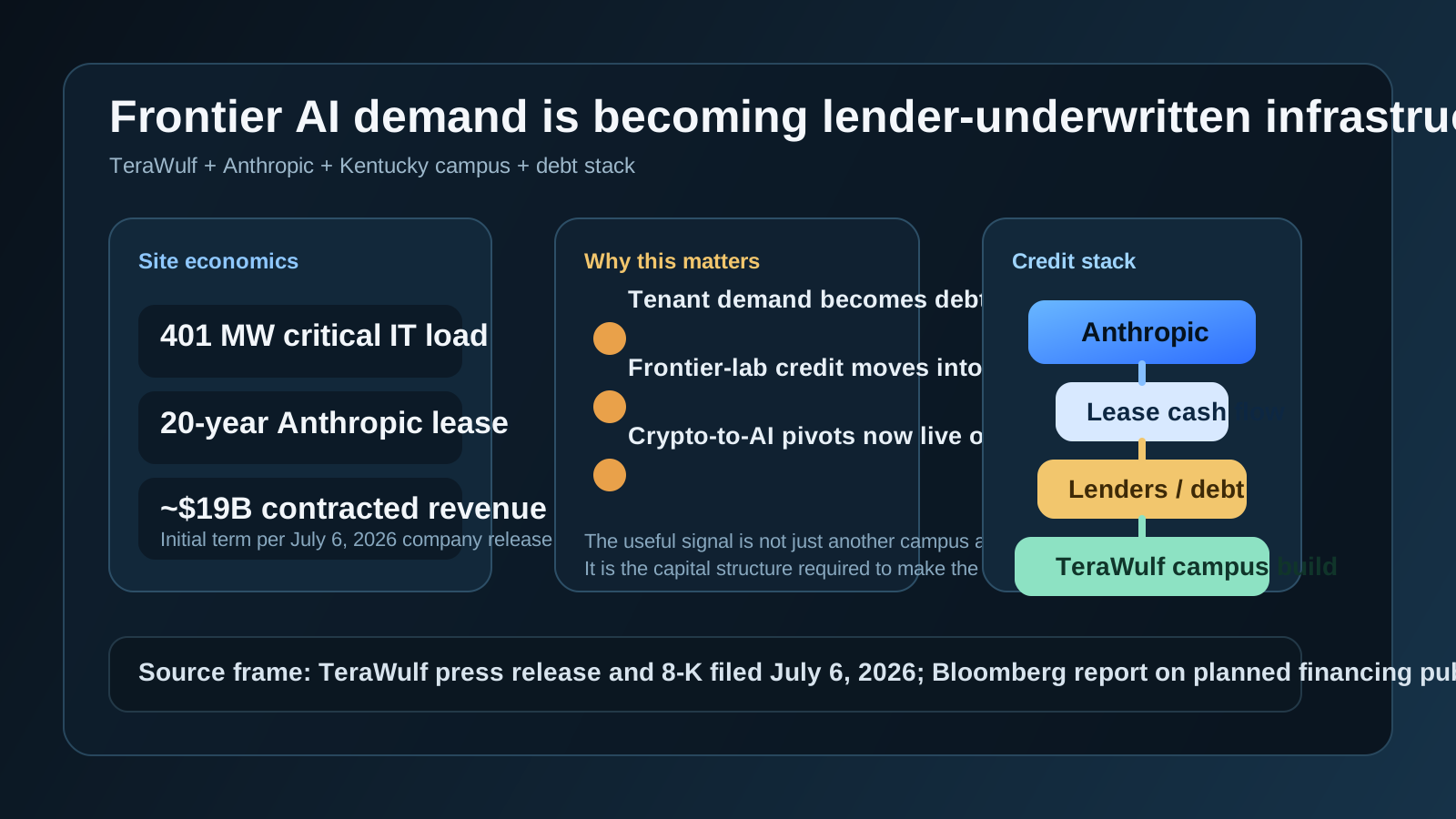
TeraWulf’s Anthropic lease clears the publish bar because the useful signal is not merely that another AI campus found a tenant. The stronger signal is financial. Frontier-model demand is now being translated into a project-finance style credit stack, where lenders, developers, and AI tenants all have to carry more of the same buildout risk together.
That is the original angle. On July 6, TeraWulf said Anthropic signed a 20-year lease at the company’s Justified Data Campus in Hawesville, Kentucky. The release said the site will support about 401 megawatts of critical IT load, ramp in phases from the second half of 2027 through early 2028, and generate about $19 billion of contracted lease revenue over the initial term. On its own, that is already a meaningful infrastructure lease. What makes it more useful now is how quickly the deal moved into financing territory.
The useful shift is not just that Anthropic leased more power. It is that frontier-AI demand is now being packaged into a credit stack that lenders have to believe in.
A few days later, Bloomberg reported that TeraWulf was preparing roughly $3.5 billion of debt for the Kentucky campus, including its first move into the leveraged-loan market. That matters because it turns the story from tenant demand into capital-markets underwriting. Once a frontier lab’s long-term compute demand is used to support a multibillion-dollar debt stack, AI infrastructure is no longer only a technology or construction story. It becomes a credit-risk allocation story.
This belongs in markets rather than generic infrastructure coverage because the key question is who is underwriting whom. In earlier campus stories, the strongest counterparties were usually hyperscalers or giant cloud buyers with obvious balance-sheet depth. Here, the demand signal sits with Anthropic, while TeraWulf is simultaneously repositioning itself from a crypto-era power-and-mining operator into a long-duration AI infrastructure landlord. That changes the market read-through. Investors are being asked to underwrite not only land, power, and delivery, but also the durability of frontier-lab demand and the tenant-credit quality behind it.
TeraWulf’s same-day Abernathy transaction sharpens that conclusion. The company said it would sell its 50.1% interest in the Abernathy joint venture to an investor group led by Fluidstack, monetizing roughly $450 million of investment at a premium and freeing capital for wholly owned AI infrastructure. Read correctly, the company is trying to rotate out of partial ownership and into assets where tenant contracts and direct control can support larger financing structures. That is more than portfolio cleanup. It is a move toward a more financeable AI-campus model.
This also clears the duplicate screen against the site’s last 30 days. Applied Digital’s Delta Forge 2 piece was about standardized campus franchises backed by take-or-pay hyperscaler demand. NVIDIA’s capital-partner story was about usage-linked financing for AI clouds. Oracle’s Wisconsin story was about collateral demands on the power side. This thesis is materially different. The sharper question here is what happens when frontier-model demand itself becomes the thing lenders are implicitly being asked to trust.
The operator and investor relevance is straightforward. If deals like this keep clearing, more AI infrastructure financing will move beyond hyperscaler-backed campuses and deeper into structures supported by neoclouds, model labs, and long-dated lease cash flows. That can widen the capital pool for new campuses. It can also make tenant concentration, contract quality, and credit support more important than simple megawatt bragging rights.
There are still clear limits. TeraWulf is telling its own story in the most favorable way, full financing terms are not yet public, and Anthropic is not the same kind of counterparty as a mature utility or legacy industrial tenant. But that caveat is exactly why the story is worth publishing. It shows where AI infrastructure risk is moving next: into the credit layer, where enthusiasm about compute demand has to survive actual underwriting.
That is enough to publish. Searchers looking up TeraWulf and Anthropic do not need another headline rewrite about a big lease in Kentucky. The more useful answer is that frontier AI demand is starting to function like collateral for AI infrastructure finance, and that changes how this buildout should be valued.
Sources
TeraWulf, “TeraWulf Announces Anthropic Lease at Justified Data Campus and Sale of Majority Interest in Abernathy Joint Venture to Fluidstack,” published July 6, 2026: https://investors.terawulf.com/news-events/press-releases/detail/142/terawulf-announces-anthropic-lease-at-justified-data-campus-and-sale-of-majority-interest-in-abernathy-joint-venture-to-fluidstack
TeraWulf 8-K, filed July 6, 2026, describing the lease and transaction: https://www.sec.gov/Archives/edgar/data/1083301/000110465926080583/tm2619468d1_8k.htm
Bloomberg Law, “TeraWulf Eyes $3.5 Billion for Anthropic-Leased Data Center,” published July 9, 2026: https://news.bloomberglaw.com/artificial-intelligence/terawulf-eyes-3-5-billion-for-anthropic-leased-data-center
By Nawaz Lalani
The Grid Report is written by Nawaz Lalani and focuses on source-backed coverage of AI infrastructure, grid power demand, automation systems, and market signals.
Follow the signal, not just the headline.
Get the daily Grid brief for source-backed coverage on AI power demand, infrastructure timing, automation, and market signals.