- DOE’s AI-on-DOE-lands request for information clears the publish bar because it turns a vague federal ambition into a siting proposal with real operator implications.
- This belongs in the energy-grid lane because the central asset is not acreage alone.
- The target timeline sharpens the story.
- Section
- Energy
- Read time
- 4 min read
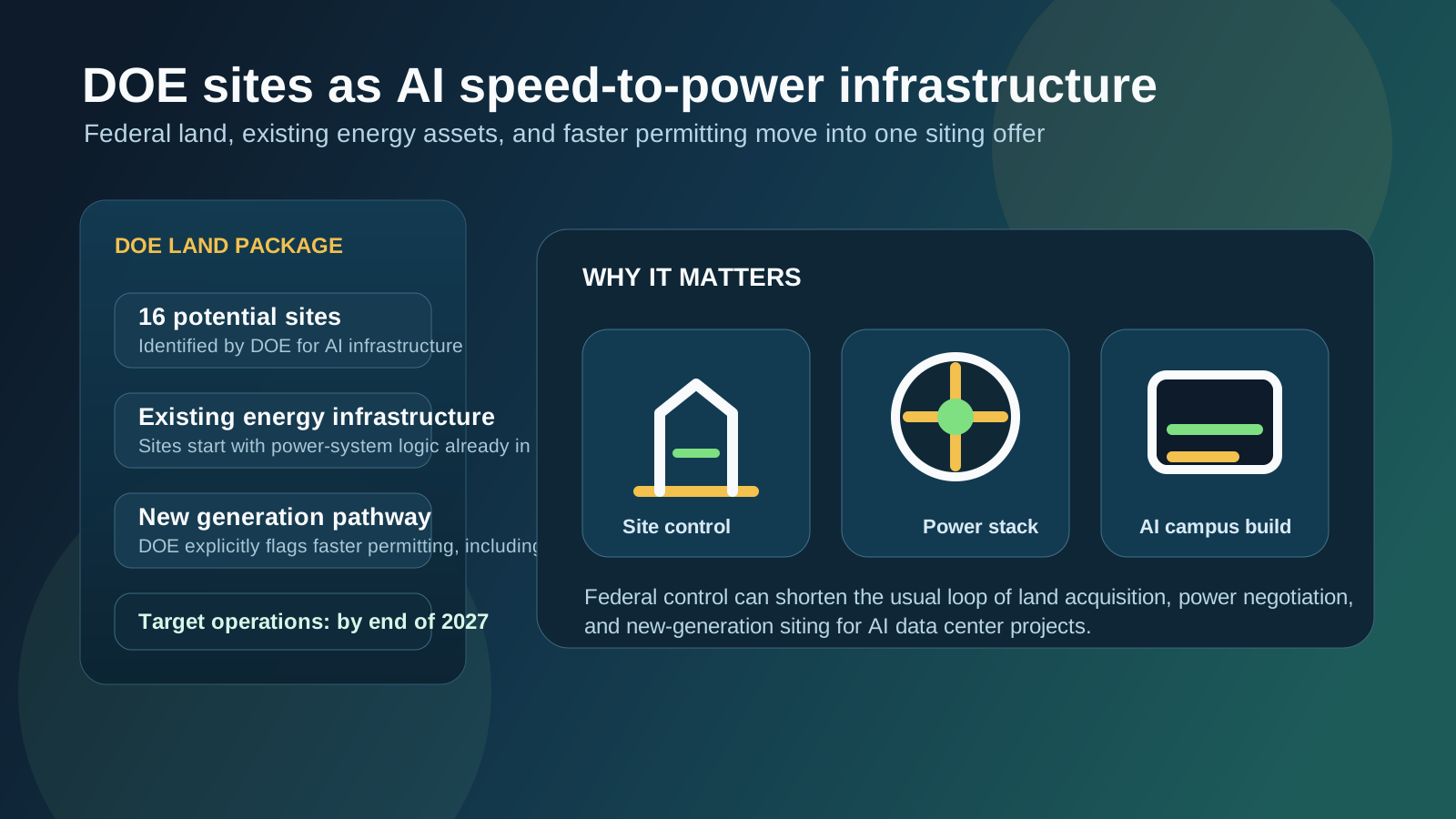
DOE’s AI-on-DOE-lands request for information clears the publish bar because it turns a vague federal ambition into a siting proposal with real operator implications. On its June 2026 Office of Policy page, the Department of Energy says it is exploring the use of DOE land for AI infrastructure development and has identified 16 potential sites with existing energy infrastructure and the ability to fast-track permitting for new generation such as nuclear. That is the important shift. Federal land is being presented not as passive real estate, but as a way to compress time-to-power.
This belongs in the energy-grid lane because the central asset is not acreage alone. It is co-location with energy systems. DOE says the effort is meant to help lower energy costs by co-locating data centers and new energy infrastructure on DOE lands. That makes the better read-through straightforward: Washington is testing whether AI load can move faster when the site-selection problem and the power-development problem are solved together on land the federal government already controls.
DOE is trying to package land control, existing energy infrastructure, and faster permitting into a single speed-to-power offer for AI builders.
The target timeline sharpens the story. DOE says the information it collects will be used to enable AI infrastructure construction at select sites with a target of commencing operations by the end of 2027. That is aggressive enough to matter. Normal data-center development often gets trapped in a sequence of land assembly, interconnection uncertainty, permitting friction, and power-stack redesign. DOE is explicitly marketing a different route: start with sites that already carry infrastructure logic and public-sector permitting leverage.
There is also a more technical angle that makes the story stronger than a typical land announcement. DOE says developers could partner with world-class research facilities already co-located on these sites, both to improve the power-system designs needed to run the centers and to develop next-generation data-center hardware. In other words, the department is not only offering land and electrons. It is offering an R&D adjacency that could matter for advanced cooling, resilient power architecture, and high-density campus design.
That is what gives this real operator relevance. For hyperscalers, neoclouds, and power developers, the proposal suggests a new class of site where permitting speed, generation strategy, and infrastructure experimentation can be packaged together. For nuclear developers, the phrase “fast-track permitting for new energy generation such as nuclear” is the most consequential line in the document because it hints that AI demand may become a practical demand sink for new firm power on federally controlled ground.
The stronger conclusion is not that DOE has solved AI power. It has not. The sites are still prospective, the RFI is still a market-sounding exercise, and many projects will still run into financing, equipment, transmission, and environmental constraints. But the federal government is now making an explicit speed-to-power offer to the AI infrastructure market, and that is new enough to matter.
This also fits the broader shape of the June 2026 buildout. Utilities are rewriting large-load rules. States are experimenting with new cost and tax treatment. Developers are pairing campuses with dedicated generation. DOE adds another layer: the federal government is now trying to make site control and energy control part of the same AI-infrastructure product.
That is why this clears the search bar. A generic “DOE wants AI data centers” rewrite would not be useful. The useful query is narrower and more durable: which federal sites might offer a faster path to energization, what role new generation could play on those sites, and whether public-sector land control can become a real competitive advantage in the AI power race.
Sources
U.S. Department of Energy Office of Policy, “AI Infrastructure on DOE Lands Request for Information,” accessed June 23, 2026: https://www.energy.gov/policy/ai-infrastructure-doe-lands-request-information
Federal Register, “Request for Information on Artificial Intelligence Infrastructure on DOE Lands,” linked from DOE and accessed June 23, 2026: https://www.federalregister.gov/documents/2025/04/07/2025-05936/request-for-information-on-artificial-intelligence-infrastructure-on-doe-lands
By Nawaz Lalani
The Grid Report is written by Nawaz Lalani and focuses on source-backed coverage of AI infrastructure, grid power demand, automation systems, and market signals.
Follow the signal, not just the headline.
Get the daily Grid brief for source-backed coverage on AI power demand, infrastructure timing, automation, and market signals.