- NVIDIA’s June 7 partnership with SK hynix clears the publish bar because it surfaces a part of the AI infrastructure stack that still gets undercovered.
- The strongest angle is that advanced memory is no longer a background component in the AI buildout.
- That matters for operators because memory bottlenecks do not show up only as a procurement annoyance.
- Section
- Infrastructure
- Read time
- 4 min read
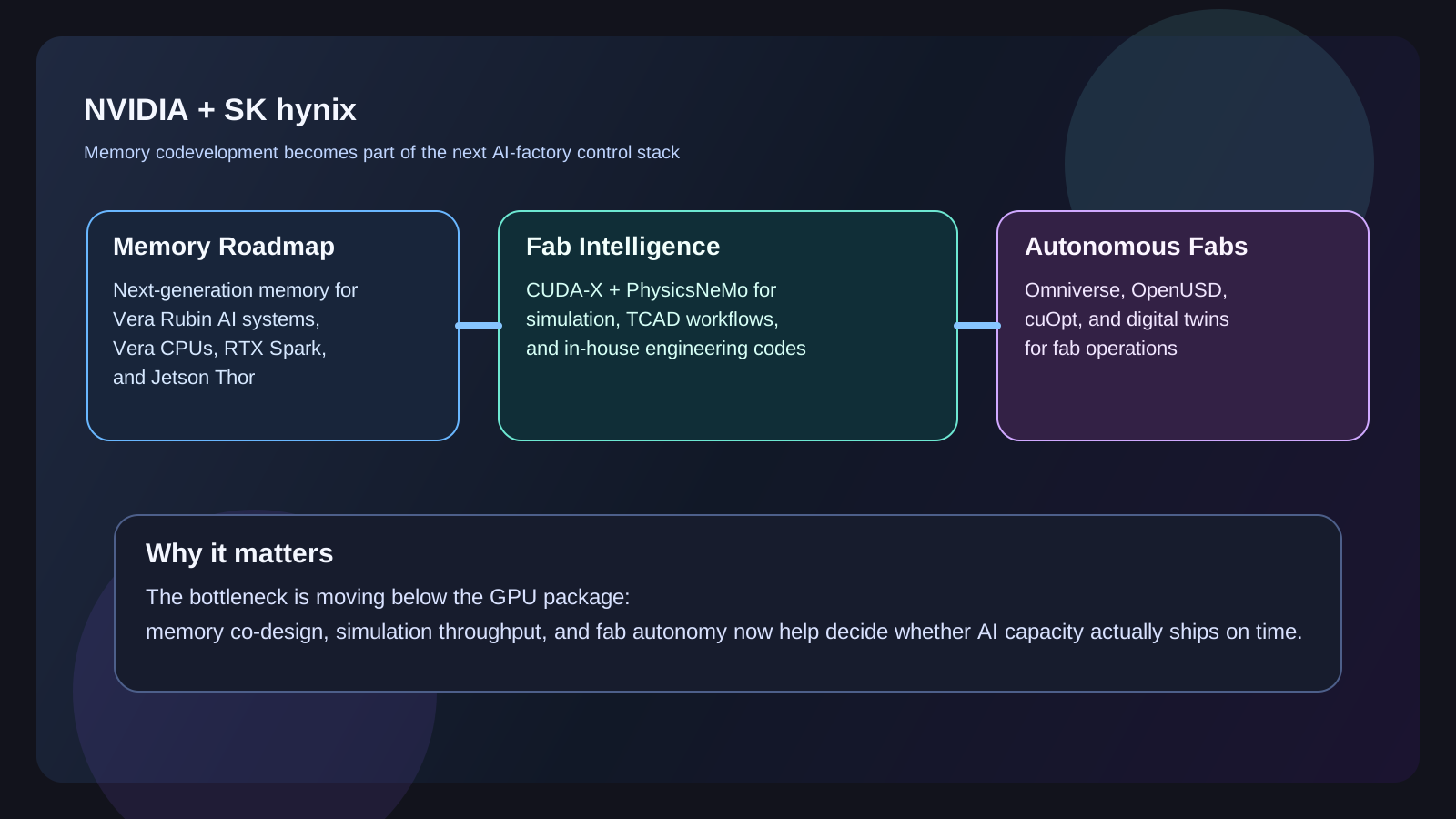
NVIDIA’s June 7 partnership with SK hynix clears the publish bar because it surfaces a part of the AI infrastructure stack that still gets undercovered. The companies said they are entering a multiyear technology partnership to codevelop next-generation memory aligned to NVIDIA’s AI infrastructure roadmap, expand memory supply for the global AI factory buildout, and apply AI to semiconductor design and manufacturing. That is more useful than another generic chip-alliance headline because it points directly at where scale pressure is moving next.
The strongest angle is that advanced memory is no longer a background component in the AI buildout. It is becoming a strategic control point. NVIDIA framed advanced memory as essential to AI factory performance, while both companies tied the partnership to extended development cycles, advanced fabrication requirements, and the capital intensity needed to keep supply moving. Read plainly, the message is that compute demand is growing fast enough that memory roadmaps and manufacturing cadence now deserve to be treated like first-order infrastructure constraints.
The next AI constraint is increasingly the synchronized hardware stack around the GPU, not the GPU alone.
That matters for operators because memory bottlenecks do not show up only as a procurement annoyance. They shape platform timing, system design, and which product generations reach usable scale on schedule. NVIDIA said the partnership will cover memory for Vera Rubin AI supercomputers, Vera CPUs, RTX Spark-powered PCs, and Jetson Thor robotic systems. That range matters. It suggests the memory problem is expanding from one training-cluster issue into a broader platform issue stretching across data center, edge, and physical AI deployments.
The more original detail is that the agreement is also a manufacturing-systems story. The companies said SK hynix will use NVIDIA CUDA-X libraries and PhysicsNeMo to accelerate semiconductor simulation and in-house engineering codes, while also combining Omniverse, OpenUSD, and cuOpt to build fab digital twins for autonomous operations. That means the partnership is not only about getting more memory out of the supply base. It is also about using AI infrastructure to speed the design and factory layer that produces the next wave of AI hardware.
Investors should care because this is what industrialization looks like. Once AI demand pushes suppliers into codevelopment agreements, tighter roadmap alignment, and automation inside the manufacturing stack, the economics stop looking like a short-cycle server upgrade story. They start looking like a longer-duration capital and supply-chain race. That is usually when the conversation shifts from who has the best accelerator to who can keep the surrounding hardware ecosystem synchronized well enough to ship at scale.
There are limits. This is still a company-led announcement, and neither side disclosed volumes, pricing, or exact supply commitments. A partnership does not erase execution risk, and memory remains only one of several chokepoints alongside packaging, optics, power, cooling, and factory construction. But those caveats do not weaken the signal. They clarify where the next competitive battle is moving.
The better conclusion is that AI infrastructure is becoming more industrial in character. The scarce asset is no longer just a faster chip. It is a coordinated stack where memory roadmaps, manufacturing automation, and platform timing all have to move together.
Sources
NVIDIA, “NVIDIA and SK hynix Announce Multiyear Technology Partnership to Advance Memory for AI Factories,” published June 7, 2026: https://nvidianews.nvidia.com/news/sk-hynix-ai-factory
SK hynix, “SK hynix and NVIDIA Announce Multi-year Technology Partnership to Advance Memory for AI Factories,” published June 7, 2026: https://news.skhynix.com/multi-year-tech-partnership-with-nvidia/
By Nawaz Lalani
The Grid Report is written by Nawaz Lalani and focuses on source-backed coverage of AI infrastructure, grid power demand, automation systems, and market signals.
Follow the signal, not just the headline.
Get the daily Grid brief for source-backed coverage on AI power demand, infrastructure timing, automation, and market signals.