- Micron’s June 24 quarter clears the publish bar because it gives a sharper signal than “AI demand is strong.” The company reported record fiscal Q3 revenue of $41.46 billion, record profitability, and a stronger Q4 outlook, then paired that with language about “transformational Strategic Customer Agreements.” That combination matters because it suggests memory is starting to be financed and planned more like infrastructure capacity and less like a purely cyclical component category.
- The stronger Grid Report angle is the contract layer.
- Micron’s own market framing reinforces that read.
- Section
- Markets
- Read time
- 6 min read
- Data included
- Why Micron’s quarter reads as a market-structure story, not just an earnings beat
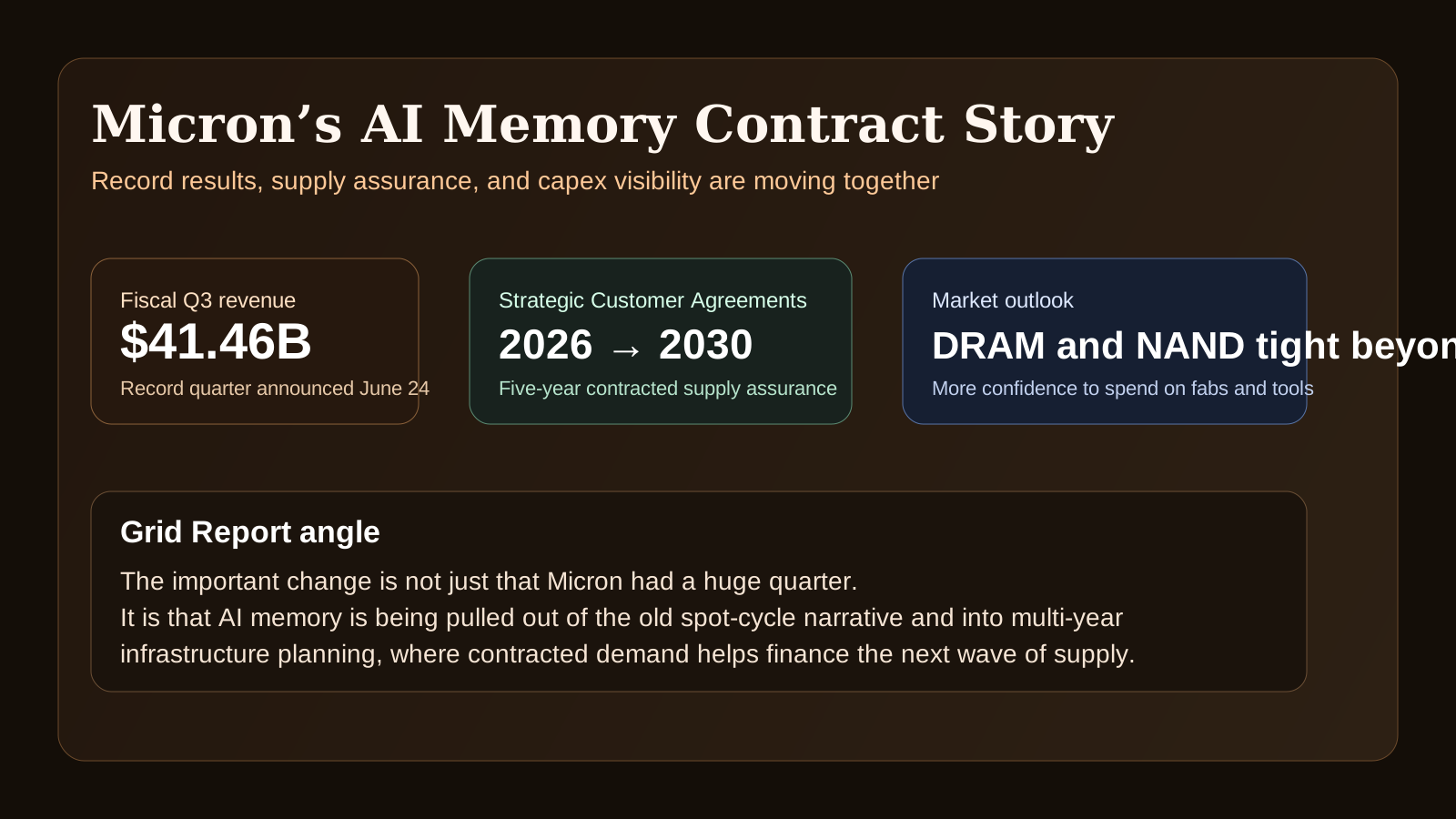
Why Micron’s quarter reads as a market-structure story, not just an earnings beat
The important shift is that AI memory demand is increasingly being translated into longer-term supply visibility.
| Signal | What Micron said | Why it matters |
|---|---|---|
| Results | Fiscal Q3 revenue reached $41.46 billion with record profitability | The quarter confirms that AI memory demand is already large enough to reshape financial outcomes. |
| Contracts | Strategic Customer Agreements typically run from calendar 2026 through 2030 | Supply assurance over several years pulls memory closer to infrastructure-style planning. |
| Demand view | Industry data-center DRAM and NAND bit shipments in 2026 are expected to be more than double from two years earlier | AI memory demand is scaling fast enough to alter the way supply is reserved and financed. |
| Constraint | Micron expects DRAM and NAND supply-demand conditions to stay tight beyond 2027 | Tightness makes long-term contracts and allocation discipline more valuable. |
| Capex effect | Micron said the agreements provide greater confidence on capex and R&D investments | Contract visibility can help finance the next wave of fabs, tools, and node transitions. |
Sources: Micron’s June 24, 2026 earnings release and prepared remarks.
Micron’s June 24 quarter clears the publish bar because it gives a sharper signal than “AI demand is strong.” The company reported record fiscal Q3 revenue of $41.46 billion, record profitability, and a stronger Q4 outlook, then paired that with language about “transformational Strategic Customer Agreements.” That combination matters because it suggests memory is starting to be financed and planned more like infrastructure capacity and less like a purely cyclical component category.
The stronger Grid Report angle is the contract layer. In prepared remarks, Micron said its Strategic Customer Agreements typically run for five years, from calendar 2026 through the end of calendar 2030, and provide customers with contracted supply assurance. That is the useful signal. When memory becomes a capacity-assurance product, it starts to sit closer to the same planning logic as power, colocation, or long-term cloud commitments.
Micron’s June 24 quarter matters because AI memory is starting to look less like a spot cycle and more like contracted infrastructure.
Micron’s own market framing reinforces that read. The company said AI is driving unprecedented data-center growth, with industry data-center DRAM and NAND bit shipments in calendar 2026 expected to be more than double where they were two years earlier. It also said supply-demand conditions for both DRAM and NAND are now expected to remain tight beyond calendar 2027. Read plainly, the company is telling the market that memory is not just enjoying a hot quarter. It is moving deeper into a constrained, multi-year build cycle.
That matters for investors because contract visibility changes the way memory earnings should be interpreted. The old framework treated memory as a notoriously violent spot-market business driven by abrupt swings in supply and pricing. Micron is arguing for a different model in AI-linked categories: strategic agreements, tighter allocation, and more durable demand visibility that can support larger capex and R&D decisions with less guesswork.
It matters for operators too. If server growth is being constrained by memory allocation, then memory availability becomes a first-order input into AI deployment timing. Micron said customers are focusing on maximizing server unit shipments amid very tight memory allocation. That means the infrastructure conversation is no longer only about whether accelerators exist. It is also about whether enough high-performance memory can be secured to make the rest of the rack useful on schedule.
This is why the article passes the duplicate screen despite our recent memory-related coverage. NVIDIA’s SK hynix story was about codevelopment, fab automation, and the strategic role of memory inside the hardware supply chain. Micron is different. The June 24 signal is capital-markets-facing and contractual. It says the memory business itself may be structurally changing as AI customers lock in supply over a longer horizon.
Micron also connected those agreements to future spending. In prepared remarks, the company said the SCAs provide enhanced visibility on long-term demand and greater confidence on capex and R&D investments. That is the important transmission mechanism. Contracted demand can help justify the fabs, tools, and node transitions needed to keep future supply from tightening even further.
There are limits. This is still company-guided disclosure, and Micron did not publish the detailed commercial terms of the agreements. Memory will also remain cyclical to some degree because supply, node migrations, and customer inventory behavior still matter. But the June 24 update is strong enough to publish because it points to a real structural shift in how AI-era memory capacity is bought and planned.
That makes the search case straightforward. Plenty of coverage will stop at record revenue. The more useful question is what Micron’s quarter says about the future market structure of AI memory. The best answer today is that memory is starting to behave less like a spot market and more like contracted infrastructure.
Sources
Micron Technology, “Micron Technology, Inc. Reports Record Results for the Third Quarter of Fiscal 2026,” published June 24, 2026: https://investors.micron.com/news-releases/news-release-details/micron-technology-inc-reports-record-results-third-quarter
Micron Technology, “Fiscal Q3 2026 Earnings Call Prepared Remarks,” published June 24, 2026: https://investors.micron.com/static-files/631b1a32-5537-46ae-8f40-82e42fc79dfe
By Nawaz Lalani
The Grid Report is written by Nawaz Lalani and focuses on source-backed coverage of AI infrastructure, grid power demand, automation systems, and market signals.
Follow the signal, not just the headline.
Get the daily Grid brief for source-backed coverage on AI power demand, infrastructure timing, automation, and market signals.