- Qualcomm’s June 24 data-center package clears the publish bar because it compresses several layers of market proof into one day.
- The most important new fact is the Meta agreement.
- That is why the cleaner Grid Report angle is a second-source CPU story, not a generic “Qualcomm enters AI” headline.
- Section
- Infrastructure
- Read time
- 6 min read
- Data included
- Why Qualcomm’s June 24 package reads as a full-stack infrastructure move
Why Qualcomm’s June 24 package reads as a full-stack infrastructure move
One press release would have been a teaser. The combination is what turns this into a credible second-source story.
| Layer | What Qualcomm announced | Why it matters |
|---|---|---|
| Demand proof | Meta agreed to use the Dragonfly C1000 CPU in its next-generation server fleet, with production planned for the second half of 2028 | A named hyperscaler roadmap is stronger evidence than a generic roadmap or benchmark claim. |
| Software portability | Qualcomm said it will acquire Modular to add an open AI-native stack that runs across CPU, GPU, NPU, and custom ASIC architectures | Second-source silicon gets more usable when the software cost of switching or mixing hardware drops. |
| Model ecosystem | Hugging Face will connect internal and developer workloads to Qualcomm Dragonfly systems and support hybrid orchestration | This creates a path from open-model experimentation to deployment instead of leaving Qualcomm dependent on one-off customer integration. |
| Rack-scale hardware | The company introduced Dragonfly CPUs, HBC memory technology, AI300 inference silicon, and high-bandwidth connectivity products | The story is about system economics and data movement, not just one component. |
| Capital signal | Qualcomm set a more than $15 billion fiscal 2029 data-center revenue target inside a $40 billion non-handset target | Management is telling investors this is intended to become a material business line, not a side bet. |
Source context: Qualcomm June 24, 2026 Investor Day releases, Modular acquisition announcement, and Business Wire releases on Meta and Hugging Face.
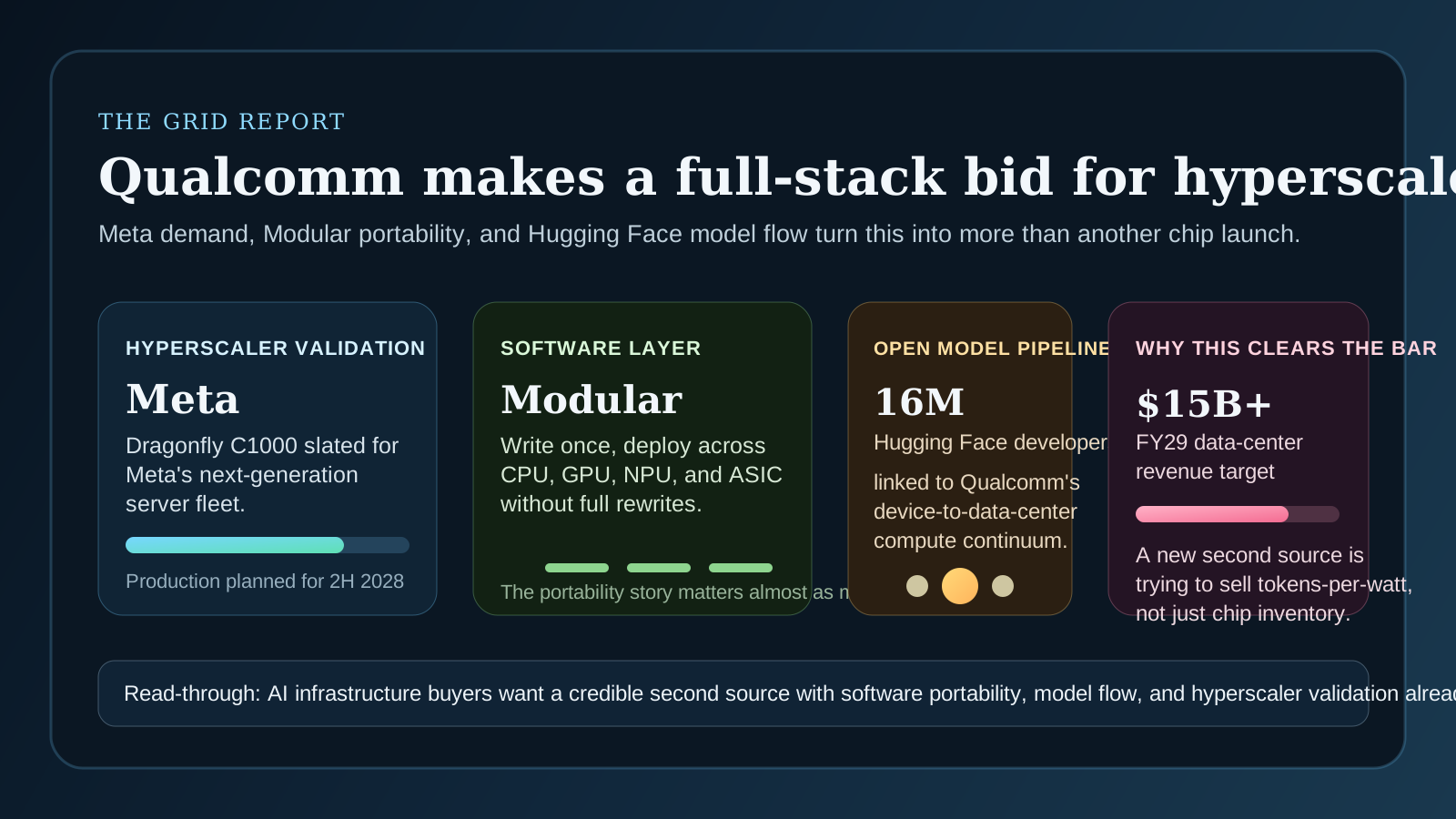
Qualcomm’s June 24 data-center package clears the publish bar because it compresses several layers of market proof into one day. At Investor Day, Qualcomm raised its fiscal 2029 non-handset revenue target to $40 billion and set a more than $15 billion data-center revenue target. On its own, that would still risk reading like a capital-markets aspiration. The stronger story is that the company paired the target with a concrete hyperscaler customer, a software-stack acquisition, and an open-model distribution path.
The most important new fact is the Meta agreement. Qualcomm and Meta said they have a strategic multi-generation collaboration under which Qualcomm will supply data-center CPUs for Meta, with the Dragonfly C1000 planned to power Meta’s next-generation server fleet and production expected to begin in the second half of 2028. That matters because the useful question is no longer whether Qualcomm wants to enter the data-center market. It is whether a hyperscaler is willing to design future fleet capacity around Qualcomm silicon. Meta just said yes.
What makes Qualcomm’s June 24 push worth publishing is not a chip. It is the combination of hyperscaler demand proof, software portability, and open-model distribution.
That is why the cleaner Grid Report angle is a second-source CPU story, not a generic “Qualcomm enters AI” headline. The hyperscaler market has been hungry for more performance-per-watt options and for leverage against single-vendor dependence across CPU, accelerator, memory, and networking stacks. Qualcomm is explicitly selling power efficiency, lower total cost of ownership, and tokens-per-watt economics into that opening. A named Meta roadmap makes the pitch materially more credible than another roadmap slide with no buyer attached.
The second layer is Modular. Qualcomm said it will acquire the AI software company to deepen its software foundation for generative and agentic AI across data center and edge environments. The press release describes Modular’s platform as a unified stack that lets models run across CPU, GPU, NPU, and custom ASIC architectures without rewrites for each accelerator. That is a real infrastructure angle because second sources do not become durable only by taping out chips. They need a software layer that lowers the switching cost of using those chips in heterogeneous environments.
The third layer is the model pipeline. Qualcomm and Hugging Face said they are expanding their relationship so Hugging Face internal and developer workloads can run on Qualcomm Dragonfly systems, while model onboarding and hybrid orchestration stretch from devices to the data center. Hugging Face said the ecosystem now includes 16 million developers. The stronger read-through is not simply “developer love.” It is that Qualcomm is trying to connect silicon, portability tooling, and open-model distribution into one adoption funnel rather than hoping a CPU win alone will pull software toward it.
The actual hardware roadmap supports that interpretation. Qualcomm’s June 24 portfolio announcement included the Dragonfly C1000 CPU, High Bandwidth Compute technology, the Dragonfly AI300 inference accelerator, and 800G and 1.6T connectivity products. That mix matters because it signals a full rack-scale infrastructure bid around data movement, memory pressure, and inference economics. In other words, Qualcomm is not only asking the market to believe in a CPU. It is asking the market to believe it can help assemble a useful AI system.
This does not mean Qualcomm has already broken into the top tier of AI infrastructure. The Meta production timeline is still in 2028, the revenue target is still forward-looking, and execution risk remains high across silicon, packaging, software maturity, ecosystem integration, and customer concentration. But those caveats are exactly why the story clears the bar now. June 24 is the first moment when Qualcomm’s data-center ambition reads like an integrated go-to-market plan instead of a collection of adjacent ambitions.
The duplicate check is also what makes this worth publishing. We already have stories on OpenAI and Broadcom building inference silicon, on NVIDIA’s efficiency and networking stack, and on storage and colocation layers tightening around AI demand. Qualcomm is a different thesis. It is the case that the next strategic entrant may win not by beating NVIDIA head-on everywhere, but by offering hyperscalers a credible second-source stack that combines CPU performance-per-watt, software portability, and open-model reach.
That is enough to publish. Search coverage will naturally focus on the stock move or the phrase “Investor Day.” The more useful operator and investor query is different: when does a data-center chip announcement become a real second-source infrastructure story? Qualcomm’s combination of a Meta CPU agreement, Modular acquisition, Hugging Face expansion, and explicit fiscal targets is one of the clearest answers yet.
Sources
Qualcomm, “Qualcomm Accelerates Diversification with Comprehensive Strategy for Data Center and Sees Multiple Inflection Points Over the Next 3 to 5 Years,” published June 24, 2026: https://www.qualcomm.com/news/releases/2026/06/qualcomm-accelerates-diversification-with-comprehensive-strategy
Qualcomm, “Qualcomm to Acquire Modular,” published June 24, 2026: https://investor.qualcomm.com/news-events/press-releases/news-details/2026/Qualcomm-to-Acquire-Modular/default.aspx
Business Wire, “Qualcomm and Meta Announce Strategic Multi-Generation Agreement on Data Center CPUs,” published June 24, 2026: https://www.businesswire.com/news/home/20260624150329/en/Qualcomm-and-Meta-Announce-Strategic-Multi-Generation-Agreement-on-Data-Center-CPUs
Business Wire, “Qualcomm and Hugging Face Expand Relationship to Advance Open, Developer-Driven AI from Device to Cloud,” published June 24, 2026: https://www.businesswire.com/news/home/20260624641281/en/Qualcomm-and-Hugging-Face-Expand-Relationship-to-Advance-Open-Developer-Driven-AI-from-Device-to-Cloud
Investing News Network republishing Qualcomm release, “Qualcomm Unveils Comprehensive Data Center Roadmap for the Agentic AI Era with New Qualcomm Dragonfly Portfolio,” published June 24, 2026, linking the full Business Wire release: https://investingnews.com/qualcomm-unveils-comprehensive-data-center-roadmap-for-the-agentic-ai-era-with-new-qualcomm-dragonfly-portfolio/
By Nawaz Lalani
The Grid Report is written by Nawaz Lalani and focuses on source-backed coverage of AI infrastructure, grid power demand, automation systems, and market signals.
Follow the signal, not just the headline.
Get the daily Grid brief for source-backed coverage on AI power demand, infrastructure timing, automation, and market signals.