- NVIDIA’s June 23 TOP500 and Green500 update clears the publish bar because it gives a clean infrastructure signal: the AI supercomputing race is no longer just about who can buy the most accelerators.
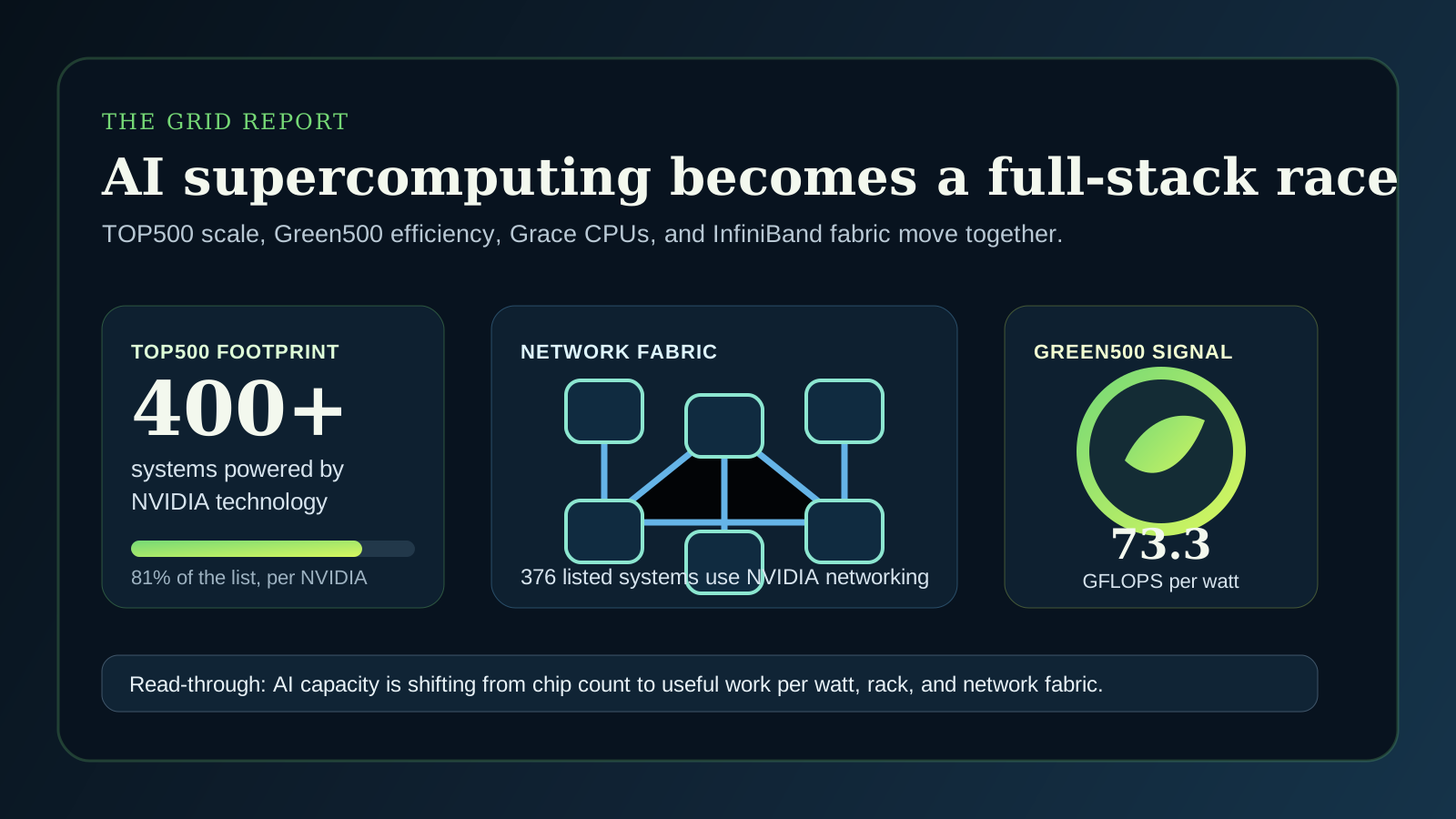
- NVIDIA said its technology now powers more than 400 of the world’s 500 fastest supercomputers, equal to 81% of the TOP500 list.
- The independent TOP500 project also announced its 67th list at ISC 2026 in Hamburg on June 23.
- Section
- Infrastructure
- Read time
- 5 min read
NVIDIA’s June 23 TOP500 and Green500 update clears the publish bar because it gives a clean infrastructure signal: the AI supercomputing race is no longer just about who can buy the most accelerators. It is becoming a full-stack systems race where GPUs, CPUs, networking, memory movement, software, and power efficiency all determine usable capacity.
NVIDIA said its technology now powers more than 400 of the world’s 500 fastest supercomputers, equal to 81% of the TOP500 list. The company also said NVIDIA technologies account for 90% of systems newly added to the list, while NVIDIA networking connects 376 TOP500 systems. Those details matter more than the headline number because they show how the bottleneck is moving from individual chips to the system fabric that lets large clusters behave like one machine.
The better AI infrastructure question is no longer how many GPUs a cluster has. It is how much useful work the full system can deliver per watt and per network fabric.
The independent TOP500 project also announced its 67th list at ISC 2026 in Hamburg on June 23. That matters because this is not only a vendor benchmark story. TOP500 remains the public scoreboard for high-performance computing, and the June list is arriving at the same moment that national AI systems, science clouds, and industrial AI factories are being treated as strategic infrastructure.
The useful read-through is that AI infrastructure is becoming a networking and efficiency product. NVIDIA said 376 listed systems use its networking, mostly Quantum InfiniBand, with the rest on Ethernet. For AI factories, that fabric is not plumbing. It is the layer that determines how much GPU capacity can be usefully scheduled, how fast training and simulation workloads can move data, and how much stranded compute sits idle because the cluster cannot feed itself efficiently.
The Green500 signal is just as important. NVIDIA said the top eight Green500 systems run on NVIDIA GPUs and that nine of the top 10 use NVIDIA technologies. It also highlighted KAIROS, a Grace Hopper system at France’s University of Toulouse, as the top Green500 system at 73.3 gigaflops per watt. That is the Grid-native angle: performance per watt is moving from sustainability footnote to deployment constraint.
This matters for data centers because AI capacity is increasingly power-limited before it is demand-limited. If two architectures can deliver similar AI throughput but one turns more of the power budget into useful work, the difference shows up in site selection, cooling design, utility interconnection, and capital efficiency. The Green500 ranking is not a perfect proxy for commercial inference economics, but it is a useful signal that power efficiency is now a central competitive axis.
Grace CPU adoption is another detail to watch. NVIDIA said 26 TOP500 systems now use Grace CPUs, up eight from the previous list, and that Grace-based systems sit high on both TOP500 and Green500 rankings. The point is not that every AI data center will look like a national lab supercomputer. The point is that the market is rewarding tighter CPU-GPU integration, shared memory movement, and architectures designed around AI and simulation workloads rather than traditional server refresh cycles.
There is also a sovereignty angle. NVIDIA cited a record 35 NVIDIA AI-HPC supercomputers in development across Europe, while the TOP500 announcement places the list inside the broader global competition around national compute capacity. Countries are not only buying models. They are building the machines that train, simulate, and industrialize them. That pushes AI infrastructure into the same policy category as energy, telecom, and semiconductor manufacturing.
The caveat is that TOP500 is not the entire AI market. It measures specific high-performance computing benchmarks, not every production inference fleet or enterprise workload. But the directional signal is still valuable: the infrastructure stack that wins public supercomputing lists is increasingly the same stack being adapted for AI factories, national AI programs, and power-constrained data centers.
That is enough to publish. The stronger conclusion is narrow and durable: AI infrastructure is becoming less about isolated chip supply and more about complete, power-aware systems. For operators, investors, and policymakers, the question is shifting from “how many GPUs?” to “how much useful work can the full stack deliver per watt, per rack, and per network fabric?”
Sources
NVIDIA, “NVIDIA Powers Over 400 of the World’s 500 Fastest Supercomputers,” published June 23, 2026: https://blogs.nvidia.com/blog/top500-green500-supercomputers-isc-2026/
TOP500, “The 67th edition of the TOP500 list of the world’s most powerful supercomputers was announced today at the ISC 2026 conference in Hamburg, Germany,” published June 23, 2026: https://top500.org/
By Nawaz Lalani
The Grid Report is written by Nawaz Lalani and focuses on source-backed coverage of AI infrastructure, grid power demand, automation systems, and market signals.
Follow the signal, not just the headline.
Get the daily Grid brief for source-backed coverage on AI power demand, infrastructure timing, automation, and market signals.