- Backblaze’s June 23 agreement with CoreWeave clears the publish bar because it puts a hard commercial signal behind an infrastructure layer that is still too often treated like background plumbing.
- Backblaze’s own wording makes that angle unusually clear.
- That matters because the storage stack around AI is no longer organized like ordinary cloud archiving.
- Section
- Infrastructure
- Read time
- 5 min read
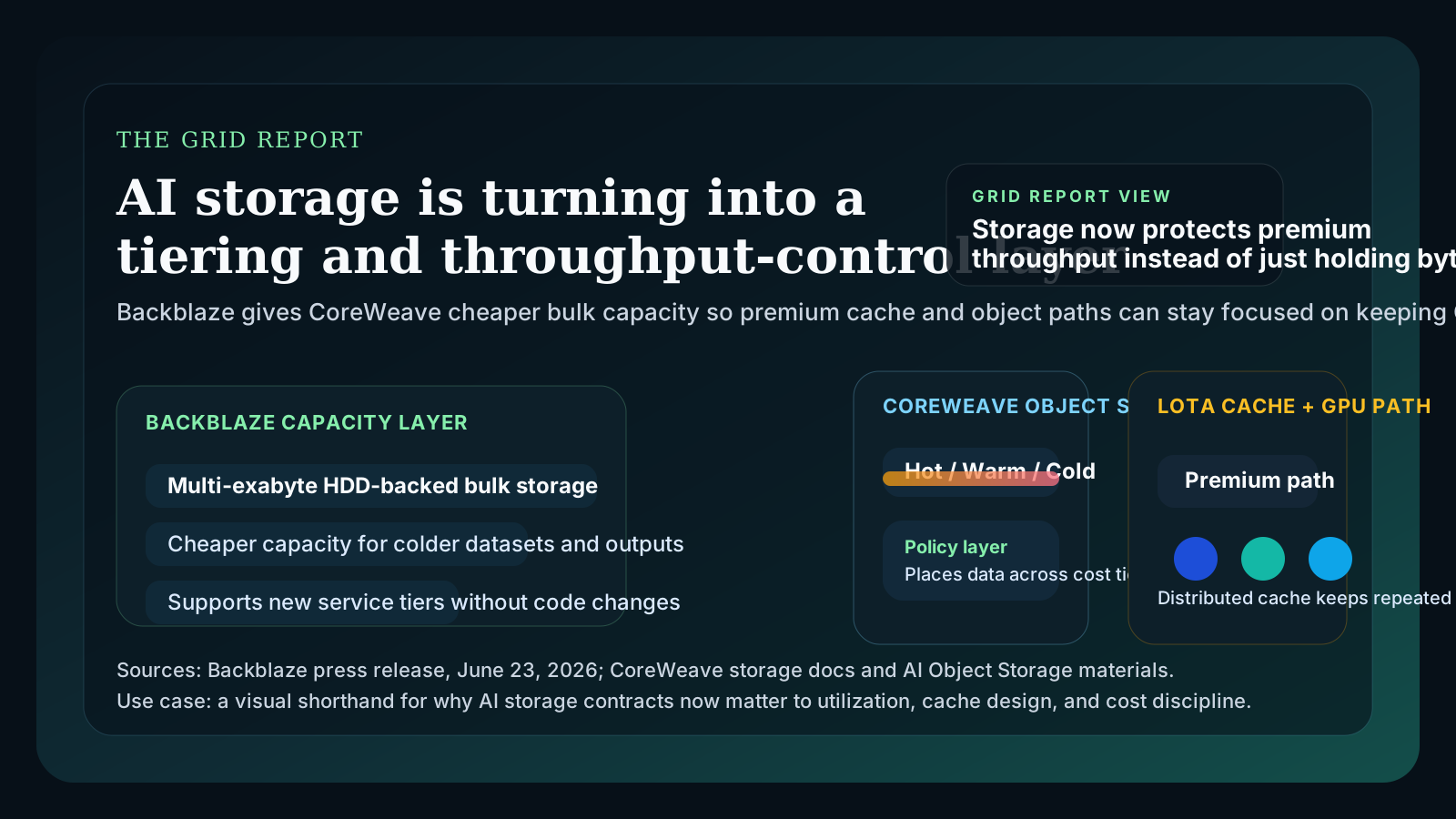
Backblaze’s June 23 agreement with CoreWeave clears the publish bar because it puts a hard commercial signal behind an infrastructure layer that is still too often treated like background plumbing. Backblaze said the five-year deal is worth $335 million and will provide multi-exabyte, cost-efficient storage capacity for portions of CoreWeave’s managed storage infrastructure. The useful story is not only that a storage vendor landed a large AI customer. It is that AI storage is becoming a placement-and-throughput problem, not a simple capacity problem.
Backblaze’s own wording makes that angle unusually clear. The company said its storage will help CoreWeave optimize data placement across performance tiers while preserving high-performance storage resources for the demands of AI workloads. That is the important phrase. In AI infrastructure, the expensive asset is not the cold data itself. It is the premium path that keeps training and inference systems fed without leaving costly compute idle.
The important AI storage question is no longer just how many bytes can be parked cheaply. It is how the stack protects premium throughput while moving bulk data into lower-cost tiers.
That matters because the storage stack around AI is no longer organized like ordinary cloud archiving. CoreWeave said customers already using CoreWeave AI Object Storage will gain access to the new service tiers without code modifications. In other words, the storage architecture is being sold as an operating layer that can shift where data lives and how it is priced without forcing application rewrites. That is a stronger infrastructure signal than a simple hardware procurement headline.
CoreWeave’s own storage materials help explain why. The company positions AI Object Storage and its Local Object Transport Accelerator, or LOTA, as a way to keep data close to GPU and CPU nodes through caching and faster fetch paths. CoreWeave’s documentation says LOTA runs on nodes across the cluster and caches fetched objects to reduce load times, while its storage platform adds usage-based tiers for different data states. Put together, that means the economic question is becoming: what data needs the premium path now, and what data can sit on cheaper bulk capacity without hurting the workflow?
That is why the better read-through is throughput discipline. AI builders are discovering that storage is not valuable only when it is fast in the abstract. It is valuable when it keeps premium compute lanes open, avoids overpaying for inactive datasets, and lets the operator move checkpoints, training data, model outputs, and retrieval corpora across tiers without operational friction. Backblaze is effectively supplying the lower-cost capacity that makes that stack easier to run.
There is also a market signal here for smaller infrastructure providers. CoreWeave has become one of the most watched AI cloud operators because it sits directly in the path of frontier-model and enterprise-compute demand. When a company like that signs a multi-year, multi-exabyte storage contract, it suggests the storage layer itself is becoming big enough and specialized enough to support dedicated supplier relationships rather than generic cloud overflow.
This story belongs in the infrastructure lane because the interesting shift is architectural before it is financial. Yes, the $335 million headline matters. But the more durable conclusion is that AI infrastructure operators are separating premium performance paths from bulk data pools and building software-mediated tiering around that split. That is exactly how storage starts to look like part of the compute control plane rather than a commodity afterthought.
There are still caveats. Backblaze is describing the relationship in the best possible light, and the press release does not disclose the exact workload mix, margins, or what share of CoreWeave’s total storage environment the deal covers. But the narrower conclusion still holds: AI storage is becoming a deliberate part of utilization strategy, where cost tiers, cache behavior, and data placement matter directly to compute economics.
That is enough to publish. Search coverage of AI infrastructure still overweights chips and underweights the systems that keep those chips productive. The stronger operator-grade takeaway from the Backblaze-CoreWeave deal is that storage is becoming a control layer for throughput, cost discipline, and workload placement.
Sources
Backblaze, “Backblaze Announces Five-Year Multi-Exabyte Data Storage Agreement with CoreWeave,” published June 23, 2026: https://www.businesswire.com/news/home/20260622788628/en/Backblaze-Announces-Five-Year-Multi-Exabyte-Data-Storage-Agreement-with-CoreWeave
CoreWeave documentation and product materials on AI Object Storage, LOTA, and usage-based storage tiers: https://docs.coreweave.com/products/storage and https://www.coreweave.com/products/storage
By Nawaz Lalani
The Grid Report is written by Nawaz Lalani and focuses on source-backed coverage of AI infrastructure, grid power demand, automation systems, and market signals.
Follow the signal, not just the headline.
Get the daily Grid brief for source-backed coverage on AI power demand, infrastructure timing, automation, and market signals.