- OpenAI’s June 24 Jalapeño launch clears the publish bar because it is not only a custom-chip announcement.
- That makes this an infrastructure story.
- OpenAI’s announcement points directly at that problem.
- Section
- Infrastructure
- Read time
- 4 min read
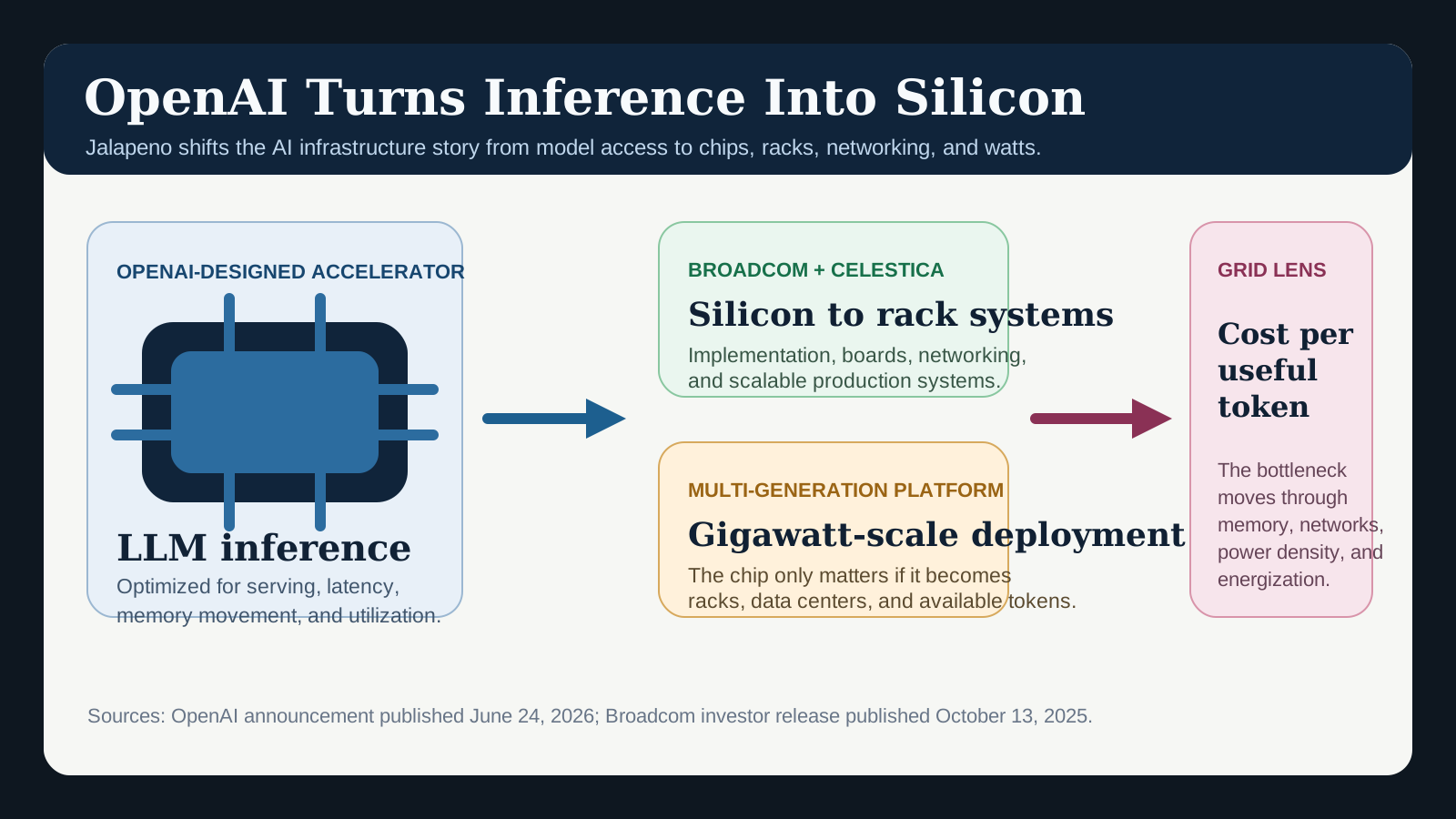
OpenAI’s June 24 Jalapeño launch clears the publish bar because it is not only a custom-chip announcement. The company and Broadcom unveiled an LLM inference accelerator that OpenAI says was designed around the serving patterns of ChatGPT, Codex, the API, and future agentic products. The useful read-through is that inference economics are now being engineered across the full stack, not only bought as off-the-shelf GPU capacity.
That makes this an infrastructure story. Training may still dominate the public imagination, but inference is where AI turns into a daily operating cost. Every prompt, coding task, agent run, workflow automation, and API call has to be served somewhere. If demand keeps compounding, the strategic question becomes less abstract: who can deliver more useful tokens per watt, per rack, per dollar, and per constrained data-center site?
Jalapeño only matters if it can move from silicon into racks, networks, power contracts, and useful tokens at scale.
OpenAI’s announcement points directly at that problem. Jalapeño is described as a blank-slate accelerator for modern LLM inference, with attention to kernels, memory movement, networking resources, latency, and realized utilization. OpenAI says engineering samples are already running machine-learning workloads in the lab at target production frequency and power, while final performance data is still pending. That caveat matters. This is a launch signal, not yet a public benchmark package.
The Broadcom piece is just as important as the chip name. OpenAI says Broadcom is helping industrialize the platform through silicon implementation and networking, while Celestica contributes board, rack, and system expertise. Broadcom’s earlier investor release framed the partnership as a 10-gigawatt custom-accelerator deployment targeted to start in the second half of 2026 and continue through 2029. In other words, the chip only matters if it can become racks, clusters, network fabrics, and energized capacity.
That is the Grid-native angle: inference cost is now tied to physical deployment discipline. A better accelerator can reduce the cost of serving intelligence, but only if the surrounding system can keep it fed with memory bandwidth, move data across the cluster, cool the rack, and secure enough power at the right locations. The bottleneck is not one component. It is the conversion of a silicon design into reliable, high-utilization infrastructure.
For operators, the signal is that AI procurement is moving from “which model do we use?” toward “which infrastructure stack gives us dependable cost, latency, and capacity?” Enterprises may not buy Jalapeño directly, but they will feel the effect if inference becomes cheaper, faster, and more reliable inside ChatGPT, Codex, and API products. Developers should watch whether lower serving costs show up as higher limits, better latency, or more agentic workloads that can run economically.
For investors and infrastructure suppliers, the launch reinforces the split between model companies with full-stack ambitions and vendors selling critical pieces of that stack. Broadcom is not merely a chip supplier in this story. It is part of the networking and deployment layer that determines whether custom silicon can scale beyond a lab sample. That is why the read-through touches Ethernet fabrics, optical connectivity, board integration, rack supply chains, and data-center power planning.
The risk is over-reading the announcement before production data arrives. OpenAI has not yet published the detailed technical report it says will come later, and early performance-per-watt claims still need public validation. But the direction is hard to miss. The AI buildout is moving from model releases into an industrial stack where inference chips, power efficiency, and data-center deployment cadence are becoming core competitive variables.
Sources
OpenAI, “OpenAI and Broadcom unveil LLM-optimized inference chip,” published June 24, 2026: https://openai.com/index/openai-broadcom-jalapeno-inference-chip/
Broadcom, “OpenAI and Broadcom announce strategic collaboration to deploy 10 gigawatts of OpenAI-designed AI accelerators,” published October 13, 2025: https://investors.broadcom.com/news-releases/news-release-details/openai-and-broadcom-announce-strategic-collaboration-deploy-10
By Nawaz Lalani
The Grid Report is written by Nawaz Lalani and focuses on source-backed coverage of AI infrastructure, grid power demand, automation systems, and market signals.
Follow the signal, not just the headline.
Get the daily Grid brief for source-backed coverage on AI power demand, infrastructure timing, automation, and market signals.