- Micron’s July 9 announcements clear the publish bar because they expose a less visible AI bottleneck than GPUs or data-center leases.
- The company announced plans to invest up to $3 billion to strengthen the U.S.
- Taken together, those disclosures say something more important than “Micron is spending a lot.” They show that AI memory capacity is now being managed as a chain of dependencies.
- Section
- Infrastructure
- Read time
- 5 min read
Micron’s July 9 announcements clear the publish bar because they expose a less visible AI bottleneck than GPUs or data-center leases. The useful signal is that memory scale is becoming an upstream supply-assurance problem: raw wafers, supplier financing, construction speed, and domestic manufacturing redundancy all have to line up before AI demand can turn into shipped systems.
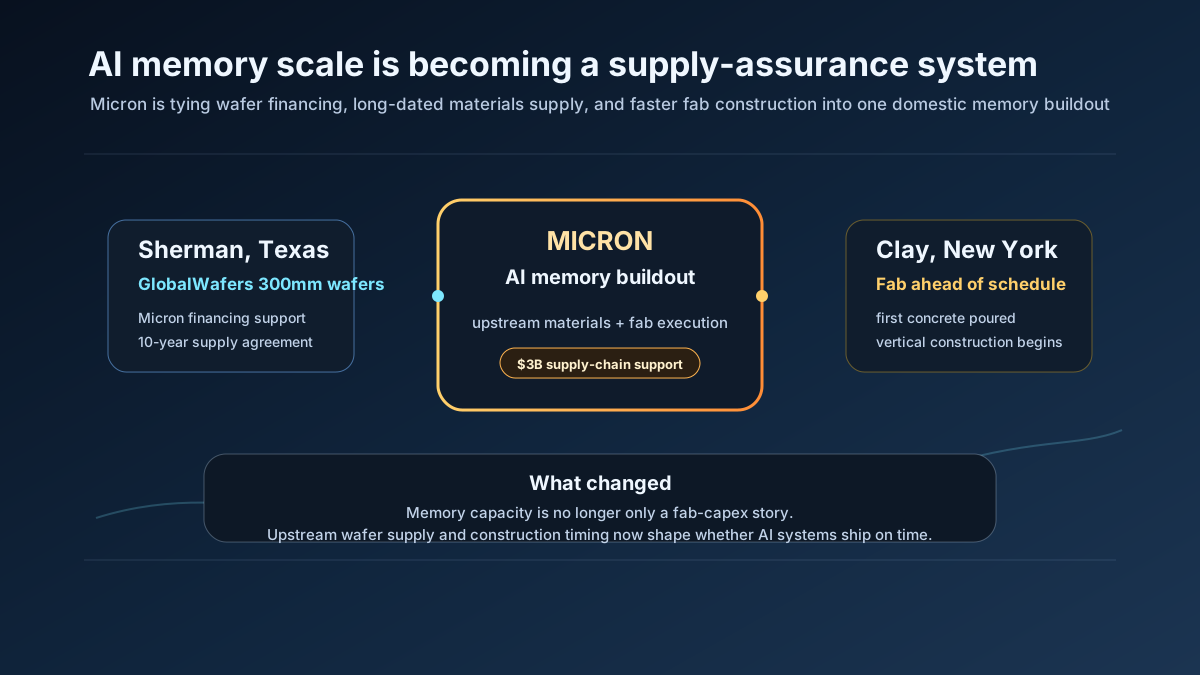
The company announced plans to invest up to $3 billion to strengthen the U.S. semiconductor ecosystem, including $500 million in strategic financing support for GlobalWafers America’s 300mm raw silicon wafer facility in Sherman, Texas, alongside a 10-year supply agreement. Later the same morning, Micron said it is increasing planned U.S. investment to more than $250 billion through 2035 and pouring first concrete at its Clay, New York fab more than one quarter ahead of schedule.
AI memory scale is becoming a supply-assurance system: wafers, supplier finance, and construction speed have to clear before the rack ships.
Taken together, those disclosures say something more important than “Micron is spending a lot.” They show that AI memory capacity is now being managed as a chain of dependencies. It is no longer enough to fund the final fab. The input materials, the supplier balance sheet, the local manufacturing footprint, and the construction schedule all need to be secured earlier and more explicitly.
That matters because the Sherman commitment is not a generic supplier relationship. Micron said GlobalWafers is developing domestic 300mm raw silicon wafer manufacturing capacity in Texas and that the two companies will pair financing support with a decade-long supply agreement. In practical terms, Micron is trying to reduce one of the quietest but most consequential risks in advanced semiconductor scale: upstream material dependence landing at exactly the wrong point in the AI build cycle.
The New York update strengthens the same thesis. Micron said its U.S. investment plan now exceeds $250 billion through 2035, that it aims to produce 40% of its DRAM in the United States over the long term, and that the Clay site has already moved from preparation toward vertical construction. That is a timeline story as much as a spending story. In AI infrastructure, earlier concrete and earlier equipment-readiness can matter more than another headline commitment with no visible execution milestone.
For operators, the implication is straightforward. AI deployment timing is shaped by more than accelerator procurement. Memory availability, wafer input assurance, and fab ramp credibility now sit upstream of server shipments. If those layers slip, the rest of the stack can be funded and still arrive late.
For investors, the more useful takeaway is market structure. Micron’s June quarter already suggested AI memory was becoming more contractual and capacity-disciplined. The July 9 package extends that logic backward into the supply chain itself. This is what a tighter infrastructure market looks like: companies do not just sign customer agreements, they start financing the material base needed to honor them.
There is also a geographic signal here. The Sherman and Clay announcements point to a more distributed U.S. memory and materials footprint, rather than relying only on downstream assembly or rhetoric about resilience. That does not eliminate execution risk, and Micron’s plans remain subject to the usual timing, approval, and buildout uncertainties. But it does show where management thinks the next constraint sits.
This is why the story passes the duplicate screen despite our recent Micron earnings coverage. The June 24 article was about strategic customer agreements and revenue quality. The July 9 update is different. It is about upstream wafer security, domestic manufacturing depth, and the speed at which memory capacity can be turned from plan into physical output.
The search case is also better than a generic semiconductor roundup. Anyone can rewrite the dollar figure. The more useful question is what Micron’s package says about AI infrastructure bottlenecks. The best answer today is that memory scale is becoming a supply-assurance system, not just a fab-capex story.
Sources
Micron Technology, “Micron Announces Up to $3 Billion Strategic Investment to Strengthen U.S. Semiconductor Ecosystem,” published July 9, 2026: https://investors.micron.com/news-releases/news-release-details/micron-announces-3-billion-strategic-investment-strengthen-us
Micron Technology, “Micron Accelerates U.S. Investments, Pours First Concrete at New York Fab,” published July 9, 2026: https://investors.micron.com/news-releases/news-release-details/micron-accelerates-us-investments-pours-first-concrete-new-york
By Nawaz Lalani
The Grid Report is written by Nawaz Lalani and focuses on source-backed coverage of AI infrastructure, grid power demand, automation systems, and market signals.
Follow the signal, not just the headline.
Get the daily Grid brief for source-backed coverage on AI power demand, infrastructure timing, automation, and market signals.