- Microsoft’s July 15 partnership with 3M clears the publish bar because it says something more useful than “another enterprise AI partnership.” The stronger signal is physical.
- The release is specific enough to matter.
- The useful Grid Report angle is that AI datacenter scale is becoming an installation-and-serviceability problem.
- Section
- Infrastructure
- Read time
- 4 min read
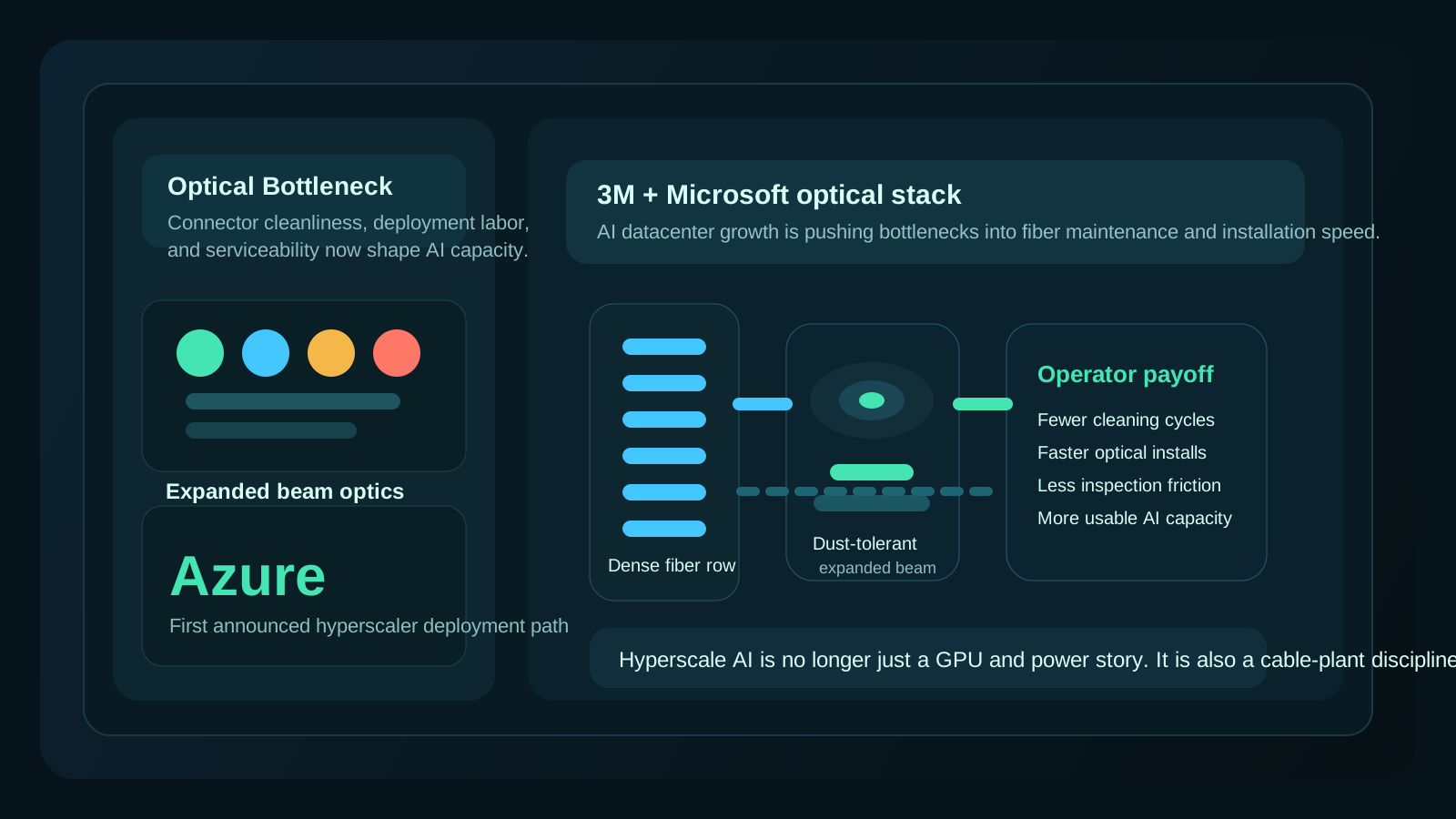
Microsoft’s July 15 partnership with 3M clears the publish bar because it says something more useful than “another enterprise AI partnership.” The stronger signal is physical. Microsoft says Azure will become the first announced hyperscale cloud provider to deploy 3M’s Expanded Beam Optical technology in its data centers. That matters because AI infrastructure bottlenecks are not only about GPUs, power, or cooling anymore. They are also about the optical layer: how quickly fiber can be installed, how often connectors need cleaning, and how much maintenance drag accumulates inside dense, high-volume environments.
The release is specific enough to matter. Microsoft and 3M say expanded beam optical connectors replace the direct-contact interface used in traditional connectors with a design intended to be more tolerant of contamination, easier to maintain, and faster to deploy. Microsoft says the technology can reduce cleaning and inspection needs while supporting reliable optical performance in live datacenter conditions where dust exposure and routine handling are unavoidable. That is a practical operating claim, not branding theater.
AI datacenter scale is moving into the optical-maintenance layer, where contamination tolerance, inspection labor, and fiber deployment speed start to act like real capacity variables.
The useful Grid Report angle is that AI datacenter scale is becoming an installation-and-serviceability problem. As clusters get denser, the networking layer stops being an invisible background component and starts acting like a throughput governor. If a connector system is easier to install cleanly, less fragile under repeated handling, and less dependent on frequent inspection, then the gain is not cosmetic. It can affect deployment timelines, maintenance labor, and how confidently operators can keep expanding fiber-heavy AI environments.
That is why this belongs in infrastructure rather than generic enterprise AI coverage. The key issue is not that 3M will also use Microsoft’s software internally. The key issue is that Microsoft is treating optical-connectivity reliability as part of AI capacity buildout. The company says early use of EBO has shown potential to reduce network deployment timelines in some environments. Read plainly, that means the race to scale AI is now hitting a layer below compute procurement: the physical realities of cable plant work, contamination tolerance, and field maintenance.
3M’s own 2026 moves reinforce that this is not a one-off press release. In March, the company announced a capacity expansion that it said would more than double EBO production to meet AI datacenter demand. In May, it joined a coalition aimed at open standards for optical connections in AI datacenters. July’s Microsoft partnership is the stronger commercial proof point because it ties that manufacturing and standards push to an actual hyperscale deployment path instead of a generic roadmap.
This also clears the duplicate screen. The site has already covered TSMC’s packaging and node timing, Micron’s wafer and memory assurance, NVIDIA’s liquid-cooling and post-training infrastructure claims, and Meta’s local campus buildout. Those stories were about compute, memory, cooling, financing, or power. This thesis is different: a meaningful part of AI infrastructure risk is moving into the optical-maintenance stack, where connector cleanliness and deployment discipline can become real scaling constraints.
There are still limits. The evidence here is company-framed, and Microsoft does not quantify how much deployment time or maintenance cost it expects to save across Azure. EBO will not erase the larger bottlenecks around power, chips, or site delivery. But those caveats do not weaken the signal. They clarify it. Once hyperscalers start talking about connector contamination and inspection cycles in the same breath as AI growth, the market should pay attention to the network plumbing, not just the compute headline.
That is enough to publish. Searchers looking up this partnership do not need another recap of who signed what. The more useful answer is that AI datacenter competition is spreading into a lower, less glamorous layer of the stack, where operators win by reducing fiber-maintenance friction and turning optical deployment speed into usable capacity faster.
Sources
Microsoft Source, “3M and Microsoft announce strategic partnership to advance AI data center infrastructure and enterprise transformation,” published July 15, 2026: https://news.microsoft.com/source/2026/07/15/3m-and-microsoft-announce-strategic-partnership-to-advance-ai-data-center-infrastructure-and-enterprise-transformation/
3M Investor Relations, “3M announces capacity investment for Expanded Beam Optical (EBO) production,” published March 16, 2026: https://investors.3m.com/news-events/press-releases/detail/1921/3m-announces-capacity-investment-for-expanded-beam-optical
3M News Center, “New coalition launches to advance and scale optical connections for AI data centers,” published May 12, 2026: https://news.3m.com/2026-05-12-New-coalition-launches-to-advance-and-scale-optical-connections-for-AI-data-centers
3M, “Expanded Beam Optical Solutions for Data Center,” accessed July 20, 2026: https://www.3m.com/3M/en_US/p/c/electronics-components/interconnect-products/expanded-beam-optical-solutions/i/electronics/data-center/
By Nawaz Lalani
The Grid Report is written by Nawaz Lalani and focuses on source-backed coverage of AI infrastructure, grid power demand, automation systems, and market signals.
Follow the signal, not just the headline.
Get the daily Grid brief for source-backed coverage on AI power demand, infrastructure timing, automation, and market signals.