- Amazon’s June 25 India announcement clears the publish bar because it offers a more useful read than a standard foreign-investment summary.
- Amazon answered that directly.
- That distinction matters because cloud competition is increasingly turning into a regional capacity race.
- Section
- Infrastructure
- Read time
- 5 min read
- Data included
- Why Amazon’s India announcement matters beyond the headline number
Why Amazon’s India announcement matters beyond the headline number
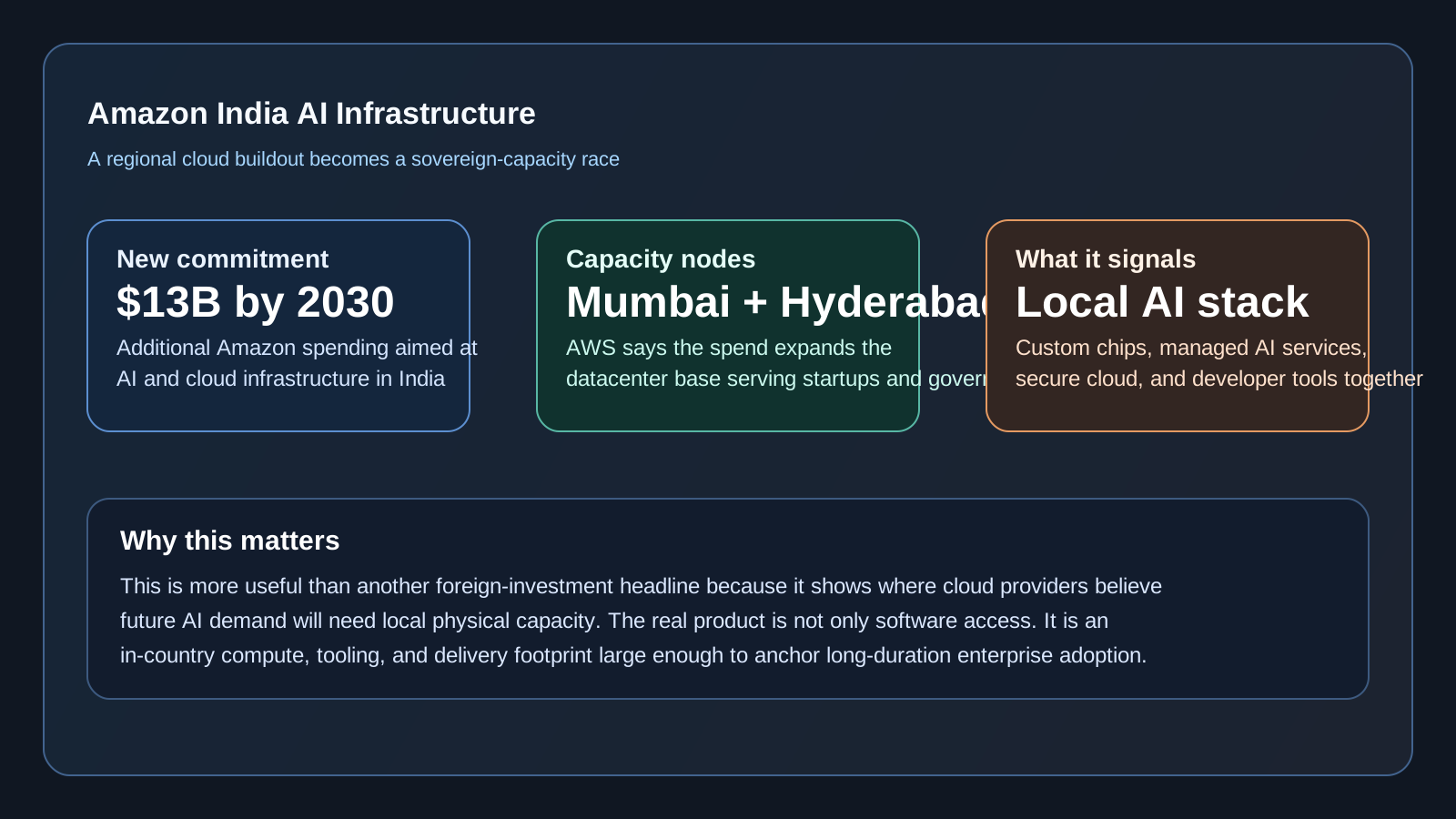
The useful signal is that regional AI competition is moving into local physical capacity, not just software reach.
| Layer | What Amazon said | Why it matters |
|---|---|---|
| New commitment | An additional $13 billion for AI and cloud infrastructure by 2030 | The scale shows India is being treated as a long-duration AI capacity market, not a marginal region. |
| Physical footprint | AWS datacenter expansion in Mumbai and Hyderabad | Local compute availability matters once latency, residency, and sovereign-control needs rise. |
| AI stack | Custom chips, managed AI services, secure cloud, and developer tools | Providers are packaging the full operating stack rather than only leasing generic compute. |
| Broader network | 20+ fulfillment centers and 100+ delivery stations planned this year | Amazon is reinforcing a wider industrial presence around its digital platform bet. |
| Strategic read-through | Total planned India investment reaches $48 billion for 2026-2030 | Hyperscalers are underwriting regional AI corridors before all end demand is fully visible. |
Source: Amazon company news published June 25, 2026, with prior December 2025 India investment announcement for baseline context.
Amazon’s June 25 India announcement clears the publish bar because it offers a more useful read than a standard foreign-investment summary. The company said it will invest an additional $13 billion to expand AI and cloud infrastructure in India by 2030, taking its total investment in the country to $48 billion between 2026 and 2030. For Grid Report readers, the better question is not simply how large the number is. It is what the company believes must be physically local if AI demand is going to compound at national scale.
Amazon answered that directly. The company said the new commitment will expand AWS datacenter capacity in Mumbai and Hyderabad and give startups, enterprises, and government organizations access to custom AI chips, managed AI services, secure cloud technologies, and developer tools. That makes this an infrastructure story rather than a generic international-business story. The product is not only more software availability. It is a larger in-country compute stack designed to keep AI workloads, data handling, and enterprise adoption inside a local operating footprint.
Amazon’s India move matters because AI cloud competition is becoming a race to pre-position local physical capacity, not just to sell more remote software.
That distinction matters because cloud competition is increasingly turning into a regional capacity race. If AI buildout were only about model access, providers could lean more heavily on globally shared infrastructure. But once governments, large enterprises, and regulated buyers want low-latency access, data residency, secure workloads, and local implementation support, regional physical capacity starts to look like strategic infrastructure. Amazon’s India move is evidence of that shift.
The local details strengthen the thesis. Amazon said the new spending builds on a previously announced $35 billion India commitment and sits alongside a broader operations push that includes more than 20 new fulfillment centers and over 100 new last-mile delivery stations launching this year. Those logistics assets are not part of AWS directly, but they matter to the operator read-through. Amazon is not treating India as a narrow cloud region expansion. It is building a wider industrial footprint around AI, commerce, delivery, and digital services at the same time.
This is also why the story is distinct from recent Grid Report coverage on campus operations, utility bargains, and reserved cloud demand. Microsoft’s Wisconsin piece was a proof-of-operations story. Snowflake’s AWS commitment was a reserved-procurement story. Amazon’s India announcement is different. It is about where hyperscalers think future AI demand will need sovereign or near-sovereign physical capacity, and how aggressively they are willing to pre-position infrastructure before every downstream workload is visible.
Operator and investor relevance both flow from that framing. Operators should read the announcement as a sign that regional cloud scale for AI will increasingly require local chips, datacenters, and enterprise tools packaged together. Investors should read it as another marker that hyperscaler capex is not only chasing U.S. campus growth. It is also underwriting durable international AI corridors where regional demand, policy priorities, and local market depth look strong enough to justify long-duration physical buildout.
There are still caveats. The announcement comes from Amazon itself, not from an independent audit of how much of the planned spend will land exactly when or in what asset mix. It also combines AI-and-cloud infrastructure language with broader India investment messaging. But those caveats do not erase the signal. The company chose to make local AI infrastructure expansion central to the announcement, and that is the part that matters most for this audience.
That is enough to publish. Searchers looking for Amazon’s India move do not need another generic recap that a big company plans to spend billions. The more useful answer is what kind of AI market structure that capital is buying: local datacenter capacity, AI chips, secure cloud access, and a regional infrastructure position strong enough to support the next wave of enterprise adoption.
Sources
Amazon, “Amazon announces it will invest $48 billion in India by 2030,” published June 25, 2026: https://www.aboutamazon.com/news/company-news/amazon-india-investment
Amazon, “Amazon to invest over $35 billion in India by 2030,” published December 2025 for baseline commitment context: https://www.aboutamazon.com/news/company-news/amazon-35-billion-india-investment
By Nawaz Lalani
The Grid Report is written by Nawaz Lalani and focuses on source-backed coverage of AI infrastructure, grid power demand, automation systems, and market signals.
Follow the signal, not just the headline.
Get the daily Grid brief for source-backed coverage on AI power demand, infrastructure timing, automation, and market signals.