- NVIDIA’s July 17 Vera Rubin post clears the publish bar because it says something more useful than “new chips are faster.” The stronger signal is that AI infrastructure is being reframed around a new economic question: not just what it costs to serve tokens, but what it costs to keep a model getting smarter after deployment through continuous post-training.
- The post explicitly argues that agentic AI changes the compute pattern.
- The useful operator angle is the metric shift.
- Section
- Infrastructure
- Read time
- 4 min read
- Data included
- NVIDIA is trying to change the governing metric for AI factories
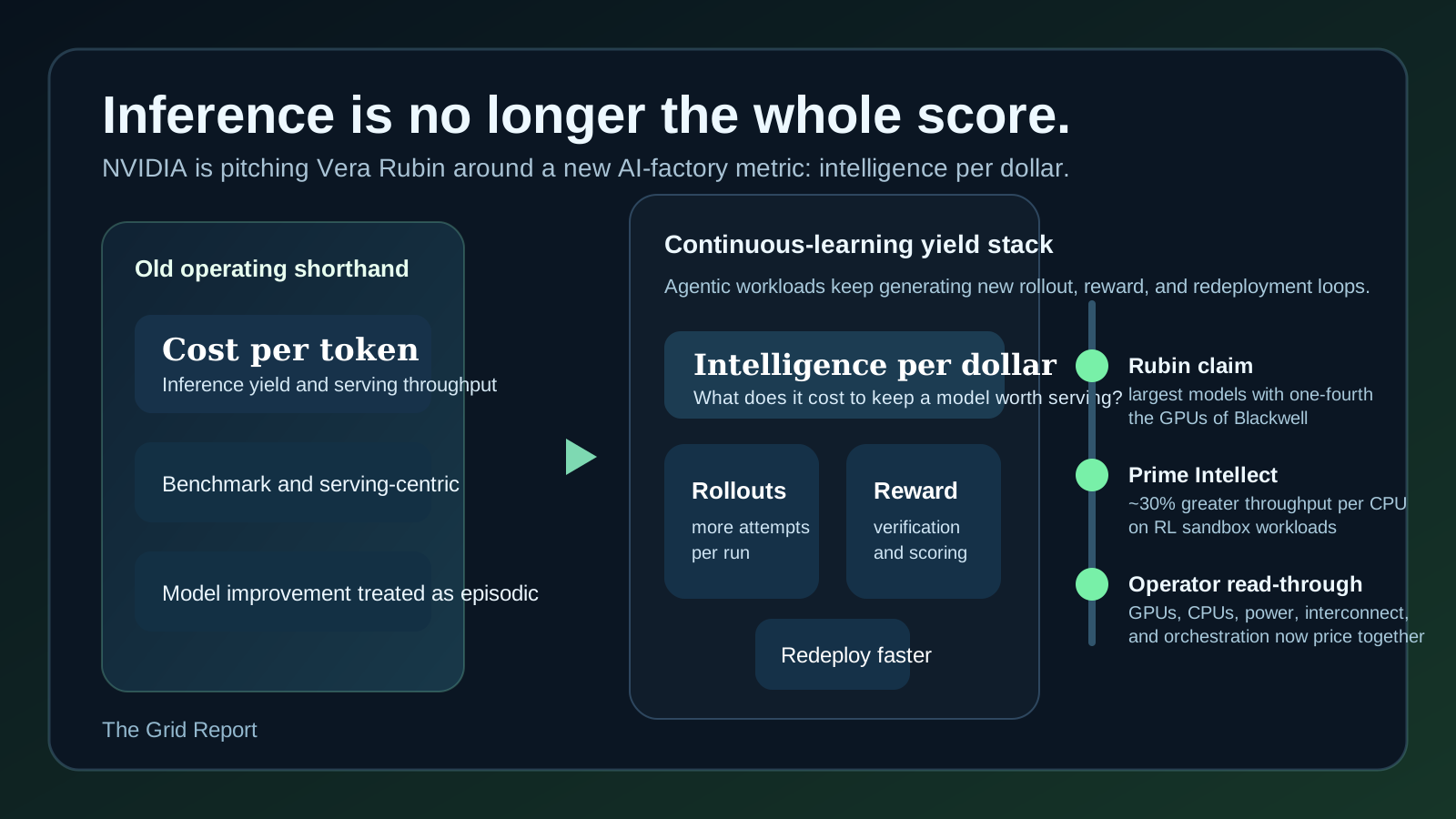
NVIDIA is trying to change the governing metric for AI factories
The July 17 post argues that agentic AI makes continuous post-training a standing infrastructure workload, not a one-off research phase.
| Layer | Old frame | New frame |
|---|---|---|
| Inference economics | Cost per token and serving throughput | Still necessary, but no longer sufficient once deployed agents keep surfacing new edge cases. |
| Learning economics | Post-training treated as a periodic model-improvement project | Continuous post-training becomes a standing operating cost tied to rollout, reward, and redeployment loops. |
| Hardware read-through | GPU count as the main shorthand | Yield depends on the full stack: GPUs, CPUs, interconnect, power efficiency, and orchestration throughput. |
| Operator question | Who serves tokens cheapest? | Who keeps production models learning most efficiently after launch? |
Sources: NVIDIA blog posts published July 14 and July 17, 2026.
NVIDIA’s July 17 Vera Rubin post clears the publish bar because it says something more useful than “new chips are faster.” The stronger signal is that AI infrastructure is being reframed around a new economic question: not just what it costs to serve tokens, but what it costs to keep a model getting smarter after deployment through continuous post-training.
The post explicitly argues that agentic AI changes the compute pattern. Instead of treating post-training as a one-time finishing step, NVIDIA says agentic systems create nonstop refinement loops as tools change, edge cases show up in production, and models have to recover from real-world failure modes. That turns post-training into a standing workload rather than a lab event.
The next AI infrastructure fight is not only about serving tokens cheaply. It is about keeping deployed models learning without blowing up the economics of the loop.
The useful operator angle is the metric shift. NVIDIA says cost per token still matters for inference, but “intelligence per dollar” now sits one layer above it: the question is what it costs to build a model worth serving and keep it worth serving as its environment changes. That is a more operationally relevant frame than generic benchmark talk because it links infrastructure economics to learning velocity, not just serving throughput.
This belongs in infrastructure because the argument is physical and economic, not purely algorithmic. NVIDIA says its Blackwell platform lowers cost per run enough to make frequent post-training economically viable, then claims Vera Rubin can train the largest models with one-fourth the GPUs of the Blackwell generation. Read alongside NVIDIA’s July 14 performance-per-watt post, the message is that the next AI factory sale is becoming a yield story across power, rack design, interconnect, and the cadence of learning loops.
The strongest detail is that NVIDIA is not describing an abstract research workflow. The company points to Prime Intellect, Perplexity, and Together AI as real post-training operators. In Prime Intellect’s case, NVIDIA says Vera-based sandbox infrastructure delivered about 30% greater throughput per CPU than alternative x86 architectures on realistic reinforcement-learning sandbox workloads. That matters because agent systems do not only consume GPUs. They lean heavily on CPU-side orchestration, environments, verification, and tool execution.
The original angle is that post-training is starting to look like a continuous-learning yield stack. Once models are deployed into agentic environments, inference and post-training stop being cleanly separate businesses. Operators increasingly need a loop that can generate rollouts, score them, move weights back into training, and redeploy improved behavior without the economics blowing up. Infrastructure vendors that can show better learning yield per watt, per rack, and per orchestration layer gain a stronger argument than raw benchmark marketing.
This also clears the duplicate screen. The site has already covered NVIDIA’s June liquid-cooling push, June TOP500 efficiency story, July 9 Nemotron-LangChain harness engineering piece, and Japan’s July 16 Vera Rubin industrial-policy announcement. Those stories were about cooling, networking, agent harness design, or sovereign deployment. This one is materially different: it is a metric-change story about how AI infrastructure will increasingly be judged once post-training becomes continuous and production-linked.
There are limits. This is still vendor-framed material, and NVIDIA’s one-fourth-GPU claim comes from its own presentation of Rubin versus Blackwell. The practical economics will depend on real deployment profiles, reward-model quality, and whether continuous post-training actually delivers enough downstream model improvement to justify the extra spend. But those caveats do not weaken the signal. They define the next search question operators and investors should ask: not just who serves tokens cheapest, but who can keep models learning most efficiently after launch.
The search value is strong because readers looking up Vera Rubin do not only need another architecture summary. The more useful answer is that NVIDIA is trying to move AI infrastructure evaluation from inference-only efficiency toward continuous-learning economics, where post-training becomes part of the core operating stack.
Sources
NVIDIA Blog, “NVIDIA Vera Rubin Maximizes Intelligence per Dollar for Post-Training Workloads — a Key Metric for Agentic AI,” published July 17, 2026: https://blogs.nvidia.com/blog/nvidia-vera-rubin-post-training-intelligence-per-dollar/
NVIDIA Blog, “Why Performance per Watt Is the Ultimate Metric for AI Infrastructure Efficiency,” published July 14, 2026: https://blogs.nvidia.com/blog/performance-per-watt-ai-infrastructure-efficiency/
By Nawaz Lalani
The Grid Report is written by Nawaz Lalani and focuses on source-backed coverage of AI infrastructure, grid power demand, automation systems, and market signals.
Follow the signal, not just the headline.
Get the daily Grid brief for source-backed coverage on AI power demand, infrastructure timing, automation, and market signals.