- France’s June infrastructure wave clears the publish bar because the useful story is no longer that Europe wants sovereign AI.
- The biggest new signal is SoftBank Group’s May 31 commitment to develop and operate 5 gigawatts of AI data center capacity in France, representing up to €75 billion of investment.
- SoftBank’s announcement becomes more useful when read with the June 17 NVIDIA France update.
- Section
- Infrastructure
- Read time
- 5 min read
France’s June infrastructure wave clears the publish bar because the useful story is no longer that Europe wants sovereign AI. The stronger Grid Report angle is that France is moving from conference-stage ambition to actual megawatt commitments, campus projects, and industrial supply-chain decisions. That turns sovereignty into an execution problem.
The biggest new signal is SoftBank Group’s May 31 commitment to develop and operate 5 gigawatts of AI data center capacity in France, representing up to €75 billion of investment. The first phase alone targets 3.1 gigawatts in Hauts-de-France by 2031 across Dunkirk, Bosquel, and Bouchain. Those are not pilot numbers. They are utility-scale commitments that force questions about grid access, construction sequencing, equipment supply, and customer demand ramp.
France’s AI story is getting more real because it now has the hard ingredients: megawatts, campuses, power modules, and a supply chain that is starting to localize around them.
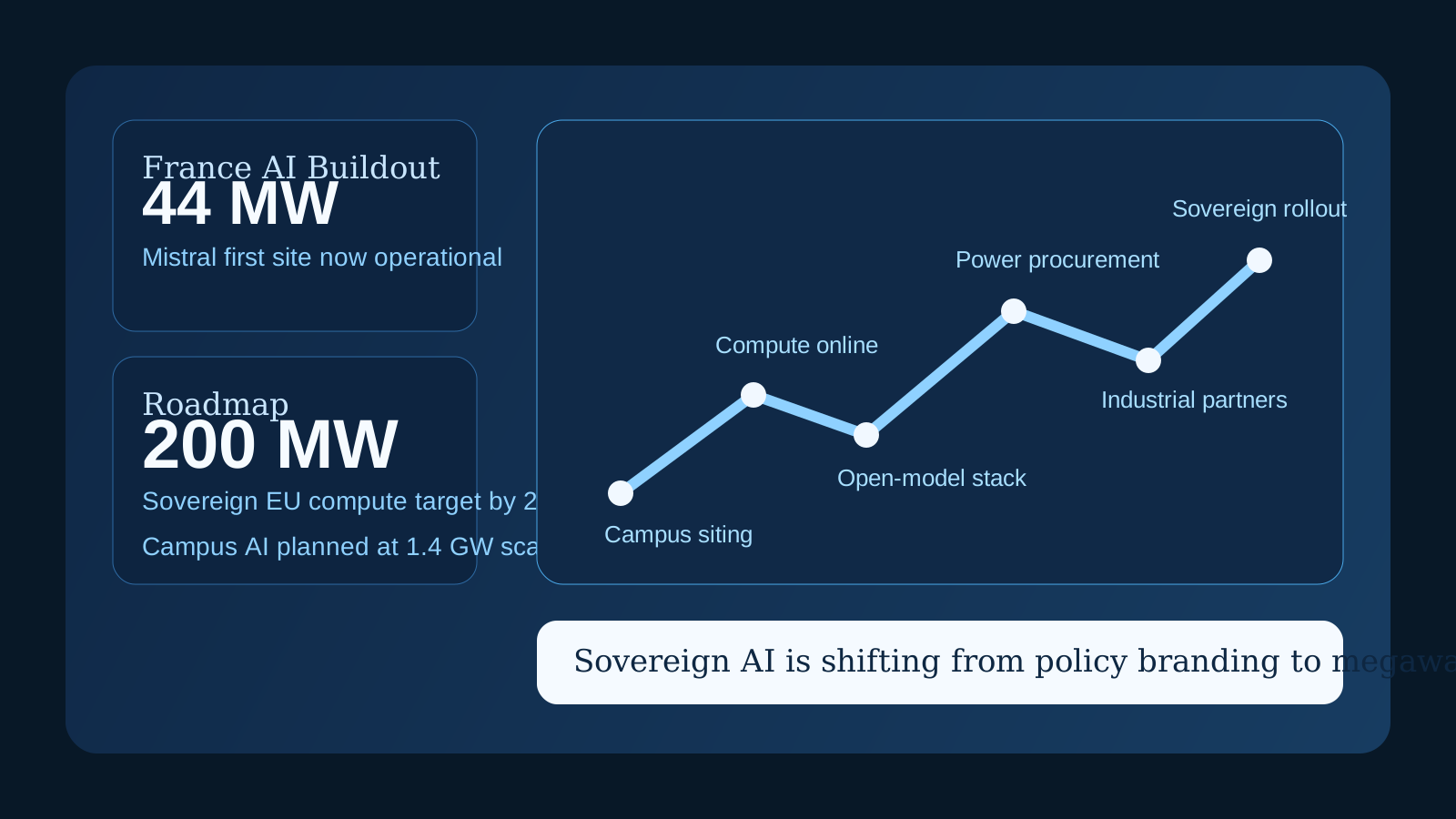
SoftBank’s announcement becomes more useful when read with the June 17 NVIDIA France update. NVIDIA says Mistral’s first deployment is already operational with 18,000 GB200 systems in a new 44-megawatt site, and that Campus AI is being expanded around a planned 1.4-gigawatt facility. Read together, the message is that France is not betting on one isolated data center. It is trying to assemble a sovereign capacity stack that spans public investment, model builders, campus development, and industrial partners.
That is why this belongs in infrastructure rather than a generic policy lane. The core issue is not whether French leaders can make a sovereignty argument. It is whether France can translate that argument into energized campuses, localized manufacturing, and durable deployment capacity before hyperscaler-style bottlenecks take over.
The industrial layer is what makes the story stronger than a usual campus announcement. SoftBank says it will work with Schneider Electric on a Dunkirk production cluster that includes enclosure manufacturing and integration of data center power modules. That matters because gigawatt-scale AI projects are increasingly constrained by electrical equipment, prefabricated power systems, and delivery speed. A sovereign AI strategy that localizes some of that backbone is more credible than one that only announces future GPU demand.
There is also a site-selection lesson in the French framing. SoftBank’s announcement leans heavily on reliable low-carbon electricity, industrial land, and government support for fast-tracking strategic projects. In other words, the sovereign-AI race is being fought with power quality, procedure speed, and industrial readiness as much as with model talent.
This angle is materially different from the site’s recent Amazon India sovereign-capacity coverage. That story was about one cloud provider deepening regional AI capacity. France is broader. It is a national attempt to bundle campuses, energy technology, public capital, open-model builders, and manufacturing into one infrastructure program.
That is enough to publish. Searchers looking for France’s latest AI push do not need another “Europe wants sovereignty” rewrite. The more useful answer is what France is actually trying to build: a multi-gigawatt campus-and-supply-chain machine that can turn sovereign ambition into running compute.
Sources
SoftBank Group, “SoftBank Group to Build 5 GW of AI Data Center Capacity in France,” published May 31, 2026: https://group.softbank/en/news/press/20260531_0
NVIDIA, “France Advances Europe’s AI Future With NVIDIA Technologies,” published June 17, 2026: https://blogs.nvidia.com/blog/france-advances-europes-ai-future/
By Nawaz Lalani
The Grid Report is written by Nawaz Lalani and focuses on source-backed coverage of AI infrastructure, grid power demand, automation systems, and market signals.
Follow the signal, not just the headline.
Get the daily Grid brief for source-backed coverage on AI power demand, infrastructure timing, automation, and market signals.