- OpenAI’s June 23 Appia announcement clears the publish bar because it points to a missing layer in the advanced-AI stack.
- This belongs in the policy lane because the bottleneck is shifting from writing principles to proving compliance.
- That is the stronger Grid Report angle.
- Section
- Policy
- Read time
- 4 min read
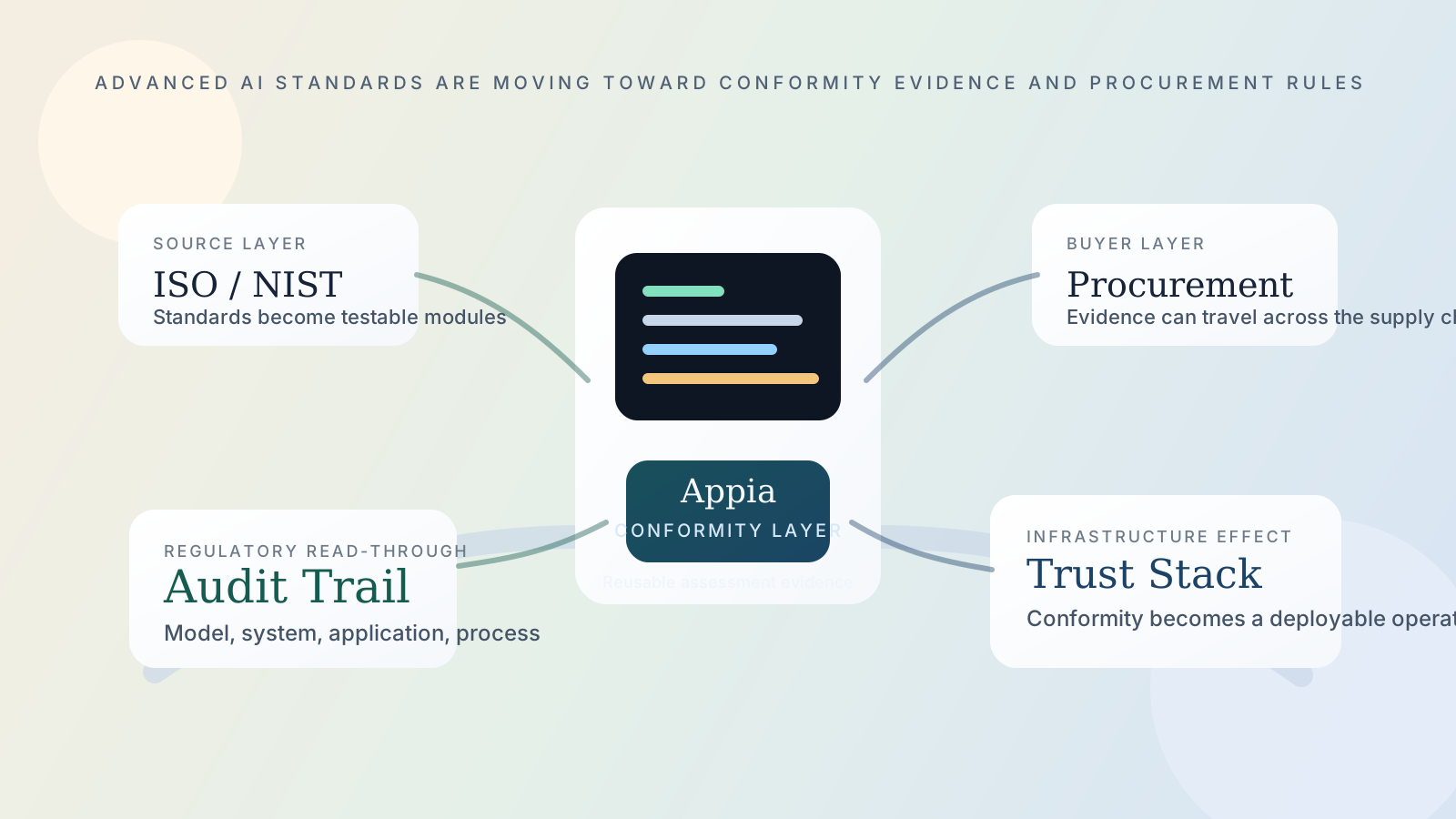
OpenAI’s June 23 Appia announcement clears the publish bar because it points to a missing layer in the advanced-AI stack. The company said it helped found the Appia Foundation, hosted by the Linux Foundation, to develop open and modular specifications that translate broad standards and frameworks into practical assessment criteria across the AI value chain. That matters because the strongest angle is not generic governance rhetoric. It is the emergence of a conformity layer that could make AI systems easier to evaluate, buy, insure, and regulate.
This belongs in the policy lane because the bottleneck is shifting from writing principles to proving compliance. OpenAI said Appia is meant to help third parties check conformity with standards and produce reusable evidence when models, infrastructure, and applications are developed by different organizations. The Linux Foundation described the same problem more bluntly in its June 17 launch release: regulations are moving into enforcement, and value-chain partners increasingly need verifiable proof of trustworthy AI in contracts and vendor reviews.
The real Appia signal is that AI trust is being rebuilt as reusable conformity evidence, not just as another set of principles.
That is the stronger Grid Report angle. AI governance is starting to become procurement infrastructure. If Appia’s modular specifications work as described, they could let an upstream model provider, tooling vendor, or infrastructure operator demonstrate conformity once and pass relevant evidence downstream instead of forcing every buyer to re-audit the full stack from scratch. That would not eliminate risk, but it could lower friction for large enterprises, critical-infrastructure operators, and governments trying to compare vendors under rising regulatory pressure.
The policy read-through extends beyond OpenAI itself. The Linux Foundation says initial Appia members include Arm, Google, Mastercard, Microsoft, Mitsubishi Electric, OpenAI, Schneider Electric, and Siemens. That coalition matters because it suggests the market is trying to build a vendor-neutral trust rail rather than a single-company certification scheme. When industrial, cloud, payments, and infrastructure players show up in the same standards effort, the likely demand is not only for model safety language. It is for assessment machinery that can travel across procurement teams, sectors, and jurisdictions.
Operator relevance is direct. Companies deploying advanced AI increasingly need evidence that a model, system, or workflow meets internal control standards before it touches production data, regulated processes, or customer-facing operations. Investors should also pay attention. A real conformity layer can change which parts of the AI stack capture value by rewarding vendors that can package auditable evidence, map cleanly to legal frameworks, and reduce diligence costs for buyers.
There are still reasons to stay narrow. Appia is early, and standards bodies do not automatically become market power. OpenAI’s post is directional, not proof that governments or major enterprises will adopt one shared mechanism quickly. But the underlying signal is strong enough to publish: advanced AI is moving toward a world where trust has to be evidenced in reusable, machine-readable, and procurement-friendly form. That is a more concrete story than another abstract call for responsible AI.
This also connects to OpenAI’s wider governance push. The company said Appia builds on its Frontier Governance Framework, its third-party evaluation playbook, and its broader call for stronger national and international assessment institutions. Read together, the more useful conclusion is that frontier labs are no longer only publishing safety documents. They are trying to shape the compliance plumbing that may sit between model builders, regulators, enterprise buyers, and infrastructure providers.
That is why this is search-worthy. The useful query is not simply whether OpenAI supports standards. It is how AI standards may become a conformity-and-procurement layer that determines who can prove trust fastest as regulation, enterprise diligence, and cross-border deployment all get harder.
Sources
OpenAI, “Helping build shared standards for advanced AI,” published June 23, 2026: https://openai.com/index/helping-build-shared-standards-for-advanced-ai/
Linux Foundation, “Linux Foundation Launches Appia Foundation to Establish Standardized Conformity Specifications Across the AI Value Chain,” published June 17, 2026: https://www.linuxfoundation.org/press/linux-foundation-launches-appia-foundation-to-establish-standardized-conformity-specifications-across-the-ai-value-chain
OpenAI, “OpenAI’s Frontier Governance Framework,” published May 28, 2026: https://openai.com/index/openai-frontier-governance-framework/
OpenAI, “A blueprint for democratic governance of frontier AI,” published June 2, 2026: https://openai.com/index/frontier-safety-blueprint/
By Nawaz Lalani
The Grid Report is written by Nawaz Lalani and focuses on source-backed coverage of AI infrastructure, grid power demand, automation systems, and market signals.
Follow the signal, not just the headline.
Get the daily Grid brief for source-backed coverage on AI power demand, infrastructure timing, automation, and market signals.