- The White House’s July 23 expansion of the Ratepayer Protection Pledge clears the publish bar because the useful signal is not only that more utilities, states, cooperatives, and developers signed onto a federal initiative.
- That is the original angle.
- The March 4 pledge text is what makes the July 23 expansion worth publishing now.
- Section
- Policy
- Read time
- 4 min read
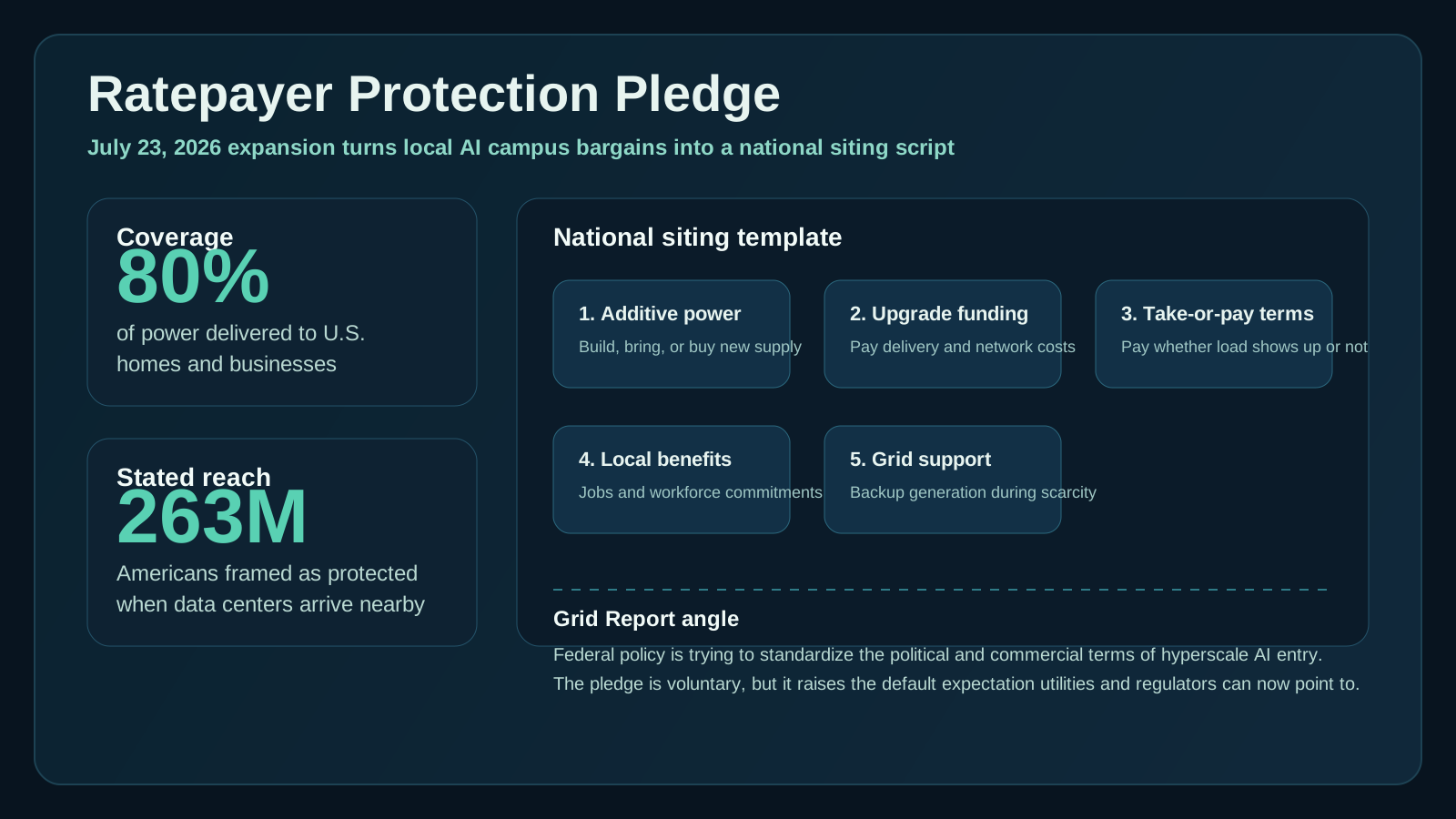
The White House’s July 23 expansion of the Ratepayer Protection Pledge clears the publish bar because the useful signal is not only that more utilities, states, cooperatives, and developers signed onto a federal initiative. The stronger story is structural. Washington is trying to turn a messy, local utility fight into a national siting template for AI infrastructure: if you want to build at hyperscale, you should bring or buy additive power, pay for the required delivery upgrades, accept take-or-pay style obligations, invest locally, and offer backup support when the grid is stressed.
That is the original angle. The White House said the expanded pledge now includes more than 200 additional participants, covers 80% of power delivered to U.S. homes and businesses, and protects 263 million Americans when a data center is built nearby. Read narrowly, those are political adoption metrics. Read correctly, they show the administration trying to standardize the social license for large-load AI projects before backlash over utility bills, stranded upgrades, and community impacts hardens into a broader anti-build coalition.
Washington is trying to turn ratepayer protection from a local bargaining chip into the national operating script for hyperscale AI siting.
The March 4 pledge text is what makes the July 23 expansion worth publishing now. The underlying framework is unusually explicit. Companies are asked to build, bring, or buy new power supply; pay for new delivery infrastructure upgrades; keep paying for that capacity whether they use it or not; invest in local job creation; and coordinate with grid operators so backup generation can contribute during scarcity events. That list matters because it moves ratepayer protection out of generic corporate-responsibility language and into a more operational contract for how AI load is supposed to enter the system.
This is why the story belongs in policy rather than commodity politics coverage. The practical question is no longer only whether one state commission or one utility can negotiate a strong tariff. The federal government is now trying to aggregate those bargains into a national default expectation. In effect, the White House is telling hyperscalers, model labs, utilities, and developers that the era of “just connect us and socialize the consequences later” is politically over.
That read-through also clears the duplicate screen. The site’s July stories on Oracle in Wisconsin, New Jersey’s tariff bill, Google’s Alabama deal, PJM backup-generation operations, and OpenAI’s Project Camellia all focused on specific projects, tariffs, or jurisdictions. This thesis is materially different. The White House expansion matters because it attempts to bundle those once-local protections into a nationwide siting script that other regulators and counterparties can point to.
The operator relevance is straightforward. Developers should assume future campus negotiations will increasingly converge on the same diligence stack: additive supply, full upgrade cost coverage, minimum-payment commitments, enforceable local benefits, and some expectation of emergency flexibility. Utilities and regulators should read the pledge as political cover for pushing harder on customer-specific tariffs and contribution requirements. Investors should read it as a signal that project economics will increasingly depend on who can carry the extra contractual weight without breaking returns.
There are real limits. The pledge remains voluntary, its enforcement mechanics are uneven, and several of the examples the White House cites still depend on separate state tariffs, commission orders, and utility agreements to become durable. The federal announcement does not eliminate the underlying fights over collateral, water, transmission cost allocation, environmental review, or whether promised customer savings actually materialize over time.
Those caveats do not weaken the story. They are the story. Washington is not nationalizing AI power regulation; it is nationalizing the political standard by which large-load projects will increasingly be judged. That is enough to matter for searchers, operators, and investors trying to understand what changed on July 23. The White House is effectively trying to turn data-center ratepayer protection from a defensive talking point into the minimum operating script for hyperscale AI siting in the United States.
Sources
The White House, “President Trump’s Ratepayer Protection Pledge Secures American AI Dominance, Protects Consumers,” published July 23, 2026: https://www.whitehouse.gov/releases/2026/07/president-trumps-ratepayer-protection-pledge-secures-american-ai-dominance-protects-consumers/
The White House, “Ratepayer Protection Pledge,” published March 4, 2026: https://www.whitehouse.gov/releases/2026/03/ratepayer-protection-pledge/
By Nawaz Lalani
The Grid Report is written by Nawaz Lalani and focuses on source-backed coverage of AI infrastructure, grid power demand, automation systems, and market signals.
Follow the signal, not just the headline.
Get the daily Grid brief for source-backed coverage on AI power demand, infrastructure timing, automation, and market signals.