- Alberta’s Claude Code deployment clears the publish bar because the useful signal is not that a government found a clever AI demo.
- Anthropic said on July 6 that the Government of Alberta used Claude Code with Opus and Sonnet models to assess 466 million lines of code in about 20 hours across the systems of all 27 provincial ministries.
- That verification detail is the real operator story.
- Section
- AI Automation
- Read time
- 5 min read
Alberta’s Claude Code deployment clears the publish bar because the useful signal is not that a government found a clever AI demo. The stronger signal is that it used agentic coding to convert an unmanageable legacy-estate problem into a triage system for cybersecurity, documentation, and modernization.
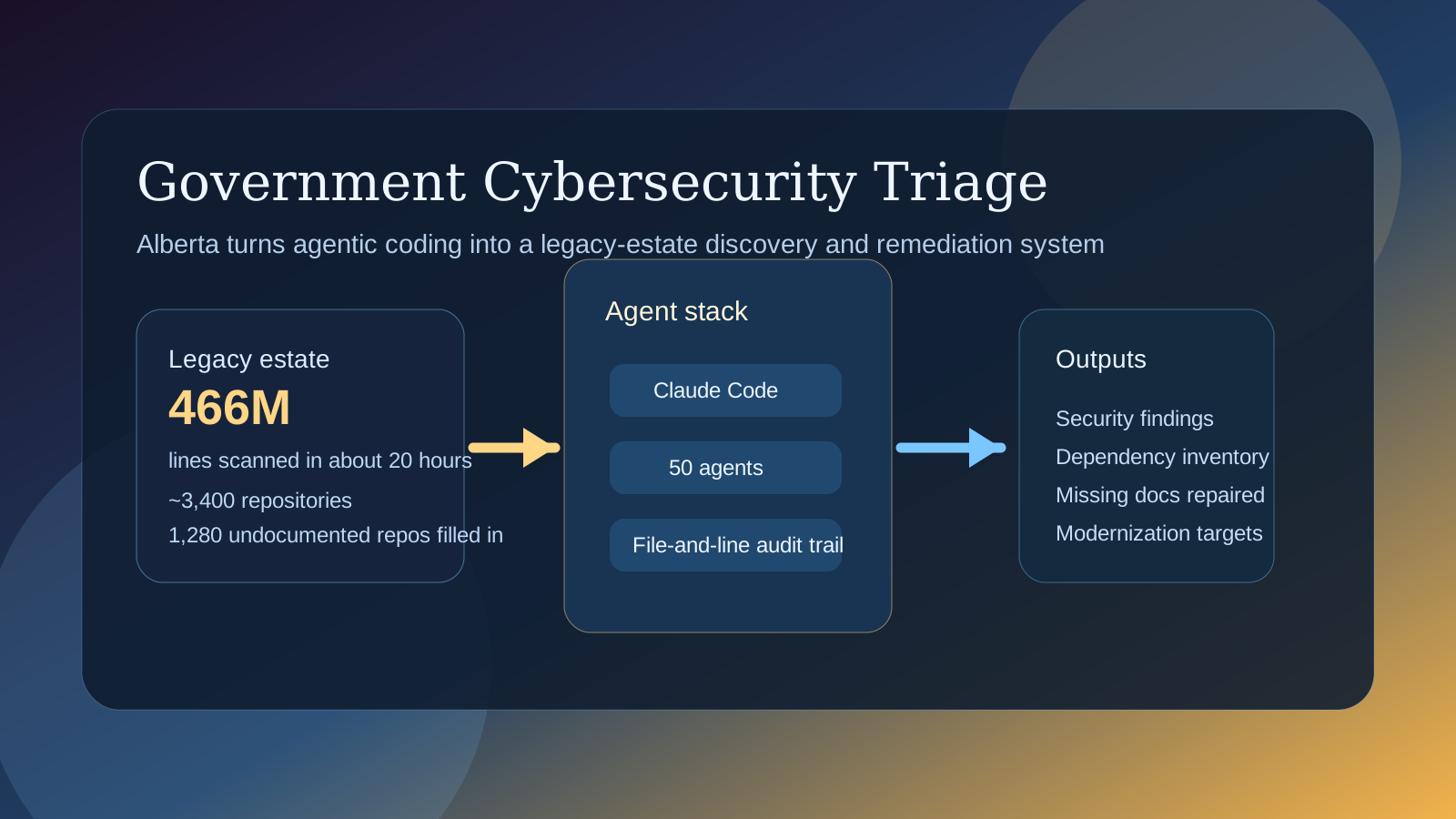
Anthropic said on July 6 that the Government of Alberta used Claude Code with Opus and Sonnet models to assess 466 million lines of code in about 20 hours across the systems of all 27 provincial ministries. The case study says around 50 agents worked in parallel to scan for vulnerabilities, infrastructure and deployment weaknesses, and documentation gaps. Alberta’s related Git Insights white paper says the process covered roughly 3,400 repositories and produced file-and-line-cited findings developers could verify directly.
Alberta is using agentic coding less like a chatbot and more like a triage system for legacy code, cyber risk, and modernization sequencing.
That verification detail is the real operator story. Alberta’s white paper says the AI was not allowed to make vague claims. When it reported a problem, it had to identify the exact file and line, explain severity, and suggest a fix so human teams could open the code and confirm the result. That turns agentic coding from a loose assistant into a governed triage layer that can actually fit public-sector remediation workflows.
This belongs in systems because the story is about execution architecture, not model prestige. Alberta describes a two-layer process: a rules engine flags known patterns and the AI agent applies judgment, while results flow into a broader observability and dashboard stack. The same program also wrote missing documentation, mapped business capabilities, and exposed redundancy across the estate. In other words, cyber review was not isolated from modernization; it became one system for understanding what the government actually runs and what to fix first.
The stronger original angle is that AI is compressing time against attacker capability. Alberta’s Git Insights paper says vulnerability pressure inflected upward alongside stronger public models, and argues that the same capability helping defenders read an estate at depth also helps attackers find flaws faster. That makes the economic case for automation sharper: if offensive discovery is accelerating, defensive review cannot stay human-linear.
It also avoids overlap with current coverage. The site already has stories on physical AI validation, coding-agent benchmark integrity, and enterprise rollout controls. This article is materially different. It shows agentic coding operating as a public-sector cyber and technical-debt triage machine, with auditable outputs and clear constraints around governance, privacy, and supply-chain control.
That gives the story search value. People looking up Alberta’s Claude Code program do not just need the headline claim that 466 million lines were scanned quickly. The more useful answer is that a government is building a repeatable system for legacy-estate reconnaissance, remediation prioritization, and modernization under real operational guardrails.
Sources
Anthropic, “Government of Alberta uses Claude to find and fix cybersecurity vulnerabilities across government systems,” published July 6, 2026: https://www.anthropic.com/news/alberta-government-claude-cybersecurity
The Velocity White Papers, “Git Insights”: https://thevelocitywhitepapers.com/paper/bbkac/
The Velocity White Papers, “The Agentic Technology Stack”: https://thevelocitywhitepapers.com/paper/qxlzo/
The Velocity White Papers, “The AI Factory: Orchestration and Observation (Nexus)”: https://thevelocitywhitepapers.com/paper/uwpxr/
By Nawaz Lalani
The Grid Report is written by Nawaz Lalani and focuses on source-backed coverage of AI infrastructure, grid power demand, automation systems, and market signals.
Follow the signal, not just the headline.
Get the daily Grid brief for source-backed coverage on AI power demand, infrastructure timing, automation, and market signals.