- OpenAI’s July 17 scorecard clears the publish bar because it tells the market to measure AI differently.
- That matters because enterprise AI has spent the last year drifting between two weak measurement systems.
- The strongest detail in the post is where OpenAI says to start: define what “done” means inside the system where the work happens.
- Section
- AI Automation
- Read time
- 4 min read
- Data included
- OpenAI’s scorecard tries to replace AI vanity metrics with workflow economics
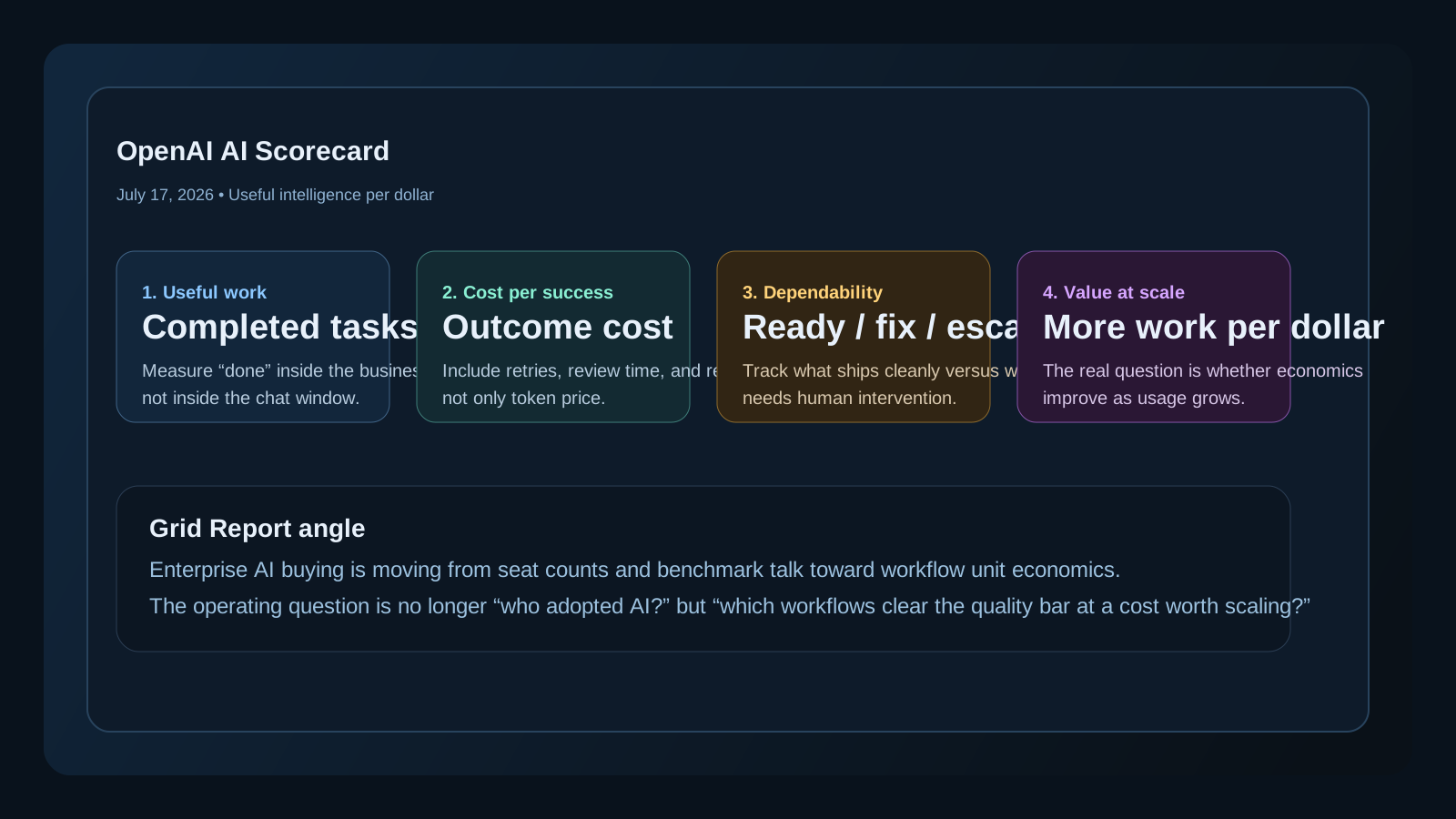
OpenAI’s scorecard tries to replace AI vanity metrics with workflow economics
The useful shift is from counting access or activity to measuring what a workflow actually produces at an acceptable quality bar.
| Metric | What OpenAI says to measure | Why it matters |
|---|---|---|
| Useful work | Completed tasks that matter inside a real workflow | Moves AI evaluation from chats and tokens to operator-grade outcomes. |
| Cost per successful task | Full cost including compute, retries, review, and rework | Shows why the cheapest token is not always the cheapest result. |
| Dependability | Ready to use, needs correction, or needs escalation | Turns trust and review burden into measurable operating data. |
| Value at scale | Whether completed work grows faster than total cost | Separates one-off demos from workflows that deserve expansion. |
Source: OpenAI, “A scorecard for the AI age,” published July 17, 2026.
OpenAI’s July 17 scorecard clears the publish bar because it tells the market to measure AI differently. Sarah Friar argues that software-style adoption metrics such as seats purchased and users active are not enough. The better frame is “Useful Intelligence per Dollar,” measured by how much useful work gets done, what each successful task actually costs, how often the result is dependable, and whether each AI dollar buys more work as usage grows.
That matters because enterprise AI has spent the last year drifting between two weak measurement systems. One is consumer-style excitement around prompts, benchmarks, and model launches. The other is SaaS-style reporting around rollouts and seat counts. OpenAI is proposing something stricter. The unit of value should be completed work inside a real workflow, not activity around the tool.
Enterprise AI is moving toward a harder question than adoption: what does a dependable successful task actually cost?
The strongest detail in the post is where OpenAI says to start: define what “done” means inside the system where the work happens. For support, that could be a resolved case. For engineering, it could be a code change that passes tests. For legal, it could be a contract reviewed accurately and on time. That is a better operator lens than counting tokens or chats because it connects model usage to an actual business output.
This is why the story belongs in systems rather than generic AI commentary. OpenAI is trying to push enterprise buyers toward workflow-level unit economics. The post says businesses should track the full cost of completing work well, including employee time, human review, retries, and rework. That shifts the buying question away from the cheapest model in isolation and toward the cheapest dependable outcome.
There is also a clean control-layer implication. In the dependability section, OpenAI says teams should track whether results are ready to use, need correction, or need escalation. It also says organizations should define what data the system can access, what systems it can use or change, and when a person should review or approve an action. That means the scorecard is not only about ROI. It is also about when governance becomes part of the economics.
The better original angle is that enterprise AI is being priced like labor compression rather than software access. Once the question becomes cost per successful task, companies can compare model tiers, routing choices, human review policies, and workflow design on the same scoreboard. That is much more useful than arguing over which model is “best” in the abstract.
This also extends current site coverage without repeating it. The Grid Report already covered OpenAI’s spend controls as a FinOps layer, its partner network as a channel-and-control layer, and GPT-5.6 in Microsoft 365 Copilot as a subprocessor-control story. The July 17 scorecard adds a different layer: what enterprise buyers should measure once those controls and routes already exist.
The reason this can help search is that people looking up OpenAI’s scorecard need more than a recap of four bullet points. The more useful answer is that OpenAI is trying to move enterprise AI buying toward workflow unit economics, where cost per successful task and dependability matter more than usage volume by itself.
Sources
OpenAI, “A scorecard for the AI age,” published July 17, 2026: https://openai.com/index/a-scorecard-for-the-ai-age/
By Nawaz Lalani
The Grid Report is written by Nawaz Lalani and focuses on source-backed coverage of AI infrastructure, grid power demand, automation systems, and market signals.
Follow the signal, not just the headline.
Get the daily Grid brief for source-backed coverage on AI power demand, infrastructure timing, automation, and market signals.