- NVIDIA’s July 21 Spectrum-6 launch clears the publish bar because it gives a sharper answer than “faster networking is good.” The stronger infrastructure signal is that AI-factory economics are moving below the GPU and into the network fabric.
- That is the original angle.
- The useful operator read-through is not about Ethernet branding.
- Section
- Infrastructure
- Read time
- 4 min read
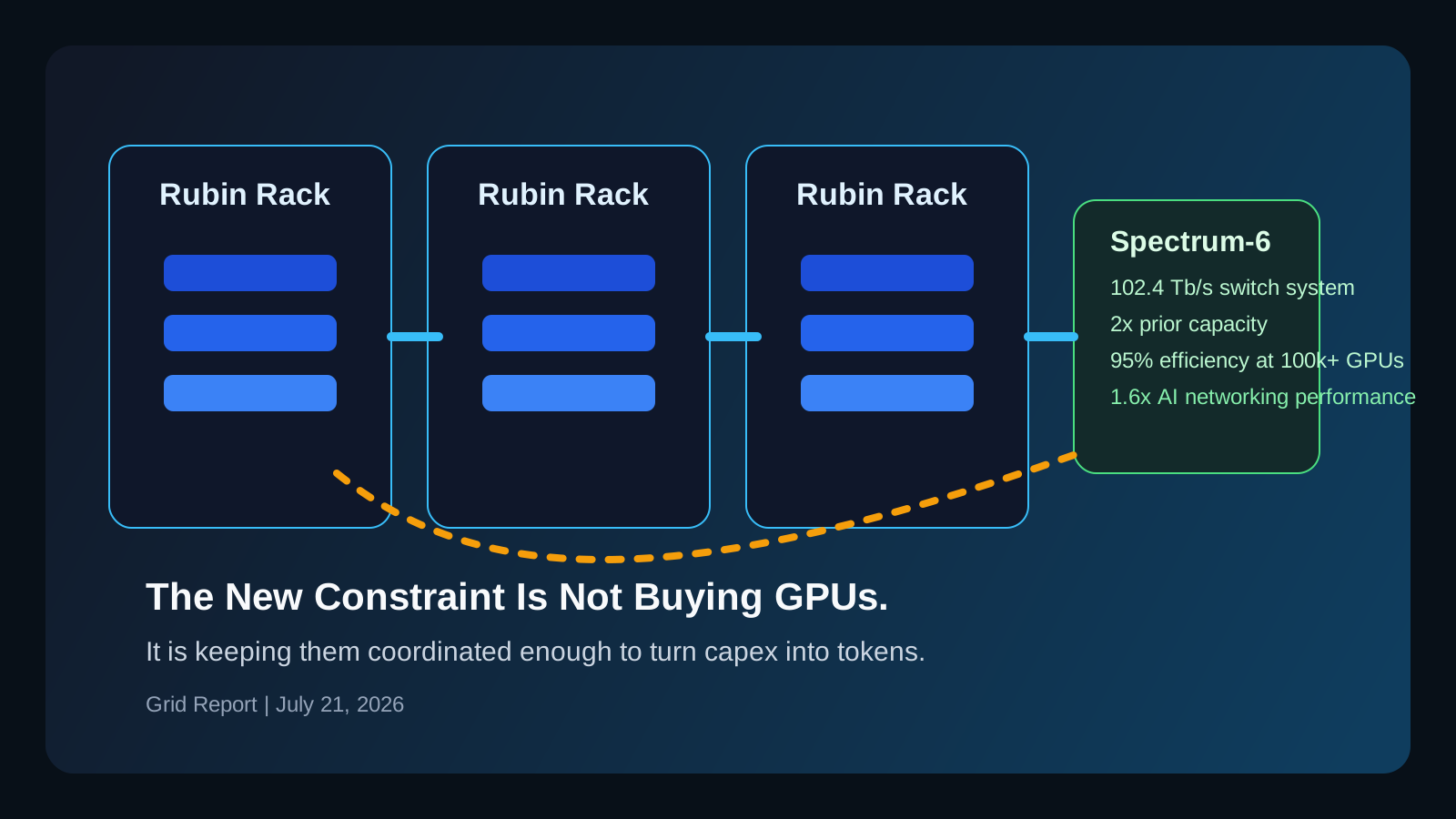
NVIDIA’s July 21 Spectrum-6 launch clears the publish bar because it gives a sharper answer than “faster networking is good.” The stronger infrastructure signal is that AI-factory economics are moving below the GPU and into the network fabric. Once clusters reach hundreds of thousands of accelerators, the real question is no longer only how many chips an operator bought. It is how much of that purchased compute can stay synchronized well enough to produce useful work.
That is the original angle. NVIDIA says Spectrum-6 is a 102.4-terabit-per-second Ethernet switch system built for gigascale AI factories, with twice the capacity of the prior generation. More important than the raw number is the company’s framing: AI performance has become a network problem because collective communications and east-west traffic increasingly determine whether large training and inference jobs stay efficient. Read plainly, networking is becoming a utilization product.
At gigascale, the network is no longer plumbing. It is the layer that decides how much GPU capex turns into useful tokens.
The useful operator read-through is not about Ethernet branding. It is about token economics. NVIDIA says Spectrum-X Ethernet can deliver up to 1.6 times higher AI networking performance than off-the-shelf Ethernet, sustain up to 95% efficiency in deployments above 100,000 GPUs, and reduce switch counts through multiplane topologies. If those gains hold in production, they do not merely make clusters “faster.” They raise the odds that expensive GPU fleets stay busy enough to lower cost per useful token.
That is why this belongs in infrastructure rather than generic chip coverage. The site has already covered optics manufacturing, connector serviceability, TOP500 networking, and Vera Rubin post-training economics. Spectrum-6 is a materially different thesis. It says the next AI capacity bottleneck is increasingly about coordination overhead inside the cluster itself. When one slow link can stall a large collective operation, the network becomes part of the compute business.
The named early adopters make the signal more credible. NVIDIA says CoreWeave, Microsoft, and Nebius will be among the first providers deploying Vera Rubin-based infrastructure with Spectrum-6, while SpaceXAI and Tesla are also named as early builders. That is useful because it places the announcement inside real hyperscale and AI-cloud deployment plans rather than leaving it as a lab benchmark story.
This also clears the duplicate screen. The June 23 TOP500 article argued that AI infrastructure was becoming a systems race across GPUs, CPUs, and power-aware networking. The June 24 Coherent story focused on optical manufacturing capacity. The July 17 Vera Rubin piece focused on continuous-learning economics. Spectrum-6 adds a cleaner new layer: how network behavior governs actual GPU utilization once the factory is already built.
There are still limits. This is vendor-framed material, and NVIDIA’s efficiency claims need to prove out in real fleets under mixed workloads. But that caveat does not weaken the strategic takeaway. It makes it more precise: the next search question in AI infrastructure is not just who has access to the most accelerators, but who can keep those accelerators coordinated cheaply enough to convert capex into tokens.
That is enough to publish. Searchers looking up Spectrum-6 do not need another spec sheet rewrite. The more useful answer is that AI networking is turning into a first-order utilization and economics layer for gigascale compute.
Sources
NVIDIA Blog, “Built for Vera Rubin, NVIDIA Spectrum-6 Arrives in Gigascale AI Factories,” published July 21, 2026: https://blogs.nvidia.com/blog/nvidia-spectrum-six-arrives-in-gigascale-ai-factories/
NVIDIA Blog, “NVIDIA Vera Rubin Driving Performance Per Watt, Lowest Token Cost for Partners Worldwide,” published July 21, 2026: https://blogs.nvidia.com/blog/vera-rubin/
By Nawaz Lalani
The Grid Report is written by Nawaz Lalani and focuses on source-backed coverage of AI infrastructure, grid power demand, automation systems, and market signals.
Follow the signal, not just the headline.
Get the daily Grid brief for source-backed coverage on AI power demand, infrastructure timing, automation, and market signals.