- EIA’s June 18 Permian update clears the publish bar because it adds a missing layer to the Texas AI-power story.
- The headline figure is straightforward.
- That matters because AI power in Texas is increasingly discussed in two operating formats: grid-connected campuses that need firm backup, and faster-to-market campuses that may lean on self-supplied or colocated generation.
- Section
- Energy
- Read time
- 4 min read
EIA’s June 18 Permian update clears the publish bar because it adds a missing layer to the Texas AI-power story. Most recent coverage has focused on queues, curtailment, and transmission rules. EIA’s data suggest that another piece matters just as much for large-load developers: the fuel base behind any gas-fired generation strategy is still growing quickly, and it is growing faster than crude production itself.
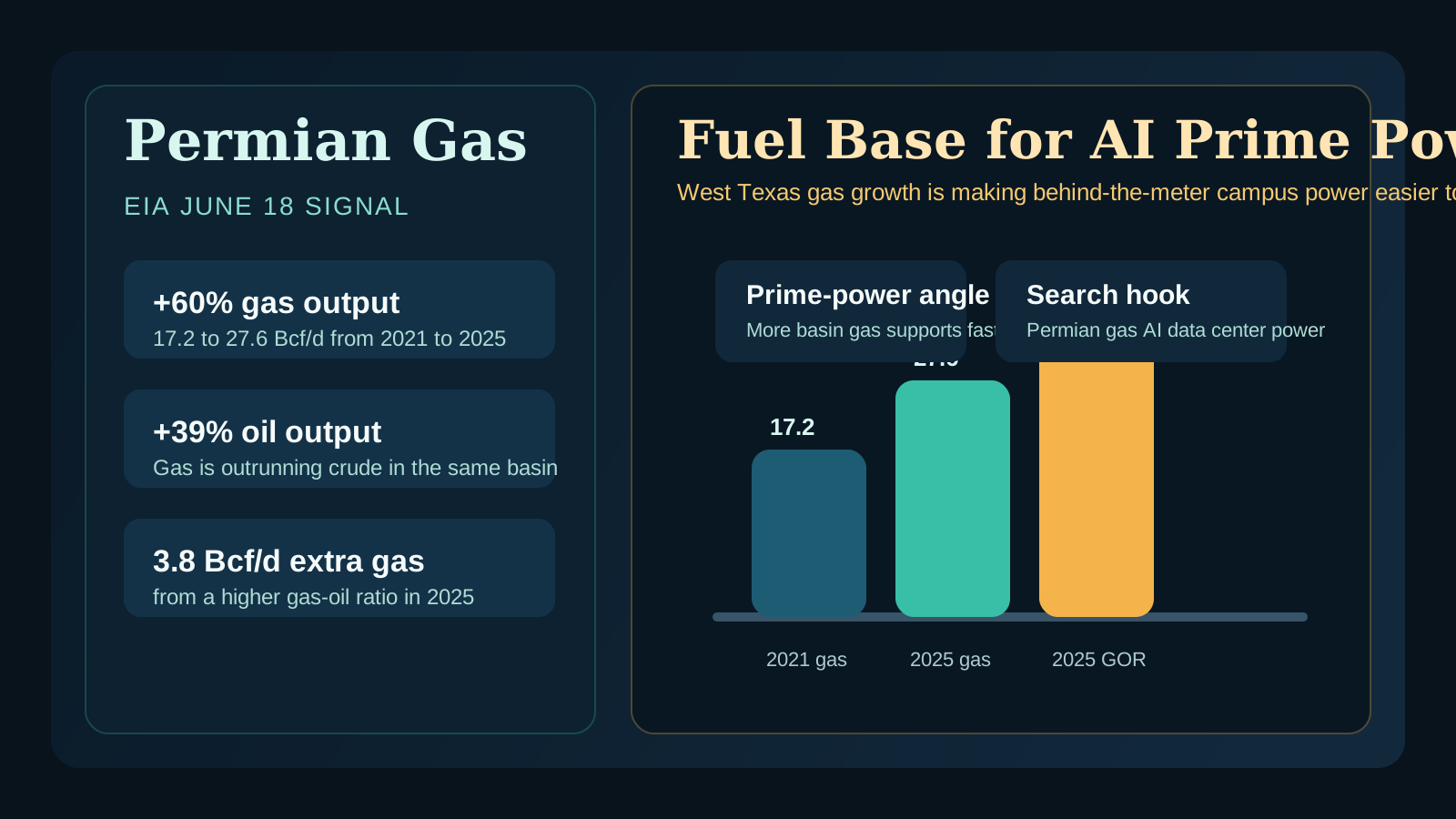
The headline figure is straightforward. EIA said Permian marketed natural gas production rose from 17.2 billion cubic feet per day in 2021 to 27.6 Bcf/d in 2025, a 60% increase. Over the same period, crude oil production rose from 4.7 million barrels per day to 6.6 million b/d, a 39% increase. The more interesting conclusion is why that happened. EIA attributes the faster gas growth to rising gas-oil ratios as the basin matures, which means Texas is producing more associated gas per barrel of oil than it did a few years ago.
Texas AI power is no longer only a queue story. It is also a question of which projects can turn gas abundance into bankable, dispatchable capacity first.
That matters because AI power in Texas is increasingly discussed in two operating formats: grid-connected campuses that need firm backup, and faster-to-market campuses that may lean on self-supplied or colocated generation. In both cases, gas remains central. If the fuel picture is strengthening while the transmission queue remains crowded, then speed to power may depend less on finding any molecule at all and more on contracting the right generation package, siting it correctly, and securing the interconnection pathway around it.
The June 18 EIA note makes the fuel expansion more concrete. In 2025, the Permian gas-oil ratio averaged nearly 4,200 cubic feet of gas per barrel of oil, up 16% from 2021. EIA said that if the 2021 ratio had stayed flat, the region would have produced only 23.8 Bcf/d of natural gas in 2025 rather than the actual 27.6 Bcf/d. That extra 3.8 Bcf/d is the useful signal. It suggests the basin is not just getting bigger in absolute terms. It is becoming more gas-rich at the margin.
Pipeline capacity is the second reason the story holds up. EIA said on May 26 that developers plan to bring 44.9 Bcf/d of new pipeline capacity online nationwide in 2026 and 2027, with more than 66% of those additions originating in Texas. EIA tied those projects directly to additional Permian takeaway and to clearing the Waha bottleneck. Read plainly, Texas is not only producing more associated gas. It is also building more infrastructure to move that gas toward export terminals, industrial users, power demand, and other end markets.
This does not mean fuel solves the grid. The Batch Zero decision in ERCOT still matters because a campus with gas access can remain blocked by transmission, distribution, or reliability requirements. But that caveat is exactly why the story is useful. The Texas AI buildout is starting to look like a chain of dependencies rather than one master bottleneck. Fuel, pipeline takeaway, generation equipment, interconnection rights, and curtailment terms all matter together.
For investors, the implication is that not every Texas AI-power story should be read as a pure utility or transmission trade. Some of the edge may sit with gas transport, prime-power developers, turbine suppliers, or campus designs that can convert fuel availability into a faster energization path. For operators, the implication is more practical: a site that looks constrained on wires may still be financeable if the fuel and generation strategy is stronger than the market assumes.
There are limits. EIA is describing basin-wide production trends, not promising that every proposed data-center campus can secure cheap gas or build on-site generation without delay. Gas abundance also does not erase air-permitting, equipment lead times, or political pushback around fossil-heavy AI infrastructure. The right takeaway is narrower and still useful: Texas AI power is becoming a fuel-and-logistics problem as much as a tariff-and-queue problem.
That is enough to publish because it is both timely and more original than a generic rewrite of the latest grid-rule fight. The better search-worthy question is not only who gets in line first. It is what fuel system can actually support the next wave of Texas AI load when those projects try to move from paper to power.
Sources
U.S. Energy Information Administration, “Permian natural gas production increased faster than crude oil,” published June 18, 2026: https://www.eia.gov/todayinenergy/detail.php?id=67785
U.S. Energy Information Administration, “Most planned natural gas pipeline capacity additions in 2026 and 2027 originate in Texas,” published May 26, 2026: https://www.eia.gov/todayinenergy/detail.php?id=67707
U.S. Energy Information Administration, Short-Term Energy Outlook, released June 9, 2026: https://www.eia.gov/outlooks/steo/
By Nawaz Lalani
The Grid Report is written by Nawaz Lalani and focuses on source-backed coverage of AI infrastructure, grid power demand, automation systems, and market signals.
Follow the signal, not just the headline.
Get the daily Grid brief for source-backed coverage on AI power demand, infrastructure timing, automation, and market signals.