- Representative Alexandria Ocasio-Cortez’s June 24, 2026 House introduction clears the publish bar because it changes the status of a story that was easy to dismiss back on March 25.
- The strongest Grid Report angle is not that Washington has discovered new concerns about AI.
- That distinction matters because the bill is broader than a narrow model-safety argument.
- Section
- Policy
- Read time
- 5 min read
- Data included
- What changed when the House version landed
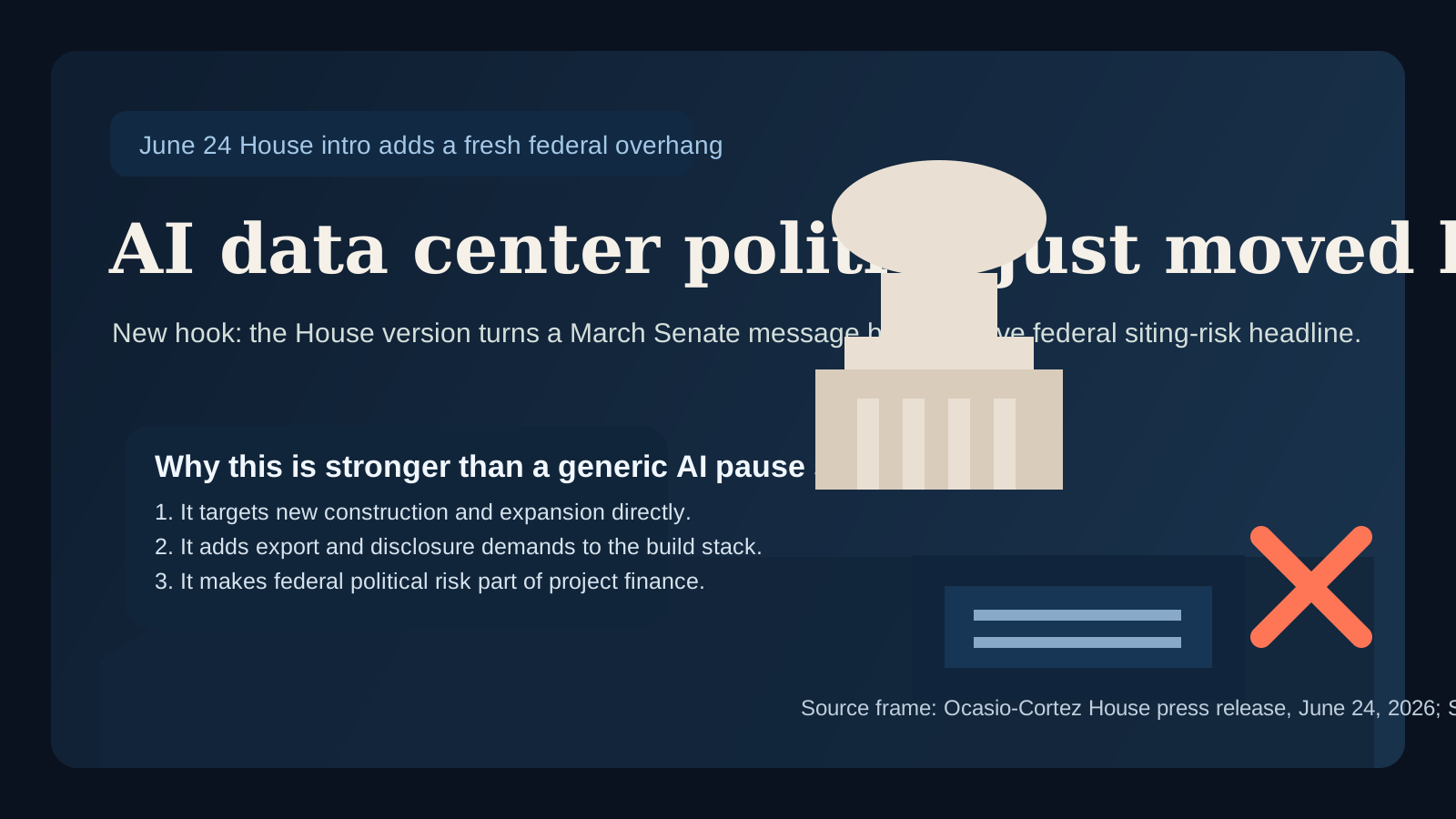
What changed when the House version landed
The bill concept is older, but the June 24 House filing refreshes the political risk around current AI-campus buildouts.
| Element | What the sources say | Why it matters now |
|---|---|---|
| Fresh trigger | Ocasio-Cortez introduced the House version on June 24, 2026 | The story re-enters the current policy cycle instead of staying a March Senate-only headline. |
| Core restriction | The bill would temporarily prohibit new data-center construction and expansion | This is a direct threat to the physical buildout pipeline, not just an AI governance talking point. |
| Conditions to lift pause | Sponsors tie the pause to safety, worker outcomes, and community and environmental safeguards | Developers now face a broader public-justification burden around the full project stack. |
| Extra provisions | The release highlights export restrictions and reporting on water, energy, wastewater, wages, and financial vehicles | The proposal reaches beyond model policy into infrastructure disclosure and international buildout. |
| Investor read-through | The House filing follows the March 25 Senate companion rather than replacing it | Even if enactment odds are low, repeated introductions can widen the political risk premium around large AI campuses. |
Sources: Ocasio-Cortez House press release published June 24, 2026, and Sanders Senate press release published March 25, 2026.
Representative Alexandria Ocasio-Cortez’s June 24, 2026 House introduction clears the publish bar because it changes the status of a story that was easy to dismiss back on March 25. The Senate-side announcement from Senator Bernie Sanders and Ocasio-Cortez was important, but it still looked like an early warning shot. The new House version gives the Artificial Intelligence Data Center Moratorium Act a fresh federal timestamp and puts the fight back into the active construction and permitting conversation this week.
The strongest Grid Report angle is not that Washington has discovered new concerns about AI. It is that anti-data-center politics are being reframed as a direct buildout constraint. Ocasio-Cortez said the bill would create a temporary prohibition on the construction of new data centers and the expansion of existing data centers until Congress passes broader legislation covering AI’s economic, environmental, and safety effects. Read plainly, that is not a governance memo. It is a siting and expansion threat pointed at the physical AI stack.
The June 24 House filing matters because it turns a message bill into a current federal siting-risk headline for AI campus growth.
That distinction matters because the bill is broader than a narrow model-safety argument. The June 24 House release ties the measure to rising electricity bills, community harm, environmental damage, worker outcomes, and surveillance concerns. It also says the legislation would ban U.S. exports of AI computing infrastructure to countries that lack equivalent safeguards and would require reporting on financial vehicles, water usage, energy usage, wastewater discharge, and worker wage and benefit information tied to data-center operations. The proposal is reaching for the full project stack, not only the chatbot layer.
This is why the story belongs in policy rather than opinion. The useful question is not whether the bill becomes law in its current form. The useful question is what kind of risk premium it introduces right now. A federal moratorium proposal tells developers, utilities, lenders, and state officials that data-center growth is no longer only a local land-use fight or a regional rate-case fight. It is becoming part of a national political coalition that is willing to challenge the premise that more AI capacity should keep moving by default.
The June 24 House version is the new hook that makes this publishable now. The Senate companion was announced on March 25, 2026. That older date matters because it keeps the story honest. This is not a brand-new bill concept. What changed is that the House side refreshed the measure, attached new cosponsors, and put the proposal back into the current cycle of AI infrastructure debate. Searchers looking for the bill today are likely trying to understand exactly that: why this story is back and whether it affects current project planning.
The deeper operator read-through is that federal political risk is starting to sit beside interconnection risk, tariff risk, and local backlash risk. The Grid Report has already covered Virginia turning data-center electricity into a political-cost story and FERC forcing large-load tariff questions into the open. This bill is different. It is not about how to charge data centers more cleanly or study them faster. It argues that new construction itself should pause until a national bargain is in place. That is a much harder signal for investors to ignore, even if the bill faces long odds.
There are obvious limits. The legislation still has to survive a hostile path through Congress, and the current release is a political introduction rather than an enacted federal rule. But weak odds do not make weak signals. The reason this matters is that it broadens the set of stakeholders who may decide to treat AI campus growth as something that requires explicit public justification before every next expansion phase. Once that frame becomes normal, project timelines can lengthen even without a statutory freeze.
It also sharpens the next question for the industry. If the strongest defense against a moratorium is that AI campuses create jobs, protect ratepayers, and manage power and water impacts responsibly, then developers will need much cleaner evidence on those points than the sector has often provided. In that sense, the bill is already a forcing function. It increases the value of operator credibility and transparent utility bargains even before any vote count changes.
That is enough to publish. The search-worthy answer is not “AOC opposes data centers.” The more useful answer is that the June 24 House filing turns the AI Data Center Moratorium Act into a current federal siting-risk story with consequences for financing, disclosure, and how the next wave of AI campuses gets defended in public.
Sources
Representative Alexandria Ocasio-Cortez, “Ocasio-Cortez Introduces House Version of the AI Data Center Moratorium Act,” published June 24, 2026: https://ocasio-cortez.house.gov/media/press-releases/ocasio-cortez-introduces-house-version-ai-data-center-moratorium-act
Senator Bernie Sanders, “Sanders, Ocasio-Cortez Announce AI Data Center Moratorium Act,” published March 25, 2026: https://www.sanders.senate.gov/press-releases/news-sanders-ocasio-cortez-announce-ai-data-center-moratorium-act/
By Nawaz Lalani
The Grid Report is written by Nawaz Lalani and focuses on source-backed coverage of AI infrastructure, grid power demand, automation systems, and market signals.
Follow the signal, not just the headline.
Get the daily Grid brief for source-backed coverage on AI power demand, infrastructure timing, automation, and market signals.