- Sunrun, Tesla, and Renew Home’s June 24 announcement clears the publish bar because it translates distributed-energy rhetoric into an explicit large-load sales pitch.
- The stronger Grid Report angle is that this is being sold as a speed-to-power product.
- That is what makes the story more useful than a broad VPP explainer.
- Section
- Infrastructure
- Read time
- 5 min read
- Data included
- Why the Sunrun-Tesla-Renew Home pitch is different
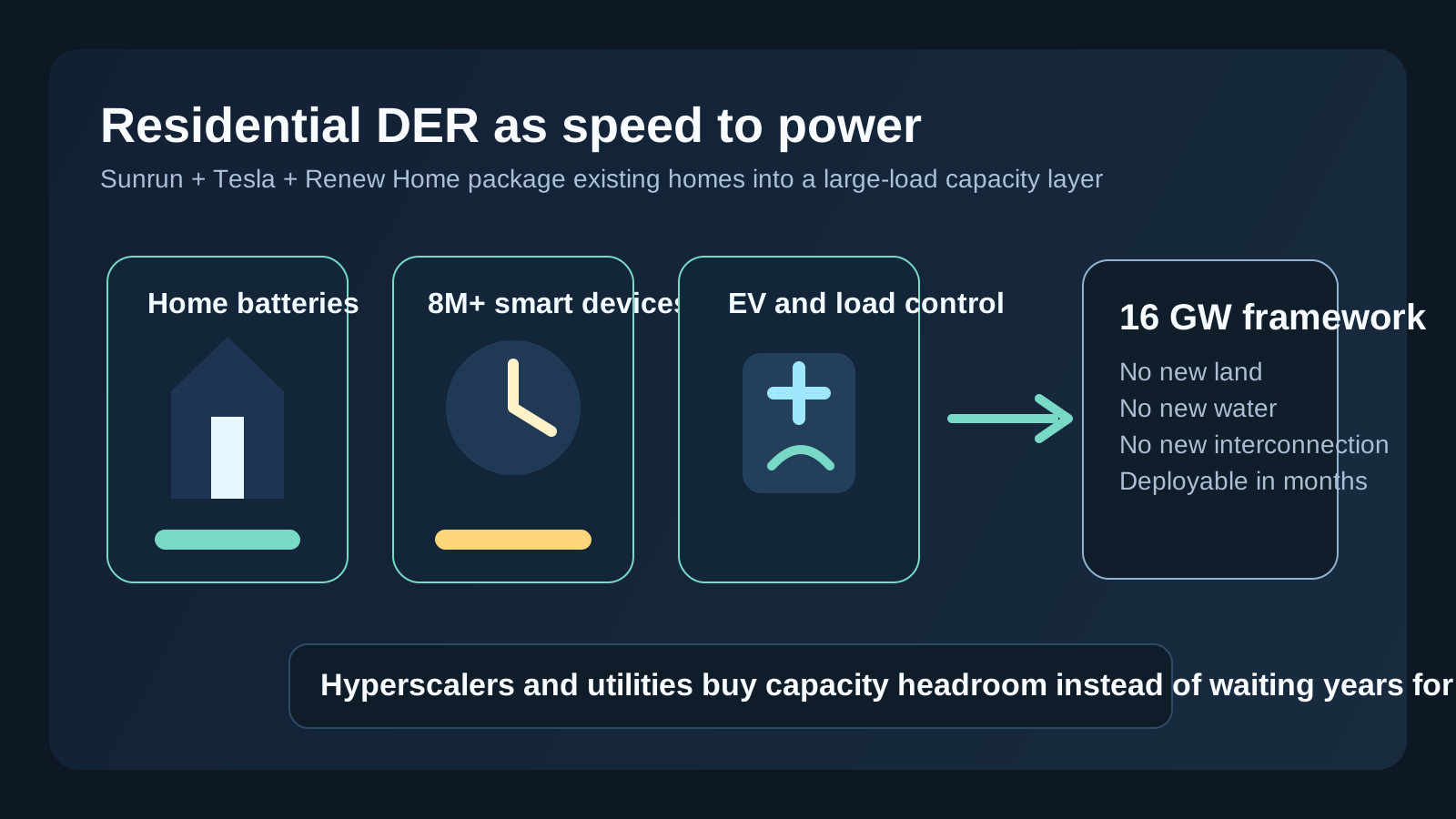
Why the Sunrun-Tesla-Renew Home pitch is different
The publishable part is not the VPP label. It is how the coalition frames existing household devices as large-load infrastructure.
| Claimed design element | What the companies say | Why it matters for large loads |
|---|---|---|
| Scale | More than 16 GW of flexible capacity | Positions residential DER as something large enough to enter hyperscaler and utility procurement conversations. |
| Asset base | Home batteries, vehicle-to-grid systems, and more than 8 million smart devices | Shows the capacity is being assembled from already distributed assets rather than one new plant. |
| Deployment timeline | Deployable in months, not years | Targets the speed-to-power problem directly, where conventional generation and transmission can take far longer. |
| Physical footprint | No additional land, water, or interconnection for offtaking parties | Recasts distributed flexibility as a way to add usable capacity without another full infrastructure siting fight. |
| PJM pathway | Proposal submitted to the Reliability Backstop Process with more than 1 GW potentially available immediately if accepted | Connects the concept to an actual regional reliability mechanism instead of leaving it as marketing language alone. |
Source context: Sunrun investor-relations release and matching GlobeNewswire release published June 24, 2026.
Sunrun, Tesla, and Renew Home’s June 24 announcement clears the publish bar because it translates distributed-energy rhetoric into an explicit large-load sales pitch. The companies said they have agreed to deliver more than 16 gigawatts of flexible capacity to hyperscalers and utilities by aggregating existing home batteries, smart thermostats, vehicle-to-grid systems, and other devices into local turnkey solutions for data centers and other large loads.
The stronger Grid Report angle is that this is being sold as a speed-to-power product. Sunrun’s release does not lean on a generic clean-energy message. It says the framework requires no additional hardware, software, interconnection, water, or land usage for offtaking parties and can be deployed in months, not years. That matters because the real large-load bottleneck in many regions is not whether another idea for generation exists. It is whether capacity can be staged fast enough without running into the usual construction, siting, and grid-upgrade clock.
The core claim is not that VPPs are interesting. It is that existing households can be packaged into a speed-to-power product for hyperscalers before another central build shows up.
That is what makes the story more useful than a broad VPP explainer. The companies are trying to turn residential distributed energy resources into a substitute for at least part of the long-delay infrastructure queue. In effect, they are arguing that latent capacity already sitting in homes can be orchestrated into headroom for hyperscalers and utilities sooner than a conventional central-build response can arrive. For AI infrastructure operators, that is a very different proposition than “rooftop solar is good for the grid.”
The official numbers are specific enough to matter. Sunrun says the combined resource includes dispatchable capacity from hundreds of thousands of home battery systems operated by Sunrun and Tesla, plus flexible peak capacity from more than 8 million smart thermostats and devices managed by Renew Home. The release also says the framework can free up transmission capacity, ease congestion on distribution infrastructure, and extend the duration and depth of available capacity. That is effectively a claim that grid slack itself can be assembled and sold as infrastructure.
The PJM read-through is especially important. Sunrun says the companies have submitted a proposal to PJM’s Reliability Backstop Process and that, if accepted, PJM could unlock more than a gigawatt of capacity immediately, with more available over time for peak shaving, locational relief, and fast-response needs. That gives the story real operator relevance. This is not only a conceptual future market. The coalition is already trying to insert residential flexibility into a near-term regional reliability product tied directly to large-load growth.
This does not mean 16 gigawatts of home-based flexibility is the same thing as 16 gigawatts of firm new generation. Performance still depends on customer participation, telemetry, market rules, weather, and operational delivery. The companies themselves list regulatory approvals, interconnection, data access, and settlement as meaningful dependencies. But those caveats do not weaken the story enough to skip it. They are exactly why the announcement is worth publishing now: the market is trying to package distributed flexibility as something bankable and procurement-ready for hyperscalers before the conventional buildout catches up.
It also marks a step beyond the smaller distributed-capacity deals already showing up around AI load. Google’s PJM arrangement with Voltus treated flexible distributed resources as a capacity product around one part of data-center growth. Sunrun, Tesla, and Renew Home are pushing a bigger version of that thesis: residential energy fleets themselves can become a large-load infrastructure layer. If that logic holds, the AI power race starts looking less binary than “grid upgrade or no project.”
That is enough to publish. Search coverage will naturally focus on Sunrun’s stock or the headline 16-gigawatt number. The more useful operator query is different: can residential batteries, thermostats, and EV-linked flexibility be turned into a speed-to-power product for hyperscalers? This announcement is one of the clearest attempts yet to answer yes.
Sources
Sunrun, “Sunrun, Renew Home, and Tesla Team Up to Deliver More Than 16 Gigawatts of Fast, Flexible Power for Data Centers and Large Loads,” published June 24, 2026: https://investors.sunrun.com/news-events/press-releases/detail/372/sunrun-renew-home-and-tesla-team-up-to-deliver-more-than
GlobeNewswire, “Sunrun, Renew Home, and Tesla Team Up to Deliver More Than 16 Gigawatts of Fast, Flexible Power for Data Centers and Large Loads,” published June 24, 2026: https://www.globenewswire.com/news-release/2026/06/24/3316793/0/en/sunrun-renew-home-and-tesla-team-up-to-deliver-more-than-16-gigawatts-of-fast-flexible-power-for-data-centers-and-large-loads.html
By Nawaz Lalani
The Grid Report is written by Nawaz Lalani and focuses on source-backed coverage of AI infrastructure, grid power demand, automation systems, and market signals.
Follow the signal, not just the headline.
Get the daily Grid brief for source-backed coverage on AI power demand, infrastructure timing, automation, and market signals.