- NVIDIA’s July 15 Jetson Thor launch clears the publish bar because it answers a more useful question than “are robots getting smarter?” The stronger operator signal is that physical AI is becoming a deployment-budget problem.
- The product details are specific enough to matter.
- The more interesting detail is not the headline compute number.
- Section
- Infrastructure
- Read time
- 4 min read
NVIDIA’s July 15 Jetson Thor launch clears the publish bar because it answers a more useful question than “are robots getting smarter?” The stronger operator signal is that physical AI is becoming a deployment-budget problem. The bottleneck is increasingly not whether a model exists. It is whether enough multimodal intelligence can fit inside the memory, thermal, networking, and cost envelope of an edge module that a robot maker can actually ship at scale.
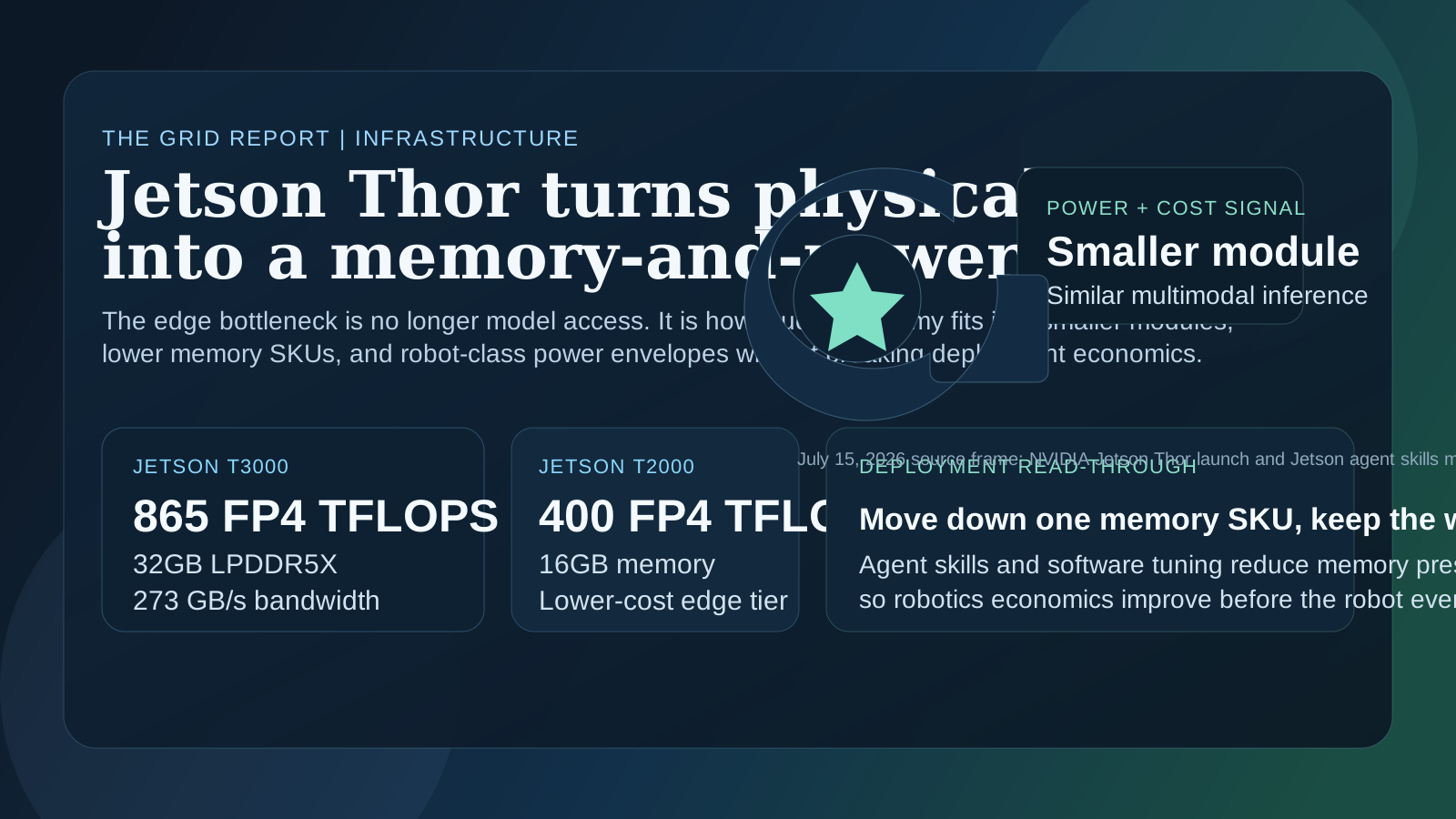
The product details are specific enough to matter. NVIDIA introduced Jetson T3000 and T2000 modules for robotics and edge AI, positioning the T3000 at 865 FP4 teraflops with 32GB of LPDDR5X memory and 273 GB/s of bandwidth, while the T2000 carries 400 FP4 teraflops with 16GB of memory. NVIDIA’s own framing is that these modules are meant to move general-purpose robotics and autonomous machines from research settings into broader real-world deployment.
Physical AI is becoming a module-budget problem: how much autonomy fits inside smaller memory, power, and thermal envelopes without breaking deployment economics.
The more interesting detail is not the headline compute number. It is the claim that the smaller T3000 can deliver similar multimodal inference performance to the larger T5000-class platform while using roughly half the size and power. That is the practical deployment read-through. Physical AI adoption will not hinge only on frontier model quality. It will hinge on whether system builders can hit acceptable autonomy on a cheaper module, a smaller battery or power budget, and a narrower thermal footprint.
The software side strengthens that thesis. NVIDIA says its new Jetson agent skills can automate memory optimization, system configuration, and deployment tasks across the Jetson portfolio, and says some users have reduced memory usage enough to step down to lower-memory module configurations. That matters because memory is often the hidden tax in edge AI. If software tuning lets a robotics developer keep the workload while dropping one memory SKU, the gain is not academic. It changes bill of materials, cooling demands, and which products can ship profitably.
This is why the story clears the duplicate screen. The site already covered Japan’s physical-AI infrastructure push as an industrial-policy stack, UST’s Claude deployment as an engineering-validation layer, and Micron’s wafer and memory moves as an upstream supply-assurance story. Jetson Thor is a different layer. The thesis here is that the physical-AI bottleneck is moving downstream into deployable module economics: memory pressure, power budgets, and edge-system fit.
It also has stronger search value than a generic robotics recap because the NVIDIA post includes concrete buyer-side signals. NVIDIA is pitching the platform across humanoids, autonomous mobile robots, industrial manipulators, retail systems, and companion robots. The company also names adoption examples and explicitly argues that memory savings can shorten optimization cycles from weeks to days. That gives operators something actionable to evaluate: not whether robotics is “the future,” but whether edge AI economics are becoming good enough to widen real deployment.
There are still limits. The launch material is NVIDIA-authored, the workloads are presented in the company’s preferred frame, and “similar inference performance” depends on the exact multimodal model and operating point. Not every robotic system will be able to move down one module tier cleanly. But those caveats do not weaken the main signal. They define the next competitive battleground: who can convert model capability into reliable autonomy inside tighter hardware envelopes.
That is enough to publish. Searchers looking up Jetson Thor do not need another feature list. The more useful answer is that physical AI is becoming an edge deployment economics story, where memory efficiency and power-aware packaging matter almost as much as the model itself.
Sources
NVIDIA Blog, “NVIDIA Introduces New Jetson Thor Computers to Advance Mainstream Robotics and Edge AI,” published July 15, 2026: https://blogs.nvidia.com/blog/jetson-thor-robotics-edge-ai-agent/
NVIDIA Jetson Thor platform materials linked from the July 15, 2026 NVIDIA launch post: https://www.nvidia.com/en-us/autonomous-machines/embedded-systems/jetson-thor/
By Nawaz Lalani
The Grid Report is written by Nawaz Lalani and focuses on source-backed coverage of AI infrastructure, grid power demand, automation systems, and market signals.
Follow the signal, not just the headline.
Get the daily Grid brief for source-backed coverage on AI power demand, infrastructure timing, automation, and market signals.