- Google’s September 9 plan to invest €13 billion in Finnish digital infrastructure over 2027 and 2028 clears the publish bar because the company did not announce compute capacity in isolation.
- That is the original angle.
- The nuclear contract is the financial anchor.
- Section
- Infrastructure
- Read time
- 5 min read
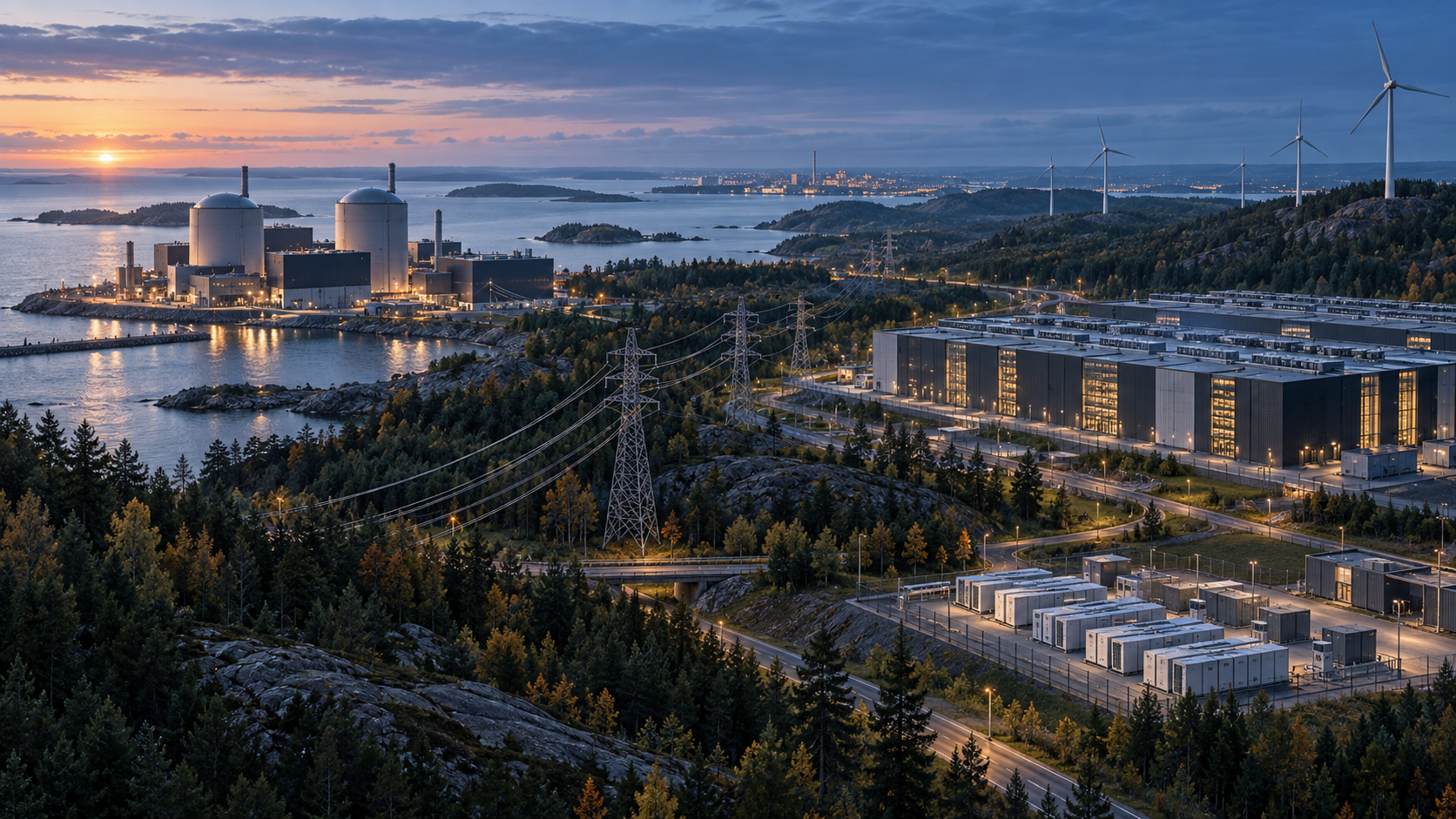
Google’s September 9 plan to invest €13 billion in Finnish digital infrastructure over 2027 and 2028 clears the publish bar because the company did not announce compute capacity in isolation. It paired the buildout with a 22-year nuclear power purchase agreement, additional wind procurement, a 94-megawatt battery system, and work on data-center demand response. The stronger infrastructure story is the portfolio: Google is assembling several different grid services around one large AI expansion instead of treating annual energy matching as the whole power strategy.
That is the original angle. Hyperscalers usually describe power procurement one contract at a time—one renewable PPA, one nuclear deal, or one battery project. Finland shows what happens when those instruments are designed together. Existing nuclear provides firm output, new wind adds energy, storage can respond to short periods of scarcity and volatility, and flexible load could reduce demand when the system is stressed. The siting product is no longer just land plus megawatts. It is a coordinated package of energy, capacity, flexibility, and local grid behavior.
The siting product is no longer just land plus megawatts. It is a coordinated package of energy, capacity, flexibility, and local grid behavior.
The nuclear contract is the financial anchor. Fortum says the agreement begins at a smaller volume in 2028 and reaches 50% of the two-unit Loviisa plant’s capacity from 2030 through 2049. The plant has two 507-megawatt reactors and produces about 8 terawatt-hours a year, equal to roughly 10% of Finland’s electricity. More important for investors, Fortum says the PPA supplies revenue certainty for the remaining lifetime-extension work and is expected to lift the company’s comparable return on net assets by about 1.4 percentage points once half the plant is contracted.
That makes the deal different from a generic claim that AI will revive nuclear. Loviisa already operates, but Fortum estimates that roughly €700 million of the approximately €1 billion lifetime-extension program still awaits investment decisions. Google is using a long-duration offtake contract to improve the risk-adjusted economics of keeping existing firm capacity online through 2050. The agreement is also expected to support a new 10-megawatt uprate on top of a planned 38-megawatt increase due in 2028. For infrastructure buyers, preservation and uprating can be as strategically valuable as contracting for an entirely new plant.
The rest of the portfolio prevents the nuclear headline from becoming a misleading single-solution story. Google says two new onshore wind projects will bring its contracted Finnish wind portfolio to 629 megawatts. It is also enabling a 94-megawatt battery near the planned Kajaani data center, with operation expected in late 2027, and plans to enroll wind assets in Fingrid ancillary-service markets. Google and grid operators will additionally study demand response that could temporarily lower data-center consumption during system stress, building on a flexibility pilot at Hamina during the 2022–2023 energy crisis.
The sequence matters. The €13 billion investment is scheduled across 2027 and 2028, while the battery is targeted for late 2027, the nuclear contract starts in 2028, and the PPA reaches half of Loviisa’s capacity in 2030. That is a real delivery stack, not instantaneous power. Operators evaluating the model should map each campus energization phase against when firm energy, flexibility, transmission service, and demand-response capability actually arrive. A portfolio can reduce exposure to one bottleneck only if its components are timed to the load ramp.
The duplicate screen holds. Recent Grid Report coverage of Duane Arnold focused on federal credit financing a retired-reactor restart. The Steel River story examined a community-facing package around one Google power project, while Australia’s framework focused on legal grid-behavior obligations for hyperscale loads. Finland adds a materially distinct thesis: a hyperscaler is bundling life-extended nuclear, new renewables, storage, and flexible demand into one national AI-infrastructure expansion plan.
The model also has limits. Google and Fortum have not disclosed the PPA price, Google’s exact Finnish load forecast, or how the contracted generation will be allocated among its sites. A memorandum of understanding covering possible new nuclear, renewables, and flexibility is not a final investment decision. The economic-impact estimates in Google’s announcement are company-sponsored projections, and individual Loviisa capital decisions still have to be made. Those gaps keep this from being proof that every promised megawatt is delivered.
Even with those caveats, the operator and policy relevance is unusually clear. Data-center developers should expect credible power plans to show how firm supply, variable energy, short-duration flexibility, and load behavior work together. Utilities can use long-term contracts to preserve existing generation while asking large customers to add storage and controllability. Investors should distinguish annual energy procurement from a bankable power portfolio whose assets, counterparties, and commissioning dates match the compute ramp.
Google’s Finland expansion is therefore useful as a blueprint, not because every market has Nordic wind, coastal nuclear, or the same grid rules, but because it defines the complete problem. A large AI campus needs more than clean-energy certificates and a connection request. It needs supply that survives dark, windless periods; flexibility that responds inside the operating day; contracts that finance real assets; and load controls the grid can call when conditions tighten. Finland packages those requirements into one infrastructure strategy.
Sources
Fortum, “Fortum and Google partner to drive sustainable growth for Finland—sign nuclear Power Purchase Agreement,” published September 9, 2026: https://www.fortum.com/en/media/2026/09/inside-information-fortum-and-google-partner-drive-sustainable-growth-finland-sign-nuclear-power-purchase-agreement
Google, “Our blueprint for responsible clean energy growth in Finland,” published September 9, 2026: https://blog.google/innovation-and-ai/infrastructure-and-cloud/global-network/clean-energy-finland/
Google, “Google deepens its commitment to Finland with a €13 billion investment in AI infrastructure,” published September 9, 2026: https://blog.google/innovation-and-ai/infrastructure-and-cloud/global-network/google-ai-commitment-to-finland/
By Nawaz Lalani
The Grid Report is written by Nawaz Lalani and focuses on source-backed coverage of AI infrastructure, grid power demand, automation systems, and market signals.
Follow the signal, not just the headline.
Get the daily Grid brief for source-backed coverage on AI power demand, infrastructure timing, automation, and market signals.