- The Energy Department’s September 8 financial close on a loan of up to $1.9 billion for the Duane Arnold Energy Center clears the publish bar because the event is more consequential than another promise to revive a nuclear plant.
- That is the original angle: Duane Arnold is becoming a test of whether federal credit can make an existing nuclear site behave like a speed-to-power asset.
- DOE says the Title 17 financing will support NextEra’s restart of Iowa’s only nuclear plant.
- Section
- Energy
- Read time
- 5 min read
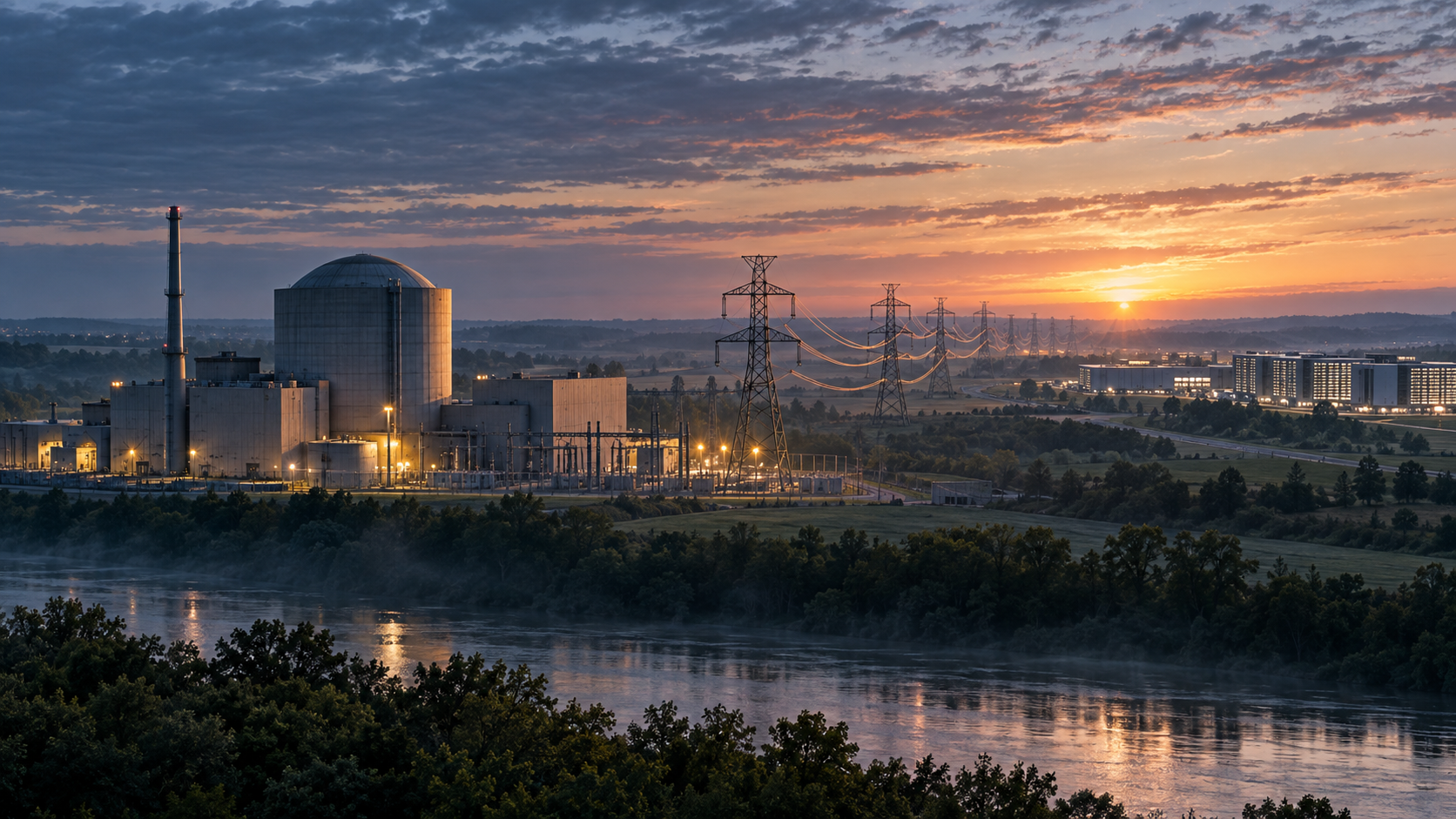
The Energy Department’s September 8 financial close on a loan of up to $1.9 billion for the Duane Arnold Energy Center clears the publish bar because the event is more consequential than another promise to revive a nuclear plant. The federal government and NextEra Energy have now put a financing structure behind the attempt to convert a retired reactor into 615 megawatts of prospective supply for a Midwest grid facing rising cloud, AI, industrial, and household demand.
That is the original angle: Duane Arnold is becoming a test of whether federal credit can make an existing nuclear site behave like a speed-to-power asset. New reactors can take many years to permit and build. A restart begins with a licensed site, grid interconnection, major civil works, and an operating history already in place. Those advantages can compress some development risks, but they do not make the power immediate or guaranteed. The loan finances a difficult conversion from decommissioning status back to safe commercial operation.
Federal credit can make a retired reactor financeable; it cannot make licensing, refurbishment, and delivery risk disappear.
DOE says the Title 17 financing will support NextEra’s restart of Iowa’s only nuclear plant. The company says it expects to return the facility to service no later than the first quarter of 2029, subject to regulatory approvals. DOE also ties the project directly to growing cloud and AI infrastructure demand. That combination matters for operators and investors: this is no longer an abstract nuclear renaissance story. It is a dated, financed capacity project with a named output, a target window, and a live regulatory path.
The key distinction is between project finance and project completion. The Nuclear Regulatory Commission still lists Duane Arnold as permanently shut down and in decommissioning status. To resume operations, NextEra must restore the plant’s operating licensing basis, return systems and components to a condition that supports safe operation, complete required upgrades, and pass the NRC’s inspections and reviews. The agency has created a dedicated restart panel, but the approval work remains a gating item rather than a formality.
That makes the loan useful as a template. Federal credit can lower the financing friction around refurbishment and help a utility carry a large, long-duration construction program before the first restarted megawatt earns revenue. It cannot erase component condition, labor availability, schedule, licensing, or cost-overrun risk. A retired reactor is therefore best understood as a brownfield power-development option: potentially faster and more infrastructure-rich than a greenfield plant, but still dependent on disciplined technical execution.
The AI-load relevance is equally specific. Large data-center customers increasingly need power commitments that can survive scrutiny over reliability and ratepayer exposure. A restarted plant adds supply rather than simply reallocating an existing block of generation, which fits the emerging political demand that new large loads bring or fund new capacity. But because the plant is expected no later than early 2029, it is a medium-term portfolio answer, not a bridge for campuses seeking energization next quarter. Developers still need interim power, transmission deliverability, and contract terms that allocate delay risk.
The duplicate screen holds. The Grid Report’s recent nuclear coverage focused on federal loans for the manufacturing supply chain, while its other energy stories examined tariffs, interconnection, curtailment, and power-quality rules for large loads. This thesis is materially different: the September 8 closing shows federal credit being applied directly to the conversion of a retired generating asset, creating a replicable underwriting question for other restart candidates.
Investors should watch three milestones rather than treating the $1.9 billion headline as completed capacity. First is NRC progress on the operating-license and technical-specification changes. Second is evidence that refurbishment remains on schedule and within the capital plan. Third is the commercial structure connecting the restarted output to customers and the MISO system without shifting an unfair share of growth costs to existing ratepayers. Those milestones determine whether the loan becomes productive infrastructure or merely patient capital attached to a delayed asset.
Duane Arnold therefore matters beyond Iowa. If the project reaches service on schedule, it will strengthen the case that retired nuclear sites can be financed as a distinct class of grid asset for the AI era—one that trades greenfield construction risk for restart, inspection, and refurbishment risk. If it slips, the same project will reveal where the apparent speed advantage breaks down. Either outcome will be valuable evidence for utilities, policymakers, data-center developers, and capital providers evaluating the next wave of nuclear restarts.
Sources
U.S. Department of Energy, “Energy Department Closes $1.9 Billion Loan to Restart Duane Arnold Nuclear Plant,” published September 8, 2026: https://www.energy.gov/articles/energy-department-closes-19-billion-loan-restart-duane-arnold-nuclear-plant
NextEra Energy, “U.S. Department of Energy Closes Up to $1.9 Billion Loan to Restart NextEra Energy’s Duane Arnold Energy Center,” published September 8, 2026: https://newsroom.nexteraenergy.com/2026-09-08-U-S-Department-of-Energy-Closes-Up-to-1-9-Billion-Loan-to-Restart-NextEra-Energys-Duane-Arnold-Energy-Center
U.S. Nuclear Regulatory Commission, “Duane Arnold Energy Center,” updated August 27, 2026: https://www.nrc.gov/info-finder/reactors/duan
By Nawaz Lalani
The Grid Report is written by Nawaz Lalani and focuses on source-backed coverage of AI infrastructure, grid power demand, automation systems, and market signals.
Follow the signal, not just the headline.
Get the daily Grid brief for source-backed coverage on AI power demand, infrastructure timing, automation, and market signals.