- DOE’s June 23 nuclear-supply-chain announcement clears the publish bar because it addresses a part of the AI power problem that is usually hand-waved away.
- That is what makes this a better story than another generic “nuclear comeback” rewrite.
- The structure is worth paying attention to.
- Section
- Energy
- Read time
- 5 min read
- Data included
- Why DOE’s reactor-financing move is really a manufacturing-timeline story
Why DOE’s reactor-financing move is really a manufacturing-timeline story
The announcement matters less as a subsidy headline than as an attempt to pull forward the slowest industrial inputs in firm power.
| Layer | What DOE said | Why it matters |
|---|---|---|
| Capital | $17.5 billion conditional loan commitment through DOE’s Office of Energy Dominance Financing | The federal government is trying to de-risk component procurement before final power arrives on the grid. |
| Procurement target | Long-lead items for up to five projects tied to 10 AP1000 reactors | Long-lead components often determine whether nuclear timelines slip before construction really starts. |
| Project structure | Westinghouse would partner with utilities or energy companies and buy equipment at fixed prices | Bulk ordering and shared ownership can lower schedule risk and improve procurement visibility. |
| Equity screen | $500 million from Westinghouse and $500 million from each partner before loan access | The structure forces real sponsor commitment instead of leaving everything at the policy-announcement stage. |
| Grid implication | DOE said deployment could accelerate by up to three years | Faster firm power matters more when AI and other large loads are testing the limits of existing supply growth. |
Source: U.S. Department of Energy press release published June 23, 2026.
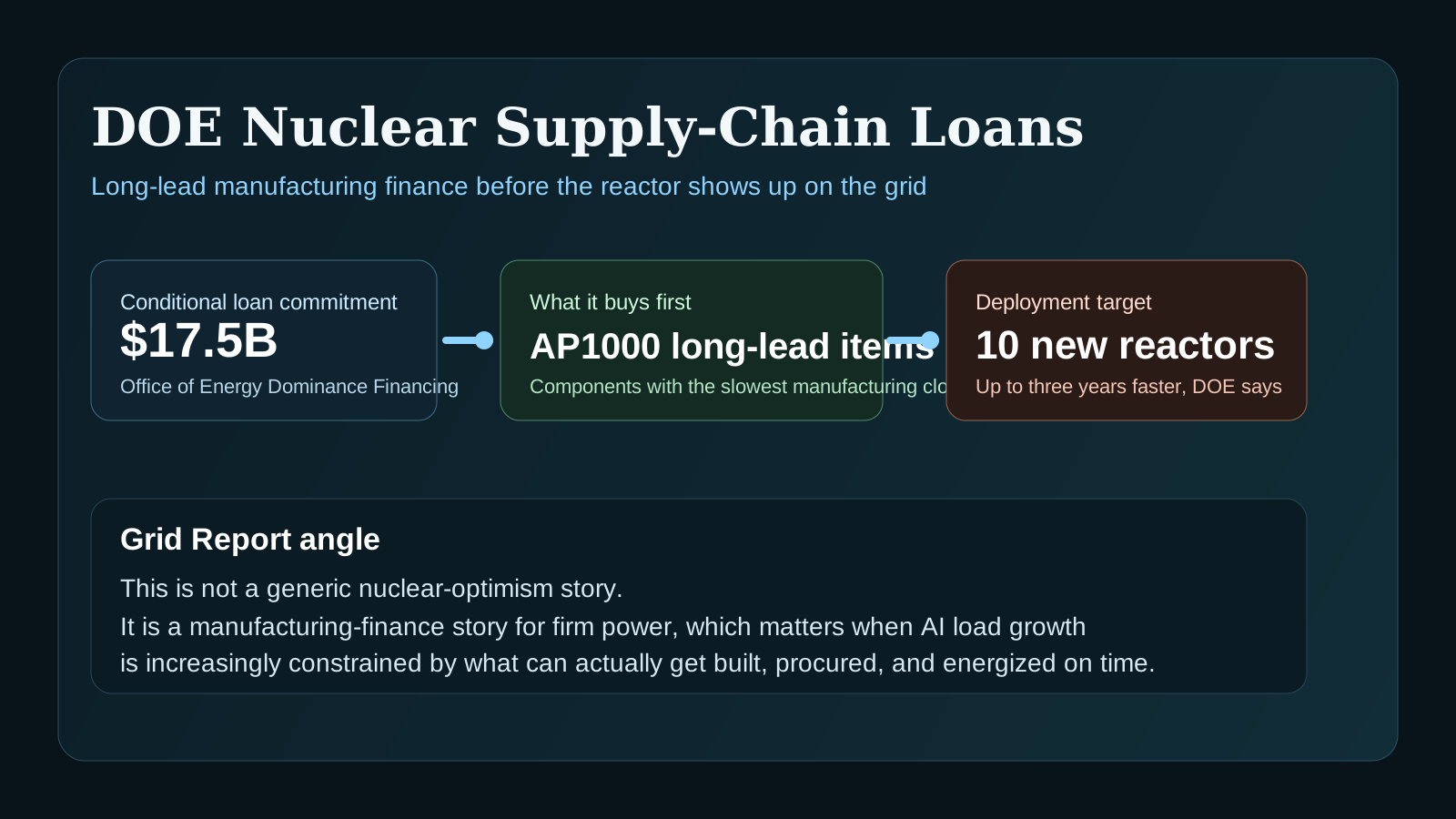
DOE’s June 23 nuclear-supply-chain announcement clears the publish bar because it addresses a part of the AI power problem that is usually hand-waved away. The Office of Energy Dominance Financing issued a conditional loan commitment for up to $17.5 billion to finance long-lead items for up to five projects, each tied to two Westinghouse AP1000 reactors. The useful question is not whether nuclear sounds attractive in a strategy deck. It is whether the equipment with the longest manufacturing clock can be financed early enough to change real energization timelines.
That is what makes this a better story than another generic “nuclear comeback” rewrite. Large-load growth, especially from AI campuses, keeps running into the difference between nominal power ambition and physically delivered firm capacity. DOE is targeting the component layer that often sits inside that gap. Long-lead nuclear parts are complex, expensive, and slow to procure. If that clock starts sooner, the power-delivery clock can start sooner too.
DOE’s June 23 move matters because it finances the manufacturing bottleneck in firm power, not just another reactor talking point.
The structure is worth paying attention to. DOE said the loan facilities would support up to five loans, with each loan backing two reactors at a project site. Westinghouse would partner with utilities or energy companies to procure the long-lead items at a fixed price, and each project would be jointly owned by Westinghouse and the partner. DOE also said both parties must commit $500 million of equity each, or $1 billion total per project, before accessing loan funds. That is a more disciplined signal than vague support for future reactor development.
The capacity implication is large enough to matter. DOE said each of the 10 AP1000 reactors would generate 1.1 gigawatts of power, with combined output sufficient to serve nearly 10 million households. Not all of that future capacity is an AI story, and it should not be described that way. But the AI buildout is exactly the kind of load growth that increases the value of firm, dispatchable capacity arriving on schedule rather than remaining trapped in a multi-year procurement bottleneck.
This is also why the article fits the Grid Report duplicate screen. We already have recent pieces on federal land as a speed-to-power product, PJM’s queue execution constraints, TVA’s gas optionality, and large-load tariff rewrites. DOE’s loan commitment is a different thesis. It is a manufacturing-finance story inside the energy stack: the government is trying to move capital into the slowest industrial inputs so reactor timelines compress before demand pressure gets worse.
Operator and investor relevance both follow from that framing. Utilities, data-center developers, and power-intensive industrial users care about whether firm generation can actually clear the component and construction queue. Investors care because reactor economics are not only about final power prices. They are also about how much schedule risk can be removed at the procurement stage. DOE explicitly said the financing could accelerate deployment by up to three years and create supply-chain efficiencies by placing bulk equipment orders.
There are obvious limits. This is still a conditional commitment, not completed financing. DOE did not identify the final project partners, and letters of intent are not the same as shovel-ready construction. Those caveats matter. But they do not undercut the thesis. They clarify it. The important signal is that the federal government is trying to finance the manufacturing bottleneck first, which is often where timeline promises quietly break.
That makes the story search-worthy now. Search results will naturally surface the headline loan amount. The more useful query is different: what does DOE’s reactor-financing move actually change for AI-era power planning? The answer is that it shifts attention from reactor rhetoric to component procurement, schedule compression, and the industrial prerequisites of firm power.
Sources
Department of Energy, “Department of Energy Announces American Nuclear Supply Chain Loans,” published June 23, 2026: https://www.energy.gov/articles/department-energy-announces-american-nuclear-supply-chain-loans
By Nawaz Lalani
The Grid Report is written by Nawaz Lalani and focuses on source-backed coverage of AI infrastructure, grid power demand, automation systems, and market signals.
Follow the signal, not just the headline.
Get the daily Grid brief for source-backed coverage on AI power demand, infrastructure timing, automation, and market signals.