- d-Matrix’s September 10 plan to adopt NVIDIA NVLink Fusion looks like a chip-interconnect announcement.
- That matters because custom silicon is only useful when it can be installed, cooled, powered, networked, managed, and supported at production scale.
- The d-Matrix plan is specific enough to test the proposition.
- Section
- Infrastructure
- Read time
- 7 min read
- Data included
- What a common AI rack standardizes—and what it does not
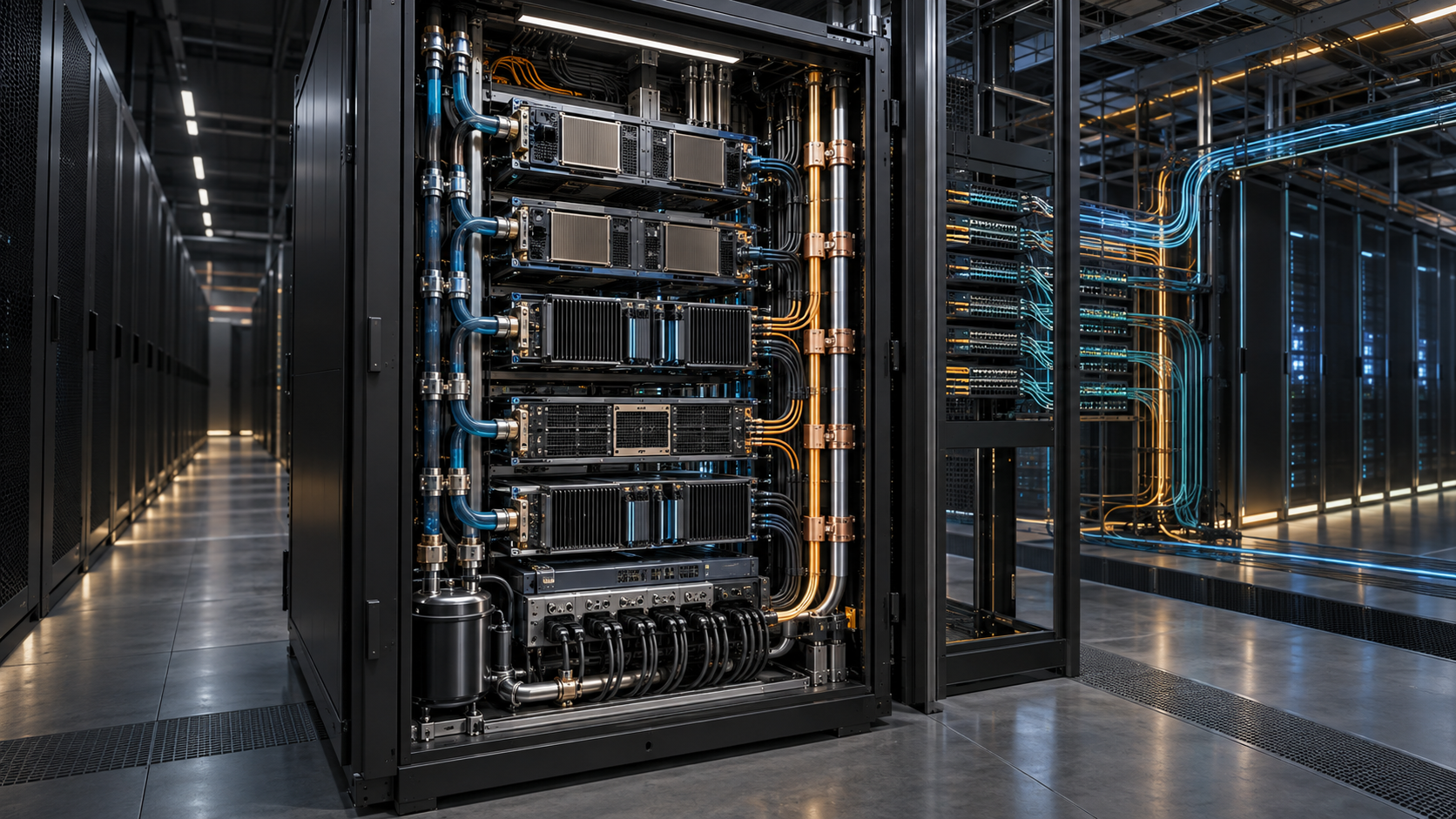
What a common AI rack standardizes—and what it does not
The value proposition is the ability to hold more of the facility constant while changing the accelerator mix.
| Layer | Common architecture can standardize | Buyer must still validate |
|---|---|---|
| Physical plant | Rack footprint, power delivery, liquid cooling | Actual rack draw, thermals, service access |
| Fabric | Scale-up links, Ethernet scale-out, interface qualification | Workload communication overhead and failure recovery |
| Compute mix | Placement of XPUs, GPUs, CPUs, DPUs, and NICs | Model support, routing, utilization, and fallback |
| Economics | Faster deployment into a known facility envelope | Energy per request, software cost, migration effort, and support terms |
Grid Report operator framework based on NVIDIA and d-Matrix product descriptions; announced performance figures remain vendor-reported.
d-Matrix’s September 10 plan to adopt NVIDIA NVLink Fusion looks like a chip-interconnect announcement. For infrastructure operators, the stronger signal is that accelerator choice is moving up from the server board into the rack design. d-Matrix says its next-generation Raptor XPUs will connect to NVIDIA’s scale-up fabric, MGX rack architecture, Spectrum-X scale-out network, and broader AI infrastructure platform.
That matters because custom silicon is only useful when it can be installed, cooled, powered, networked, managed, and supported at production scale. A new accelerator may outperform on a target workload and still lose commercially if every deployment requires a bespoke rack, a different coolant design, separate network validation, unfamiliar management tools, and a supply chain that operators do not already trust. NVLink Fusion is NVIDIA’s attempt to make more of that surrounding system reusable.
As specialized AI chips multiply, the valuable infrastructure may be the rack that lets operators defer the chip decision while standardizing everything expensive around it.
The d-Matrix plan is specific enough to test the proposition. NVIDIA says Raptor will use NVLink for a high-bandwidth, low-latency scale-up domain and can operate alongside GPU systems such as Vera Rubin NVL72 for disaggregated inference. d-Matrix also plans to integrate Vera CPUs, ConnectX-9 SuperNICs, BlueField-4 DPUs, and Spectrum-X Ethernet. The result is not an independent alternative stack. It is specialized inference compute entering a common NVIDIA-defined rack and network envelope.
For a data-center operator, that can create an option value before the silicon arrives. NVIDIA says MGX racks can share footprints, networking, cooling, power delivery, and management across GPU- and XPU-based systems. If the promise survives qualification, a facility could make physical design decisions while preserving more freedom over the eventual accelerator mix. Capacity could be reprovisioned as inference demand, unit economics, or silicon availability changes instead of being stranded behind a processor-specific rack design.
The distinction is important in a market where chip road maps and construction schedules move at different speeds. Data halls, substations, coolant loops, and switch fabrics are planned years ahead; accelerators can change within quarters. A common rack cannot eliminate model risk or supply risk, but it can reduce the number of physical assumptions that have to be correct on day one. That is valuable to cloud providers, neoclouds, and large enterprises trying to reserve powered space without betting the entire facility on one inference architecture.
There is also a workload-routing thesis. Specialized XPUs do not need to replace GPUs across every task to be useful. They can handle latency-sensitive or high-volume inference while GPU systems retain workloads that demand broader software support or different compute characteristics. The commercial question becomes whether orchestration can route work cleanly enough that the efficiency gain survives data movement, queuing, model conversion, observability, and fallback overhead.
Operators should therefore evaluate this as a system qualification problem, not accept headline fabric numbers as a procurement case. NVIDIA cites three-times-lower XPU-to-XPU latency than off-the-shelf Ethernet, ten-times-higher packet rates, and 3 terabytes per second of all-to-all bandwidth for the announced design path. Buyers still need workload-level evidence: tokens per second at a defined latency target, energy per completed request, rack-level utilization, recovery behavior, model portability, and the time required to bring a new accelerator pool into service.
The common architecture also changes the bargaining structure. NVIDIA is opening its rack ecosystem to third-party processors while keeping its interconnect, networking, CPU, DPU, management, and qualification layers central. Accelerator vendors gain a faster path to deployable systems; customers gain more compute choices; NVIDIA expands the portion of the AI factory that remains attached to its platform even when the primary accelerator is not an NVIDIA GPU. Openness at the processor layer can therefore reinforce control at the infrastructure layer.
That tradeoff does not make the approach weak. It makes the diligence clearer. Infrastructure buyers should separate accelerator optionality from platform independence and ask which components are genuinely interchangeable, which software and management interfaces remain proprietary, how capacity is reprovisioned in practice, and whether service contracts cover mixed XPU-GPU environments. A common rack is only an option if changing the compute mix is operationally repeatable rather than theoretically possible.
d-Matrix has not yet supplied production customer economics for Raptor on NVLink Fusion, and the announcement describes a plan rather than a completed fleet deployment. That is the main reason to avoid treating it as proof of an inference-cost breakthrough. The search-worthy insight is narrower: as specialized AI chips multiply, the winning infrastructure may be the rack architecture that lets operators defer the chip decision while standardizing everything expensive around it.
Sources
NVIDIA, “d-Matrix Adopts NVIDIA NVLink Fusion for Rack-Scale XPU Deployment,” published September 10, 2026: https://blogs.nvidia.com/blog/d-matrix-nvlink-fusion/
NVIDIA, “NVIDIA NVLink Fusion,” accessed September 10, 2026: https://www.nvidia.com/en-us/data-center/nvlink-fusion/
d-Matrix, “Corsair at Rack Scale,” accessed September 10, 2026: https://www.d-matrix.ai/corsair-at-rack-scale/
By Nawaz Lalani
The Grid Report is written by Nawaz Lalani and focuses on source-backed coverage of AI infrastructure, grid power demand, automation systems, and market signals.
Follow the signal, not just the headline.
Get the daily Grid brief for source-backed coverage on AI power demand, infrastructure timing, automation, and market signals.